It seemed simple. The prompt was: “write a six-word manifesto”. There was one catch -- I was in a digital arts class.
This semester I’ve taken up the illustrious (pun intended) disciplines of Photoshop and Illustrator. Through an imaging course, I’ve begun the art of masking, filtering, and vectorizing, in order to create other-worldly portraits or simply face-swap my friends with the actors of Friends. Most projects aim to make use of a visual technique, but last week’s task was very different. Despite the seemingly simple prompt, from Project H Design, the assignment posed a complex question: Can you express all your values in only six words?
Find a Promising Site
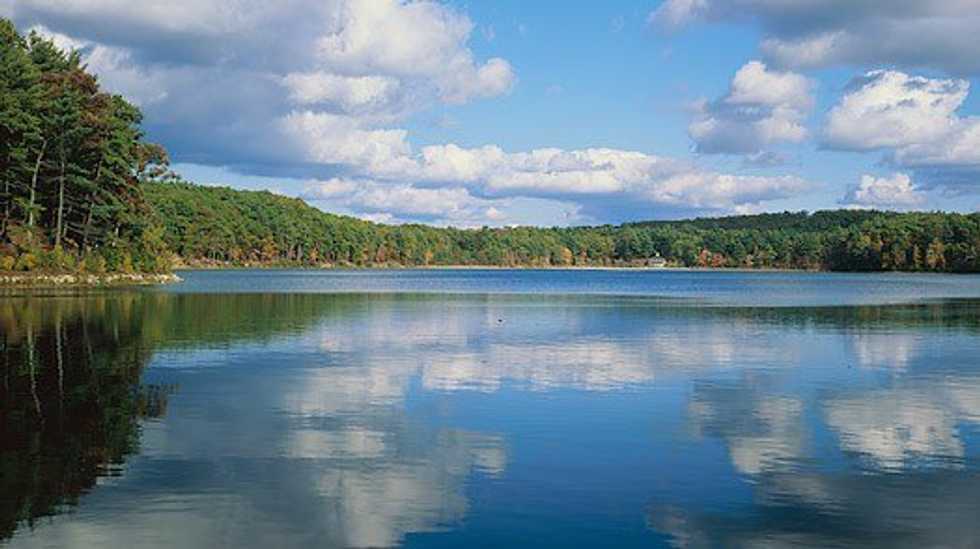
To begin, the prompt provided manifestos from well-known artists and thinkers. They had the luxury of more than six words, touching on everything from where to live, to how to practice one’s art. Most notable was Thoreau's "Where I Lived and What I Lived For". In this chapter from Walden, he outlines a code of conduct for engaging with the environment. Reading others’ manifestos helped me consider what I wanted to say in my own.
Dig up Seventy-Five Words
After reading some inspiring passages, I wrote three lists: nouns, adjectives, and verbs. Within each category I wrote twenty-five words which felt meaningful to me. It was important to find all twenty-five words. While nouns like “friends”, “happiness”, and “love” come easily, they might compose only half of the list. To completely fill the list, it was necessary to think more deeply about what I valued.
Prospect for Crystallized Words
After creating three lists, the elimination process began. For each list, I crossed off unnecessary words until six ones remained. While it was easy to eliminate words which were synonymous, refinement grew challenging when I had to whittle the lists down to ten words total.
I found I could throw out words which might, through some mental gymnastics, be associated another idea. For example, I crossed off “environment” and kept “family” because I decided environmental conservation could be considered caring for one’s family. “Family” took on multiple meanings. Through the pressure of elimination, each of the six remaining words had crystallized. They changed by taking on facets of the words I was forced to discard.
Polish and String it Together
This was, after all, a design project. Once I had decided on six words, I moved on to the visual component of the manifesto. I needed to arrange the words in a certain order, with a font or graphic style which felt meaningful to me.
To be honest, I’m still working on this component. Project H provides some examples from students:
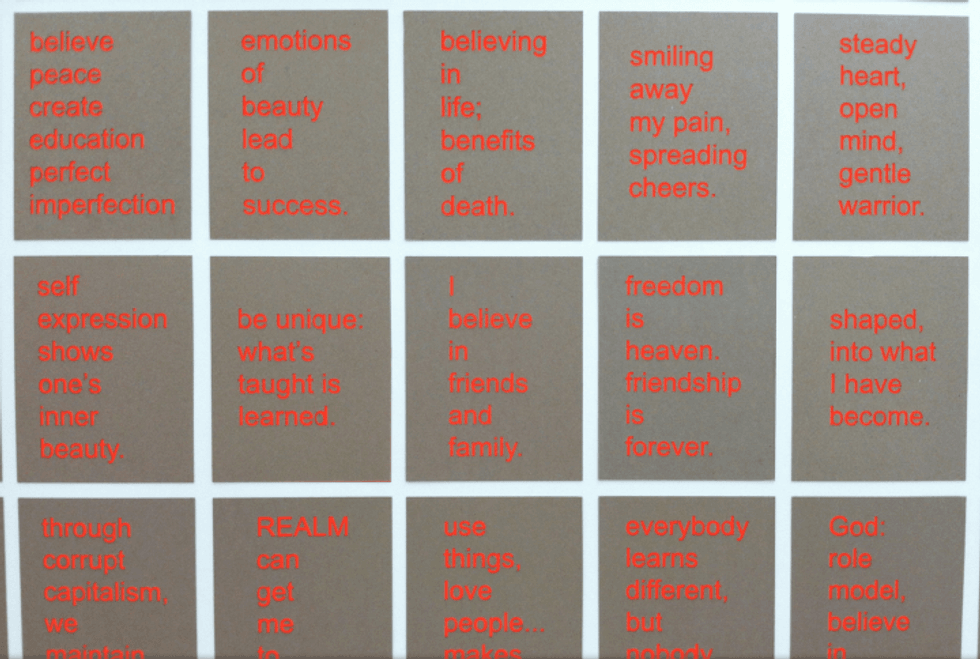
I’ve enjoyed the creation process and I don’t mind that my own manifesto is incomplete.
Perhaps someday soon it will be strung together, shining, inspiring, and in tasteful font too. That’s the goal. Until then, I’ll be honing my imaging skills: face-swapping my friends in Photoshop.