

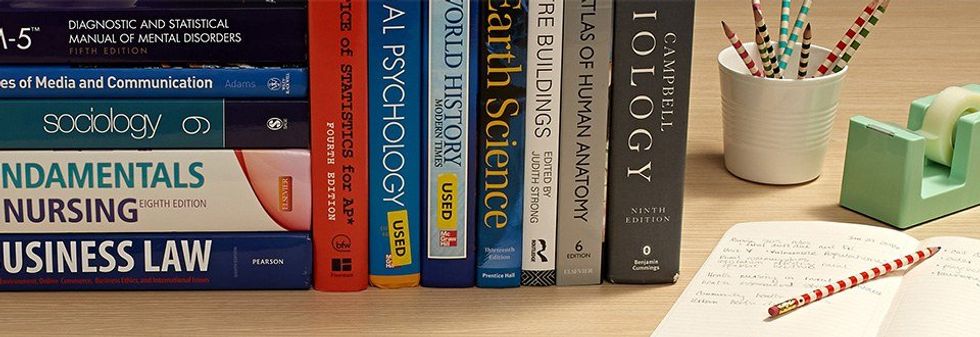
It’s been said before, but it bears repeating—as we have a decidedly short memory about things these days; publishing companies are hurting students. While any college student can attest to the blatantly ludicrous price of school books, many would actually be surprised to learn the larger offenses of the industry. In a time where college tuition is at an all-time high, the practices of publishing companies like Pearson are repugnant—as is the system that allows and promotes it.
In 1976, the average four-year private school’s price for tuition with room and board was $16,213 (adjusted for inflation). In 2015, that price was $43,921. The horror of this impoverishing and crippling hike in tuition over the last 40 years can be observed with all its absurdity in this chart from College Board.
While it’s true that the cost of textbooks do not match that of 'room and board', it is worth noting their contribution to the rising price of getting a secondary education in America. One staggering bit of data, in regards to textbook cost, is NBC’s review of information provided by the Bureau of Labor Statistics. According to NBC, the price of textbooks “have risen over three times the rate of inflation from January 1977 to June 2015.” Now, if three times the rate of inflation appears disconcerting, the percent increase of this cost should be nauseating: 1,041%.
An 1041 percent increase over 40 years. That means that a textbook that costs $300 today would have cost $28 in 1977 — adjusted for inflation, that price is roughly $109. What exactly contributed to this kind of increase? Has paper become more expensive; has the minimum wage increased; have workforces increased; has there been a rise in competition?
The most frequent —and somewhat ironic— reason given for the price of textbooks is the ‘used book’ trade. Publishers and authors only make money when students buy a new book; as Price Economics states: “used textbook markets and real sites like Chegg…have pressured major publishers.” Certainly, any college student buying books have looked for the cheaper option of something used or to rent. This has led to a rather sinister kind of countermeasure by publishers however, namely: the new edition scam.
Textbook companies will frequently release new additions of textbooks without any real change in content. As Dr. Robert Guell of Indiana State University’s Economics department puts it: "Calculus hasn’t changed since Newton figured it out so why would anyone need to write a new edition? Because publishers and authors only make money when the new edition sells for the first time”.
Dr. Guell goes on to say that everyone is partially to blame for this trend, as our buying used textbooks does indeed cost publishers money. With that in mind, and in this day and age of the internet robbing publishers of book sales, one might imagine that companies like Pearson are seeing a significant drop in revenue. Except, they’re not. Pearson, the largest education publisher in the world, had a revenue of $8.2 billion dollars in 2014— up from $7.75 in 2009.
What many apologists for publishers seem to omit from their discussions of textbook pricing, is that publishers like Pearson have a rather particular market and certain influence over it. Like the pharmaceutical industry, companies in education have a consumer base that can’t opt out. Students have to buy textbooks; even considering the industry for used textbooks, many students have to buy new ones due to the requirements of professors and schools.
Many professors are actually incentivized by publishing companies to use their textbook, and those companies know that once courses have been built around a certain book, they often don’t change for a long time.
Now, if all that was not enough of an indictment, consider this: Pearson makes a large amount of money from taxpayers, so you’ll be paying them even after college. Yes, as Politico explained it, Pearson made the very prudent investment in education assessment — that is to say, standardized testing. That’s right before you paid for textbooks in college, your parents paid taxes that went to Pearson for exams it administered from K-12, as well as the textbooks schools used and the data systems they employed to track student performance.
That same Politico article also mentions the fact that Pearson’s involvement with the No Child Left Behind program goes a little further than providing the materials, testing, and systems to manage either. Pearson was also a part of the process of setting performance goals, and in some states was the direct determiner of said goals. When schools failed to meet these standards, they would face funding penalties, however, Pearson would somehow be without any kind of blame for its curriculum or the books it provided. In fact, Politico found that “public officials often commit to buying from Pearson because it’s familiar, even when there’s little proof its products or services are effective.”
From Kindergarten to College, publishing companies like Pearson are a virtual monopoly. They set performance standards and curriculums for primary education; their data systems are used to track student performance; they “[treat] school officials…{to} trips abroad”; they lobby in congress; they influence Collegiate curriculums, and they provide the materials that these programs require of their students who have consumed formal education through said singular entity their entire lives. In light of this, the idea that the used book market is hurting publishers like Pearson is laughable, if not insulting.
College is expensive; from public to private schools, the cost has weighed heavily on the backs of so-called millennials. The $1.2 trillion collective debt of college tuition in America hurts everyone with its impact on the economy and suffocating an entire generation. While we wait for the possibility of a free education system —which is not very likely to happen— we have to examine what we can do to limit these costs. At a time when they have an influence on and profit from every level of the American education system, our politicians and school officials, should not be handing publishing companies any more blank checks or policy directions.
Are used books and online copies hurting Pearson’s profits? Sure, they must be on some level. That, however, does not mean that the cost of their products would be any cheaper otherwise — they don’t have enough competition to force them to lower costs. These publishers can make whatever price they want, they wield the political and economic influence to guarantee consumption because our system allows it. Whatever their rationale, and whatever we are told allows it, publishers like Pearson should not get to levy these costs on students who have no choice but to accept them—that’s not capitalism, that’s oligarchy.

















