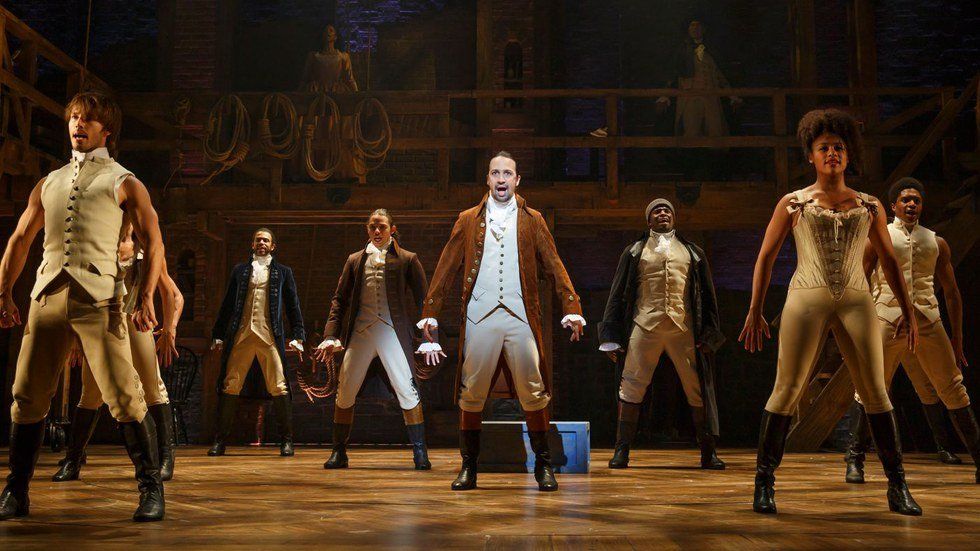
Earlier this year I had the amazing chance to see what may have been the best musical I’ve ever seen: Hamilton. Now, I say “amazing” because, if you haven’t heard, Hamilton tickets are extremely difficult to come by. Luckily, I had a good friend push me to go ahead and commit to buying tickets for this March…last November. Even with that planning, they still didn’t come cheap; however, I would pay every penny to see this show again. Not only is Hamilton incredibly well-written, beautifully designed, strikingly choreographed, and magnificently orchestrated, but Hamilton manages to do something so flawlessly that I didn’t even truly pick up on it initially. Hamilton unifies people.
If you haven’t heard of the Hamilton craze that’s sweeping the nation, allow me to summarize. Hamilton is a new musical written by Lin-Manuel Miranda that tells the story of the United States’ first Secretary of the Treasury, Alexander Hamilton. One of the many things that makes Hamilton unique is that Miranda chose to predominantly use hip-hop music to tell Alexander’s story. At first glance, this may seem laughable. However, after hearing Miranda explain his reasoning, I can’t help but see exactly why he assumed the music of the American Revolution was hip-hop and rap. To Miranda, those genres of music represent people struggling to rise above the poverty and oppression they were born into in the face of an unsympathetic authority.
Another immediately recognizable oddity within Hamilton is the casting choices. As the setting is 18th century Colonial America, and the main characters the founding fathers of the United States, the actors chosen to portray them may shock at first. Why? They are all of minority races. In other words, they aren’t white. I’ve seen or read about productions involving “colorblind” casting, but this took the idea to a whole new level. Hamilton has an exclusively minority cast portraying historical figures who were all white.
Initially, the juxtaposition of hip-hop and rap with the historical setting, as well as the specific choice to cast actors to play people of a different race, struck me as an unimportant gimmick, a nice little quirk that would draw more people in just from simple curiosity. As I became increasingly obsessed with the show, though, I began to see it as something more, as something vital, not only to the show, but to musical theatre’s future, our country’s future, and even humanity’s future.
Admittedly, the musical genre choice does retain elements of gimmickry intended to draw audience members in. That “gimmick” however, is forgiven by the quality of the music. Miranda (as well as the others that worked along side him in the music writing process) has fashioned a soundtrack I can’t stop listening to, full of songs that range from intensely exciting to heart-wrenchingly painful and beautiful. The more amazing accomplishment, at least to me, is that he was able to use extremely modern mediums to communicate a historical tale without compromising the facts. (A great example of this is “The Room Where it Happens,” where Miranda has taken a section of history we actually don’t have information about and, instead of creating a convenient fiction to fill the space, has a character who was also ignorant of what happened [Aaron Burr] sing about the fact that we don’t know what occurred.)
In addition to the artistic accomplishment this feat already is, Miranda has done something even more difficult: he has connected people from centuries ago to people living now. If he had been trying to compose music that realistically represented the musical style of the American Revolution, hip-hop and rap would have been far from his mind. But if he had written that musical, well, I doubt it would’ve been performed at this year’s Grammys. “Pop” music and the current styles of music, are popular because they connect with the culture of the time. They communicate in a way that a large majority of people living in the time are able to understand. What Miranda has essentially been able to do is take us, sit us down across the table from Alexander Hamilton, Aaron Burr, George Washington and the other founding fathers, and translate for us what they felt and did into the artistic language we most readily understand. I’ve been in history classes my whole life, and I’ve memorized many facts about the American Revolution, but I cannot say that, until I listened to this musical, I ever had an inkling of what George Washington felt when he stepped down from the presidency, what war meant to an immigrant or poor man, or the pain a young woman felt when she knew she must marry for station and economic means. Now, I am happy to say, I have wept over these things multiple times.
Just as the musical genre serves as bridge across time, the diverse racial casting allows contemporary Americans to connect to their history. In an interview with the cast, Daveed Diggs (who plays Layfette and Thomas Jefferson, and who I got to meet. AH!!) said that being in this musical was the first time in his life he’s ever felt “particularly American.” When I heard this, it immediately struck an emotional chord. I had never considered the fact that I, as a white man, could more easily identify with the historical figures in my country’s history. It was at this point that the “colorblind” casting took on a whole new light for me. This wasn’t about a gimmick, or some form of “reverse racism,” but instead it was a chance for Americans who never connected to their own history to feel a part of our country, in the past as well as the present. It was beautiful. Additionally, in a spectacular paradoxical fashion, the decision to cast essentially only minority races made race unimportant. The show never addresses the fact that the characters are any particular race, or that their race is significant. Instead, what you get is a show about people. People with ambitions, hopes, joys, and heartbreaks. Their race becomes insignificant in light of their character.
Needless to say, I love Hamilton. I sing along with the soundtrack daily, wake up to “Wait For It,” and cry regularly as I listen to the more emotionally charged tracks. I look forward to watching it sweep the Tony’s, and I’m excited to see what new shows and actors it has opened doors for as it demonstrates to Broadway that musicals are successful when they fulfill one of the main purposes of art: to unify people by reminding us of how similar we all are.