Throughout every Disney movie, young women are depicted differently given their role in the story, as in a good or evil character. For example, every Disney princess has a tiny waist, beautiful hair, a blemish free face and aesthetically pleasing features that represented the “ideal” woman. These standards that were set by the Disney princesses, who greatly influence what young girls dress like and the makeup they put on in order to achieve that “ideal” body image, conversely, every female villain is either fat or ugly.
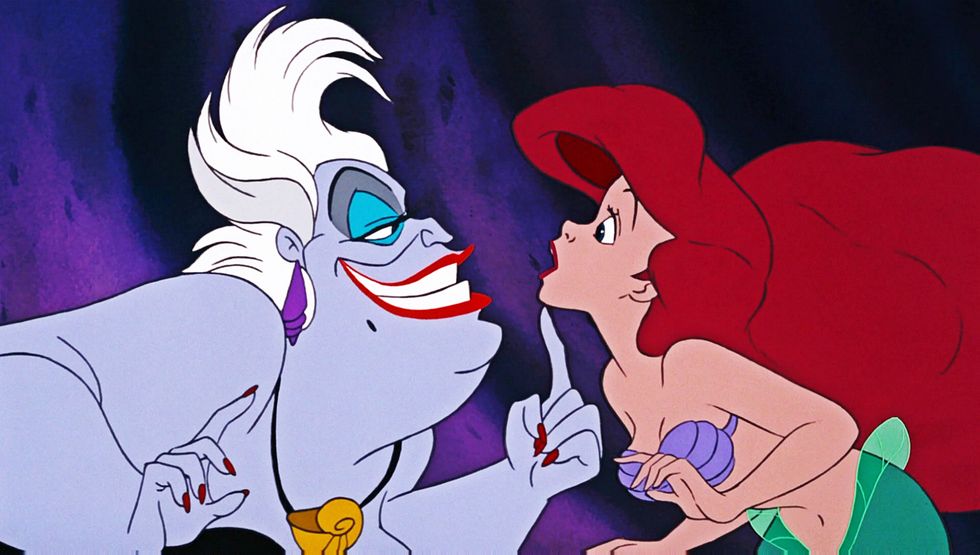
In The Little Mermaid, Ariel is shown as a pretty, white, shapely, kind young women with a goal of marrying the prince. Furthermore, Ursula is characterized as fat, white, mean and wants revenge against King Triton. The contrast between the heroin and antagonist, Ariel and Ursula, is not only explained by their actions but is related to their physical appearance. This leads children to believe that the skinny and pretty children are always nice, while the fat children are supposedly evil.
The contrast in physical appearance of the protagonist and antagonist is also shown in Snow White, where the evil witch appears wrinkly, short, with long grey hair and lives alone, while Snow White not only emphasizes white power through her name, but is beautiful, has a tiny waist and waits for her prince to save her. This story not only discusses the importance of beauty, but the need for a woman to have a man.
While some movies depict women as independent, most women are shown as the damsel in distress, sometimes even the women who are supposedly strong. The princess is always in need of a prince, and they aren’t able to find their prince without having certain ideal qualities or by accomplishing stereotypical tasks.
In the movie Aladdin, the main female character, Jasmin, has to use her sexuality to get herself out of a tough situation. Also, The Beauty and The Beast teaches children that it is okay if your significant other is mean to you, and that maybe if you change, they will treat you better. Therefore, this reflects on the relationships children build in school while on the playground or in the cafeteria, and eventually translates into not so happy endings in romantic relationships or friendships.
From Cinderella cleaning, to Sleeping Beauty having to wait for a prince to wake her up, Disney princesses have contributed to a large portion of the socialization of young girls. Forcing them into stereotypical gender roles and expecting societies view of perfection to be seen as the ideal woman. When in fact, every girl and woman is perfect, no matter their looks or role in society.