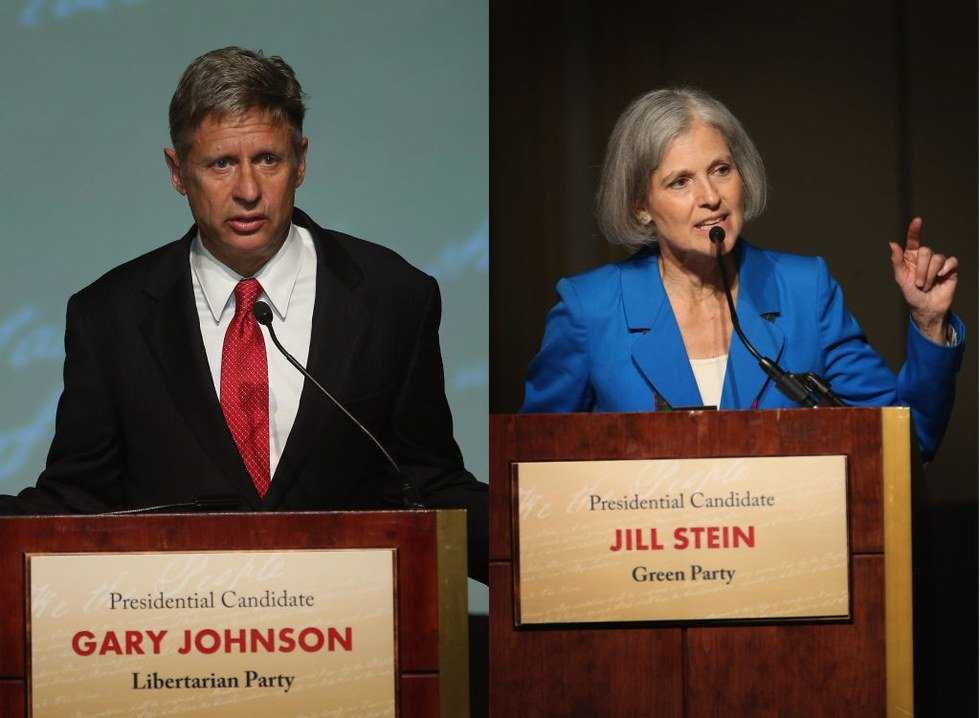
With Hillary Clinton and Donald Trump, pulling off some of the worst approval ratings in recent history, a number of third party candidates are lining up to make their pitch to the disgruntled voter. In an open letter released last week, Green Party candidate Jill Stein heaped praise on the Sanders campaign while sharply criticizing the Democratic Party for "becoming more corporatist, imperialist and militarist" as it leaves its progressive roots behind. Meanwhile, CNN recently announced that it's hosting a town hall featuring Libertarian candidate Gary Johnson. With Johnson hop
The questions of whether or not these third party candidates have a chance is irrelevant this early in the game, but a June 16-19 CNN/ORC poll does show Johnson as high as 9 percent and Stein at 7 percent. According to the Commission on Presidential Debates, Johnson and Stein will each need to be polling at least 15% by Labor Day to participate in presidential debates, and, at the moment, that does not seem to be too lofty of a goal.
Third party candidates stand to offer a silver lining to an election year that has left many voters out in the cold. It is ridiculous that the two-party system could be so entrenched in American politics that it can leave the American voter with a choice between the two most unfavorably viewed presidential candidates in recent history. No matter your political views or your candidate of choice, the introduction of more competition into the national election stands to bring out what is best in our democracy—representation. We live in a complex and changing world where issues are no longer painted in red and blue.
In an ideal world, choosing a candidate to support should be chiefly about finding the one that aligns most with your views. After all, you're searching for the candidate that you feel will represent you and your hopes for the country. Let's not take that particular aspect for granted because it can have huge ramifications in the next four years. Already, at the start of this general election, news networks have caught themselves up in a cycle of "he said, she said" rather than offering a true analysis of the candidate's views and stances.
I'm expected to trust that Hillary Clinton's views will align with my own simply because she is "blue" and Trump is "red." On the other side of things, Republicans are forced to fall in line behind a xenophobe who represents their views so little that their chief line of praise has been "at least he's not Hillary." We've reduced voting down to a task less complicated than choosing a sports team, and any opportunity for that system to change should be welcomed with open arms and open minds.