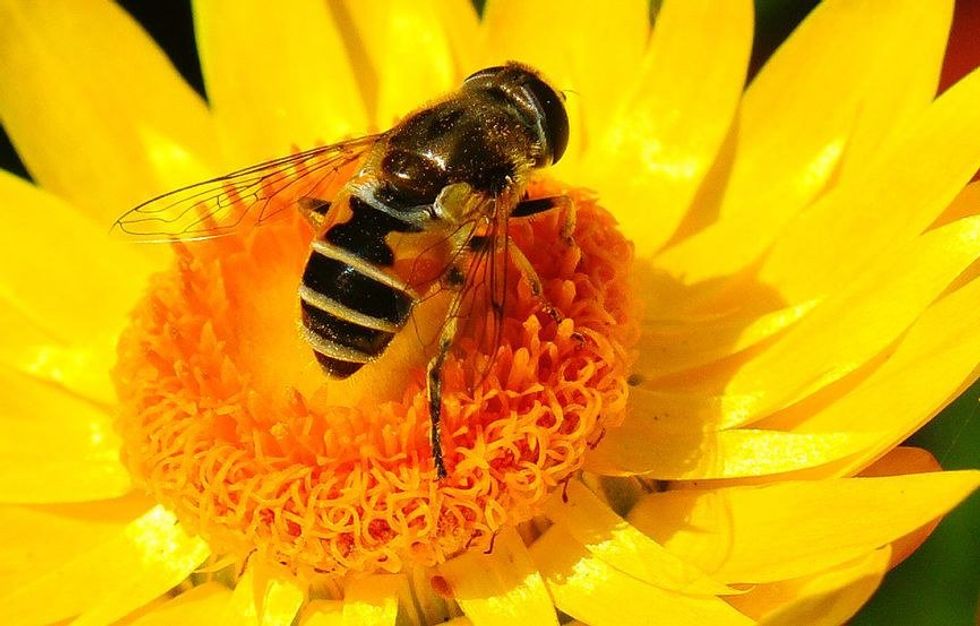
Man’s best friend descended from the wolves that many still fear and kill. Honey bees descended from wasps. Attitudes toward dogs have warmed up, yet fear still surrounds our honey producers. Which stinging insects ruin picnics and which ones supply the food in your basket?
“I don’t know if [they’re] naive, [but] most people blame any sting incident on bees,” said Chris Beck, a part-time beekeeper from Breckenridge. Honey bee stingers break off from their abdomen which causes death. This gives them a docile nature compared to yellow jackets, which don’t lose stingers and can attack multiple times. Through displays at farmers markets and at festivals, Beck provides education on the creatures that produced the honey he sells.
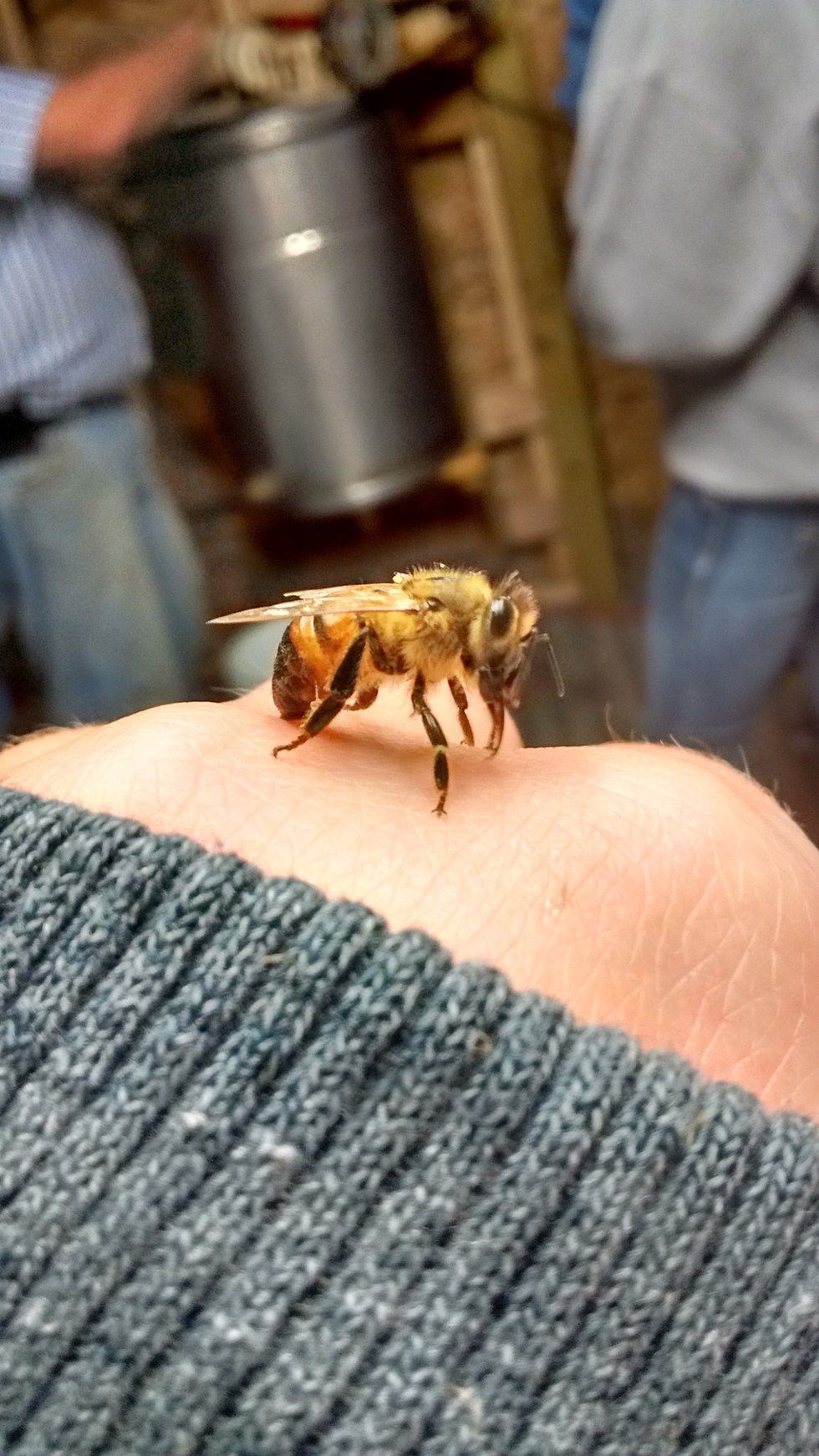
A docile drone sits on a hand while Alma College students extract honey from one of their two hives.
Flowers reproduce through the spread of their pollen to other plants. This reproductive powder is also a high-protein snack for insects. An exchange of food for pollination resulted between the two parties.
Bees and flowers came to co-evolve as a result of their ancestral partnership, according to Joe Hanson, who has a Ph.D. in biology and created the PBS show “It’s Okay To Be Smart.”
Flowers produced bright colors and tantalizing nectars, appealing to their pollinators. Bees adapted from the wasps that once fed on the pollen-feeding insects. Now adaptions such as UV vision, hairy bodies, and straw-like proboscises make honey bees superior pollinators.
Of America’s 115 top crops, 87 are dependent on honeybee pollination, according to the White House Website. Professor of Entomology at Michigan State University and long-time student of bees, Zachary Huang, explained that this equates to one billion dollars worth of crops per year in Michigan.
Mark Bartholomew lives with more than 100,000 honey bees in his residential yard. His neighbors are unaware and his grandchildren are in love. “[Exposing them to colonies] is how you teach little children to love bees,” said Bartholomew.
Bartholomew’s backyard is lined with his neighbor’s fence and tall shrubs. Behind these borders are a garden, a shed and a pair of hives- one nearly as tall as a woman.
On a summer day, there’s never a dull moment. Bee’s are continuously buzzing in and out. Occasionally a fight ensues when a yellow jacket tries invading the hive.
Honey bees are reluctant to sting because they have a docile nature and die as a result, according to garderners.com. Yellow jackets become a common pest and are mistaken for bees in late summer when their population is high. Physically bees are distinguished from other stingers by their fuzzy body, four wings and presence on flowers.
Bartholomew’s love for bees began when he was a child apprentice of the neighborhood beekeeper. “I was one of the kids he’d line up at his dinner table [to] make [hive] frames. We didn’t have problems with child labor laws back then,” Bartholomew joked.
After building, inspecting and maintaining hives as a kid, Bartholomew began keeping his own in 2000. He has taken others under his wing like the team of students at Alma College in Michigan who constructed a hive box and began rearing bees.
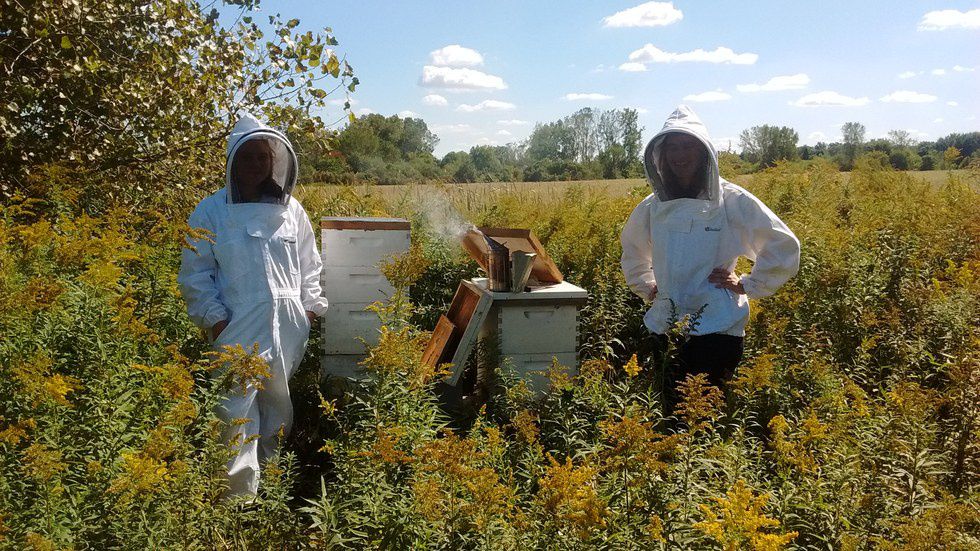
Alma beekeepers pose next to their hives.
Alma grad Brendan Goethe started the club in the spring of 2015 after researching bees for an environmental class. He was inspired by a friend who pointed out a number of dead bees on the sidewalk.
Student interest has continued after Goethe’s graduation. Six students helped Bartholomew uncap, drain and harvest sweet stuff from the school’s honey-producing colony one night this past September.
An hour south, another Mark helps a batch of Michigan State University students with their new bee club. Five years ago, Mark O’Neill’s neighbor said to him, “I don’t see any honey bees in my garden. You should keep bees.”
“Ninety percent of the time I thoroughly enjoy working with bees,” said O’Neill. “Keeping bees has taught me many things. Probably more than I realize. Patience is a good one, and one I am still working on. The bees prefer that you move slowly and deliberately.
“I have also learned there are many ways and techniques for accomplishing the same goal. It is true that if you ask five beekeepers a question, you will get a minimum of six different answers in response. It is also that they all may be equally correct.”
Keeping healthy colonies contributes to a sustainable earth. Nearly every crop aside from wheat depends on pollination, according to O’Neill.
He guides Joe Fox, the student founder of MSU’s bee club, and assists with the care of the hive. Fox started pushing for the organization in 2013 and his work came to fruition this year. He gushed about bees, emphasizing they’re not “malevolent creatures” and mentioning “so many good uses for honey.”
While starting the group with two hives did not seem hard to him, he explained “bees are a livestock animal. [If you] put them out and forget [about them] without upkeep, [you’re] putting them in an unnatural environment and it’s easy [for them] to get disease and mites.”
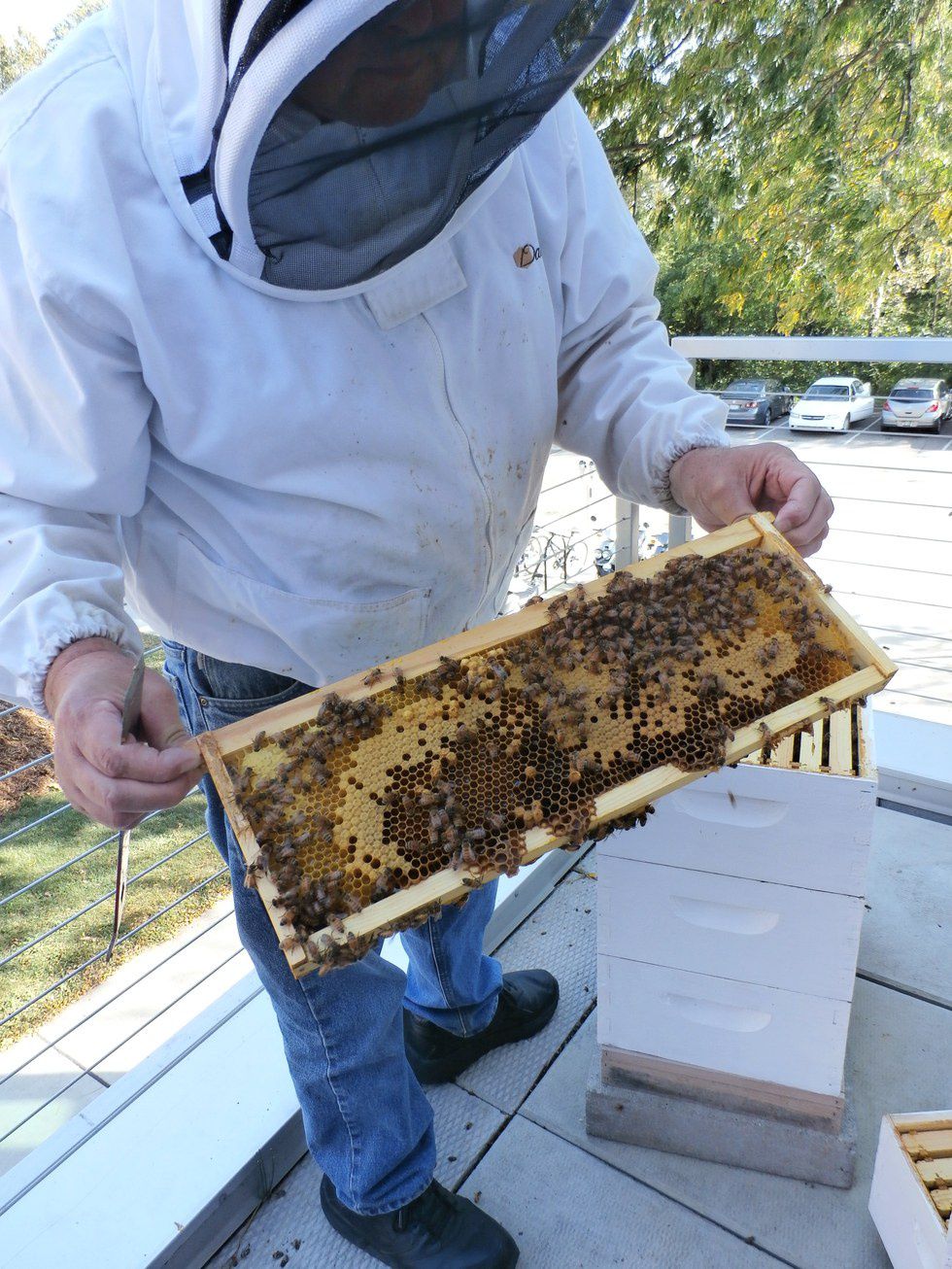
Beekeeper Mark O'Neill holds a slot of honey bees working to seal their gold.
College groups aren’t the only ones who think keeping colonies is the bee’s knees. “Beekeeping has taught me the value of community,” said Beck, the Breckenridge, Mich. keeper.
“I am proud to be a beekeeper and have developed a good reputation for it. Interaction with people is interesting as they are intrigued by bees. I appreciate the benefits of bees to our lives and the environment and am happy to share the knowledge to make a difference.”
Helping a healthy hive entails guarding against the threat of mites and disease.
“I do not use any chemicals,” said Beck. “I’ve found them to be unreliable. If you need to use a special mask and gloves, [the chemical is] pretty scary to use on bees.”
Instead of using formic acid or other irritants to fight varroa destructor, a parasitic mite that feeds on bees and spreads disease through colonies, Beck practices drone trapping.
The mites target drone (male bee) larvae more frequently than worker (female bee) larvae. Specialized slots that encourage the construction of larger combs and the laying of drones can be inserted in bee hive boxes. Removal of the slot, once larvae is sealed in with the majority of the mite population, can help protect the entire colony.
Alma’s local beekeeper, Bartholomew, spoke of another alternative that traps mites without killing drones. He compared bee behavior to that of dogs. They shake their bodies upon entrance of the hive. If a screen is installed that is too small for bees to fall through, shaken mites can become trapped in a bottom compartment because they don’t know how to find their way out.
Chemicals threaten honey bees as well. Often a form of pesticide called neonicotinoids, synthesized nicotine, is blamed for the insect’s plight. Though the European Union has banned its use, Amanda Harwood, who has a Ph.D. in aquatic toxicology and teaches at Alma College, questions the blame.
“Bees have lots of problems,” Harwood explained. “Colony collapse disorder (the phenomena of the majority of bees vanishing from a hive) [is linked] to lots of other issues.”
She explained that neonicotinoids and other pesticides cause nerves to fire in bees and other pollen-feeding insects, which leads to seizures and death. Regardless of whether the chemical is controlled, Harwood stated that new, equally harmful pesticides would replace them.
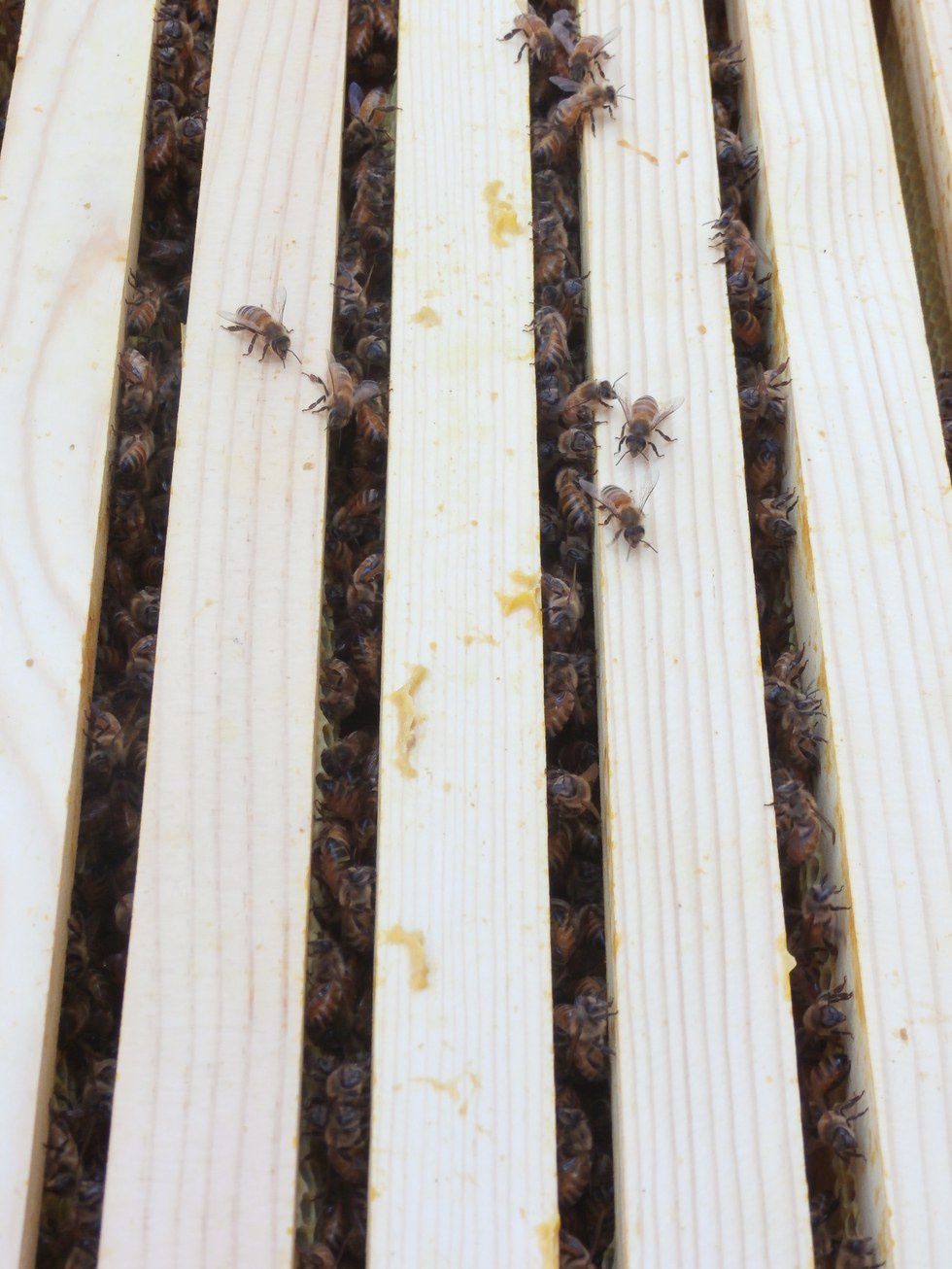
Honey bees crawl between the slots of their hive.
In Michigan, bees need ample protection against harsh winters through supplementary feeding of sugar and pollen, according to hobbyist beekeeper Mark Petz of Fremont. The third beekeeper-named-Mark started when his wife bought equipment from an old Ukrainian couple.
“I have learned a ton about honey bee behavior, life-cycle, needs, best (and worst) beekeeping practices and how modern monoculture farming may be endangering honey bees and, in turn, the sustainability of our food supply.”
Caring for bees is a learning process, even for Kentucky’s State Apiarist Tammy Horn. “I've been working with bees since 1997, but was absolutely horrible until about 2006, when I went to Hawaii to work in the queen bee industry.
“I don't think it is any more difficult to keep bees than to keep pets, but it is not intuitive. There is a lot of learning. You'll be a beginner for 20 years. For some folks, this is difficult. For some, it is a new way to look at the world. For me, it became a new career.”
If putting on the veiled suit and getting up close and personal with a smoker and some bees is out of the question, there are simpler ways to help the buzzing population. Starting gardens of native plants, reducing pesticide usage and buying honey from local keepers all benefit bee populations.
But things are looking sweeter. When asked about the current state of bees, Horn quoted a fellow entomologist Dennis vanEngelsdorp: “We have gone from horrible to bad."
To transition from a bad situation to a good one, Horn doesn’t “waste a lot of time convincing people who have had bad experiences or perceptions of insects. They slow me down. I just try that much harder with children or other people who are receptive.”