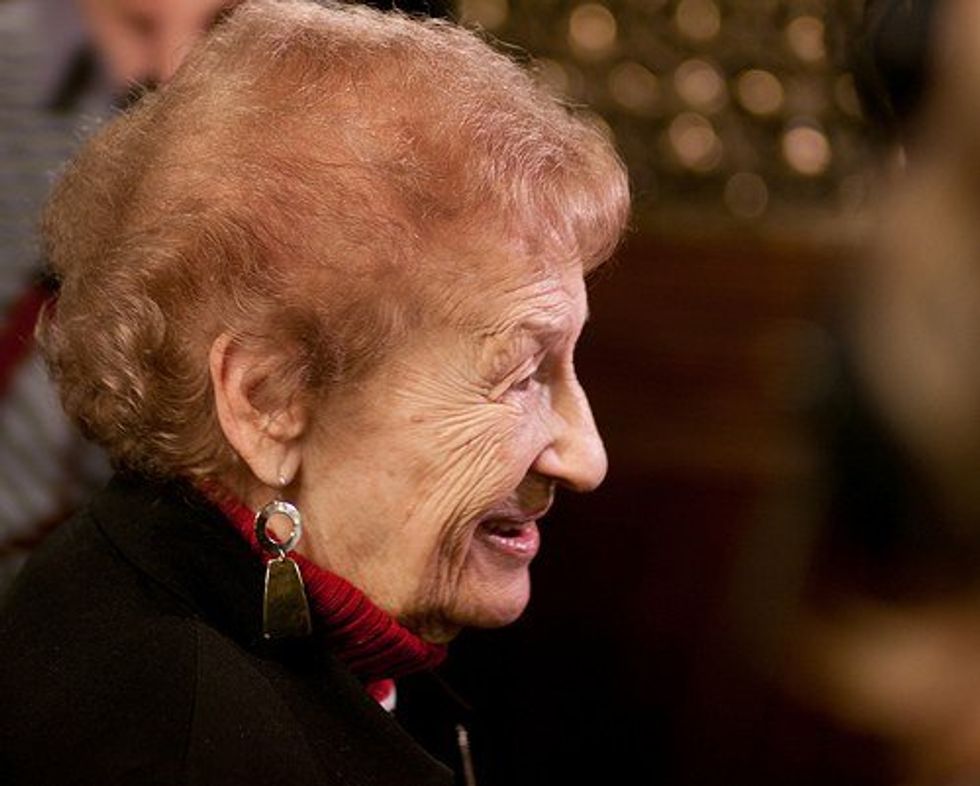
“This is my boy toy. He is seven months younger than me and we're very happy together."
With this statement, the entirety of the CUB Senior Ballroom bursts into a viscous fit of laughter. Said “boy toy" is seated directly in front of the small stage, which he constantly makes his way up to in order to aid his 92-year-old girlfriend in recalling her tragic past.
Meet Esther Jonas Bauer. Born to a Jewish mother and father in Karolinenstrabe, Germany, she is one of the few remaining Holocaust survivors alive today. Esther resides in New York, but she has devoted much of her life to visiting various college campuses, institutions and groups all over the world, to speak about her horrific, personal experiences from the Holocaust. Although the topic was quite heavy, during her talk at WSU, Esther managed to keep the audience engaged, attentive, and above all, laughing. For someone who has been through h*ll and back you'd never know it, mainly because of her quick wit, spicy personality, and poise. During the hour-long program, she managed to not only continue smiling, but keep the audience smiling as well.
Esther was nine when Hitler rose to power, but she was unaware of the situation's severity for several years due to her parents' sheltered approach. “Change happened slowly and overtime," Bauer states while discussing the quiet transition from prejudice and intolerance to full blown extermination. She mentioned many of the practices we typically associate with the Holocaust, including forced wearing of the yellow star, the train to Auschwitz, the lack of edible food within the camps, and the infamous gas chambers. As college students, we are all familiar with the torture methods used in the Holocaust, but to hear someone speak about them from memory is an experience all its own. As Bauer's held the microphone, a small, faded tattoo with the numbers, “7899," became visible on her forearm.
During this slow progression of Nazi fascism, Esther became stricken with pneumonia and nursed back to health by a Czech man that would later become her first husband. It was he who she followed when he was suddenly shipped off, as well as how she ended up in the worst concentration camp known to man — Auschwitz. Once she arrived, Bauer's was immediately sorted to the right, which happened to be the group spared from immediate extermination. However, this did not prevent her from witnessing a Jewish woman being shot directly beside her for attempting to throw food over the gate. On multiple occasions, she was forced, along with several other prisoners, to enter a mass shower. She states to the audience that she had many moments where she thought it was the end, but each time she entered the shower, it was water that poured out of the faucet.
After an unspecified amount of time in Auschwitz, Esther was transported to a small town called Freiburg where she was put to work in a factory making Nazi planes. Cheekily she remarks, “ I like to say that no plane I built ever flew, because I sabotaged them every chance I got." At this factory, a group of young, Jewish women were forced to put in 12+ hour days, beaten, and deprived of food. Receiving only one piece of bread a day, many resorted to eating grass in an attempt to fill their aching bellies. At the end of their shifts, the women would return “home" to a bunker where they were placed two to a bed which was infested with bed bugs, vermin, and fleas. Incredulously, this was still a step up from the camp Bauer's left behind.
Finally, Esther comes to the part of her story we have been waiting for, her liberation. After her compound had been liberated, she moved to New York to live with a Jewish girl she knew. She also found out that her first husband, mother and father, had all been killed in Auschwitz. Gradually, she built a life for herself in the United States, and she eventually went on to have one son and two grandsons.
During the Q+A portion of the program, Esther was asked how she managed to keep going during such hopeless times. “The will to live is very strong," she states, “You live in a shell and that is how you survive."
Her story seems like one too horrific to be true, but it is only when you acknowledge the realness of her story that you are truly impacted. At many moments during her recount, it felt as though she was not going to make it out, but she did, and that is the lesson everyone should take from her story. Survive. Even when there is no light at the end of the tunnel, you must continue moving forward. Through the many ups and downs of her life, Esther has remained kind, tolerant, and alive, both mentally and physically. She is still able to laugh, crack jokes, and enjoy all life has to offer. They say the happiest people have the deepest wounds, and Esther is the complete embodiment of this statement. To listen to her is to listen to strength, courage, and bravery.
Thank you Esther Jonas Bauer, for having the strength, courage, and bravery to share your story with us. I'm sure I speak for everyone when I say we are truly humbled by you.