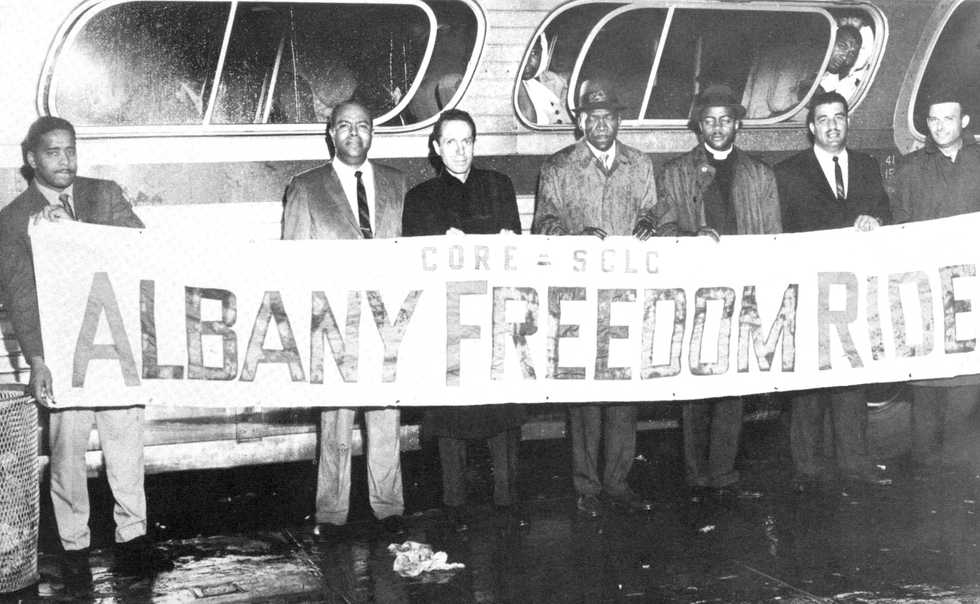
The Civil Rights Movement was largely a slow and tedious effort, lacking government activism and a strong participation of youth. In 1961, the Freedom Riders Movement changed the course of the Civil Rights Movement as a whole. For the first time, American youth was heavily involved in not only the activism, but the leadership roles of the movement, sparking a strong splurge of government participation under President John F. Kennedy. After the Freedom Riders Movement, law after law was passed that not only made certain segregatory acts illegal, but actually began to break down the system of black oppression, especially in the Deep South. The Freedom Riders Movement of the 1960s represents a turning point in the greater Civil Rights Movement because it demonstrated an expansion of the movement to youth culture and ended the government’s lack of engagement in Civil Rights.
In 1955, Rosa Parks helped begin the post-Brown v. Board of Education period of the Civil Rights Movement by refusing to give up her seat on the bus to a white passenger. Martin Luther King Jr. emerged soon after as perhaps the most famous leader of the movement, adopting the non-violence tactics that would shape activist strategies in the future. In the early 1960s, leadership within the movement expanded to youth, mainly college students. The Student Nonviolent Coordinating Committee (SNCC) was founded by four college freshmen in North Carolina in 1960. They began a wave of lunch counter sit-ins to end southern segregation. The students largely began autonomous local activism that contrasted King’s use of campaigns to achieve reform on a national level. The college student participation of the SNCC quickly spread and formed the Freedom Riders Movement in 1961. The Freedom Riders rode interstate buses into the deeply segregated south to challenge the U.S. government to become involved. They were able to gain attention from the government because they put themselves in situations in which the government had to step in and speak out against the illegal punishments they were enduring.
The Civil Rights Movement was not new to the United States in the 1960s; since the Civil War, activists have fought for the rights and treatment of African-Americans. Still, the government stood one step behind and hardly acknowledged the movement. In the 1896 Supreme Court Case, Plessy v. Ferguson, the government legitimized the doctrine of “separate but equal”, justifying deep-rooted patterns of segregation throughout the U.S.. In the early to mid-1900s, the repeal of this law and similar “Jim Crow laws” was a main focus of the Civil Rights Movement. In 1954, the “separate but equal” doctrine was overturned by the Linda Brown v. Board of Education Supreme Court Case. While this pro-equality government action was significant, it was not enforced, especially in the Deep South. Even after the Brown v. Board of Education of Topeka Supreme Court Decision which illegalized the separation of black and white students at different schools, the government did not maintain any sort of recurring participation in the movement; it continued its passive position for the next decade. Consistent involvement from the government in the Civil Rights Movement was started largely by the Freedom Riders Movement of the early 1960s. The Freedom Riders caught the attention of President John F. Kennedy who began to push for the passage of a new civil rights legislation. Shortly after, the Civil Rights Act was passed, outlawing discrimination based on race, color, religion sex, and any other identity. The Voting Rights Act followed, and together, these acts began to dismantle the deep-rooted racist ways of the South.
The Freedom Riders’ relentless efforts for change were not the first that the Civil Rights Movement had seen. After the Nat Turner Slave Rebellion in 1831, abolitionist William Lloyd Garrison rose as a leader of the movement, relentless in reaching for his goals. While abolitionism was not a new concept, Garrison was one of the first to be so unyielding in his tactics: “Immediate emancipation can alone save her from the vengeance of Heaven, and cancel the debt of ages". The Freedom Riders displayed a similar dedication toward the cause through their unwavering commitments, not only in speech, but in action. They sought to challenge government non-enforcement through ceaseless travail until they had made significant progress in their cause. Both Garrison and the Freedom Riders demonstrated a change in strategy in the Civil Rights Movement.