


Heading towards the Hero Now Theatre’s presentation of Oresteia by Aeschylus started like any regular play, pondering the usual considerations. What will the adaptation be like considering the original is a trilogy and tonight’s version is a three-in-one? I wonder how the actors will do capturing such tragic character? What will the set design end up looking like: dramatic or simplistic?
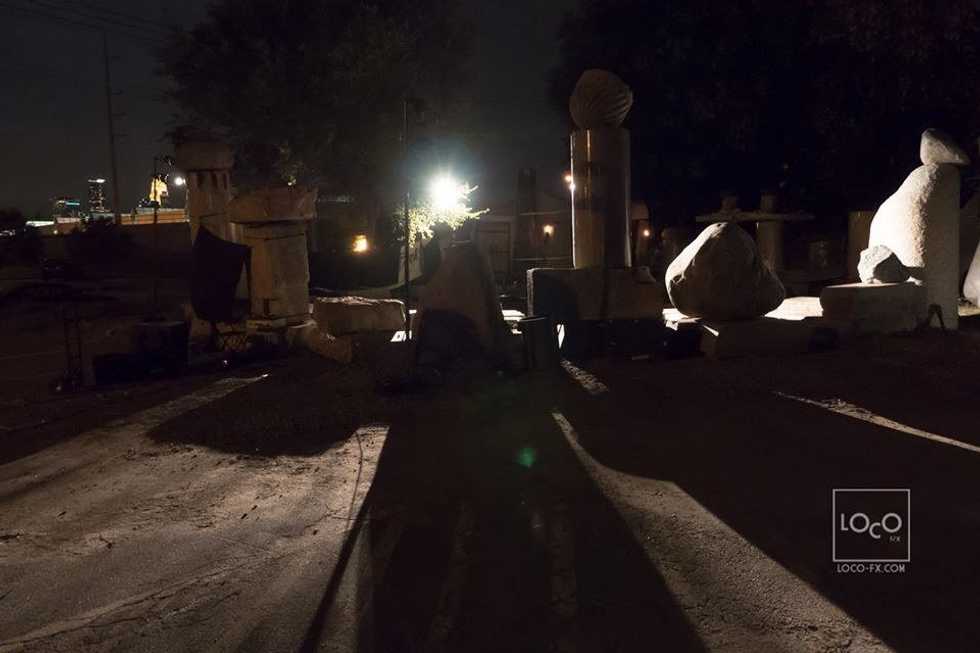
However, considering all the usual elements of judgement didn’t prepare me to arrive at the venue itself. Pulling up, my first impression involved a dirt parking lot at what looked to be the fringe of Minneapolis where the city had started to fade out. Then, off to the side, was a strange rock structure.
“Where’s the play going to be?” I thought to myself and asked aloud all at once, looking around in an attempt to respond to my own question while some fear began to build in my gut at the only buildings around to house a theater being what could have passed for an abandoned warehouse and an ale house across the street.
“It’s outside.”
Oh, okay. Outside. I look around for a park, some green grass housing a short amphitheater or just an opportunistic hillside where we can makeshift an outdoor stage. None of that there, instead my eyes are directed to the strange, stonehenge-esque rock pilings that are the epicenter for bustling activity as stagehands rush this way and that preparing. The location was the Zoran Mojsilov Outdoor Sculpture Gallery, a found location that Hero Now Theatre merely borrows to perform their play as is.

Stooping low to enter the play’s space beneath the arch of rock, instantly the scene comes to live as some Greek ruins. “Did they put this here all for this play?” I couldn’t help but wonder, but the truth is that they use the space as it was, but the place they found was perfection for the performance.
That aspect, that practice of performing in changing, stumbled upon locations is a major reason for Hero Now being such a unique performative group.
The company began to form just a year and a half ago with a manifesto and a one-act play, A Thing of Beauty, performed in a backyard. Before that, Kristen Halsey and Peter Aitchison, a husband and wife duo, graduated with degrees in theater from Iowa State University. So, fast forward, they have the background of theater schooling and the dream for a company when they met David Severtson, executive director, in high-school theater shows. Over time, the idea of a theater company surface and re-surfaced, but it wasn’t until within the last two years it became serious, developing a vision, mission, and purpose.
From there, with the profits from their backyard show, they acquired rights for Terra Nova which was set to be their second play and the first in a truly “found” location.
With a play surrounding the first successful British expedition to the South Pole, they only needed someplace to put up a tent and Minnesota’s winter would provide the rest of the staging.
“I believe the places we've chosen provide a visceral connection with something about the play,” Severtson said of their unique locations. “Watching the Antarctic adventurers in "Terra Nova" while sitting in an Arctic-like venue brought something immediate, especially when you watched one of the characters go crazy and start to remove his clothes. You FELT for him!”
While the found locations provided a powerful, physical connection to the piece, it also brought all new challenges to theater. With The Oresteia, the major concern was rain.
“Not just because the audience would be miserable but because we had high-powered lights plugged into electrical sockets: rain and electricity don't mix well!” Severton explained.
Typically, theater venues come with lighting, electricity, basic safety, and comfort all built into the local, so the theater company is freed to focus on craft, acting, design, but Hero Now tackles an entirely new set of concerns to offer the experience of borrowing community space to perform in.
This idea of possibly foregoing comfort for a grander connection to the play fits hand in hand with the company’s title and mission. Their manifesto mentions the viewer themselves being a hero, becoming a hero defined as someone facing their fears or moral concerns to make decisions on principle, not choosing the easiest option.
“Audience members who, for instance, say, "Yes, I'll attend an outdoor play in January in Minnesota because why would a play about the South Pole be convincing in a heated or air-conditioned theater?"--those are heroes.”

Hero Now’s concept of embodying their audience with heroic mission is fully encompassed in their mission and slogan: “Affective. Effective.”
“Affective refers to feeling, effective refers to result. We like producing theater that makes people feel something--a primal emotion, a revulsion, a surprising affection for an otherwise despicable character, even a sudden, overwhelming thrill over theatrical spectacle.”
They believe in making the audience feel, the audience might also act whether that action is merely to see more theater or is as grand as jumpstarting social change.
In the future, they hope to continue sparking discussion, self-reflection, and openness to the wisdom of the community surrounding oneself starting, hopefully, with The Turn of the Screw Jeffrey Hatcher’s two-person adaptation of Henry James’s novella of which they’ve applied for rights to perform.
In addition to bringing more performances, they aspire to implement a BOGO concept in which tickets will include a free ticket to give away, encouraging and supporting other people to go to theater. Logistically, this concept is still in development.
More information on Hero Now Theatre including their full manifesto and future information on performances can be found on their website: http://heronowtheatre.org/.















