
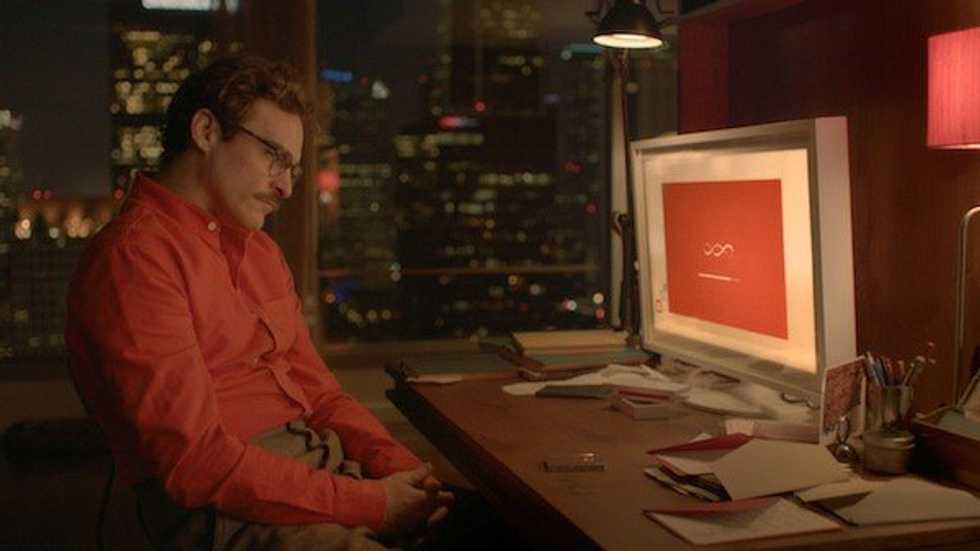
Within the genre of science fiction, there are an infinite number of ways to depict the future because there is nothing to dispute a writer’s assumption. A plot set in the future is much more than just flying cars, utopias, or dystopias. They are predictions. A writer’s foreshadow. And the incredibly unique and original world writer and director Spike Jonze creates in "Her" is more technological than human, and yet it is the setting for one of the most appealing, important, and strangest romances put to film.
"Her" is the story of Theodore (played by Joaquin Phoenix), a recently divorced L.A. love-letter writer who installs a new operating system, “OS 1,” onto his computer. What makes “OS 1” special is that it has the ability to think. As a desperately lonely person, Theodore chooses to have the OS be a woman; her name is Samantha (elegantly voiced by Scarlett Johansson). And as she gains knowledge of how the world works, and how to act more like a human being, Theodore falls in love with her.
Samantha is much more than an evolved version of Siri. She has emotions and is able to understand Theodore’s by the sound of his voice. The two have long discussions about what they want out of love and life. She helps him overcome his ex-wife (portrayed by Rooney Mara), influencing him to sign the divorce papers he had been putting off, and he gives her a taste of the human experience.
What makes Samantha such an interesting character to watch is that unlike most other technologically-based movie characters, Samantha longs to be human. In one scene, she asks Theodore what it’s like to be sitting down with a body, and if she can watch him sleep. The two bond as they fill the gaps in each other’s hearts.
With the peculiar relationship developing in an unexpectedly believable way, Theodore finds himself in an awkward position as to how to present himself with Samantha. At first, he just tells his friends that he met someone, not giving too much away. He answers their questions with honest and heartfelt responses. But as he and the audience knows, the truth has to come out eventually. And when he finally tells his best friend Amy (Amy Adams) that Samantha is a computer, she informs him that his story is not unique. Apparently there are people all over the world who have fallen for their OS systems, she even uses her ex-husband’s one as a close friend.
The film brings up a different perspective of our gadget controlled generation. With phones that talk and listen to us, it is interesting to think about how that feature is going to evolve. Will our iPhones eventually have emotions? Will they counsel us when we are upset? Will they love us as much as we love them? Perhaps. But it is the way the film carries out this absurd hypothesis that makes Her so gripping.
By the end of the film, Theodore ends up being totally engrossed by Samantha. Walking up and down the street, he is constantly talking into his earpiece, and to no one else. The concerning part of it is that everyone else seems to be doing the same thing. There is a very little amount of human interaction, and this is what I believe is the film is questioning - if people are able to talk and connect with their technology the same way they would with other people, is the technology really a bad thing for humanity’s social structure?