Almost all of us have admired a relationship other than our own before. For some of us, it was “power couple” Brangelina, or #GOALS like Jay-Z and Queen Bey; for others, it was our OTP from our favorite book, movie, or TV show. However, are these ideations healthy or are they causing us to enter more and more broken relationships with unrealistic expectations?
The first example of this that comes to mind is the pop culture trend of movie adaptations. There are so many examples of bad relationships in pop culture, and what is worse is that films further romanticize them in the theatrical adaptation.
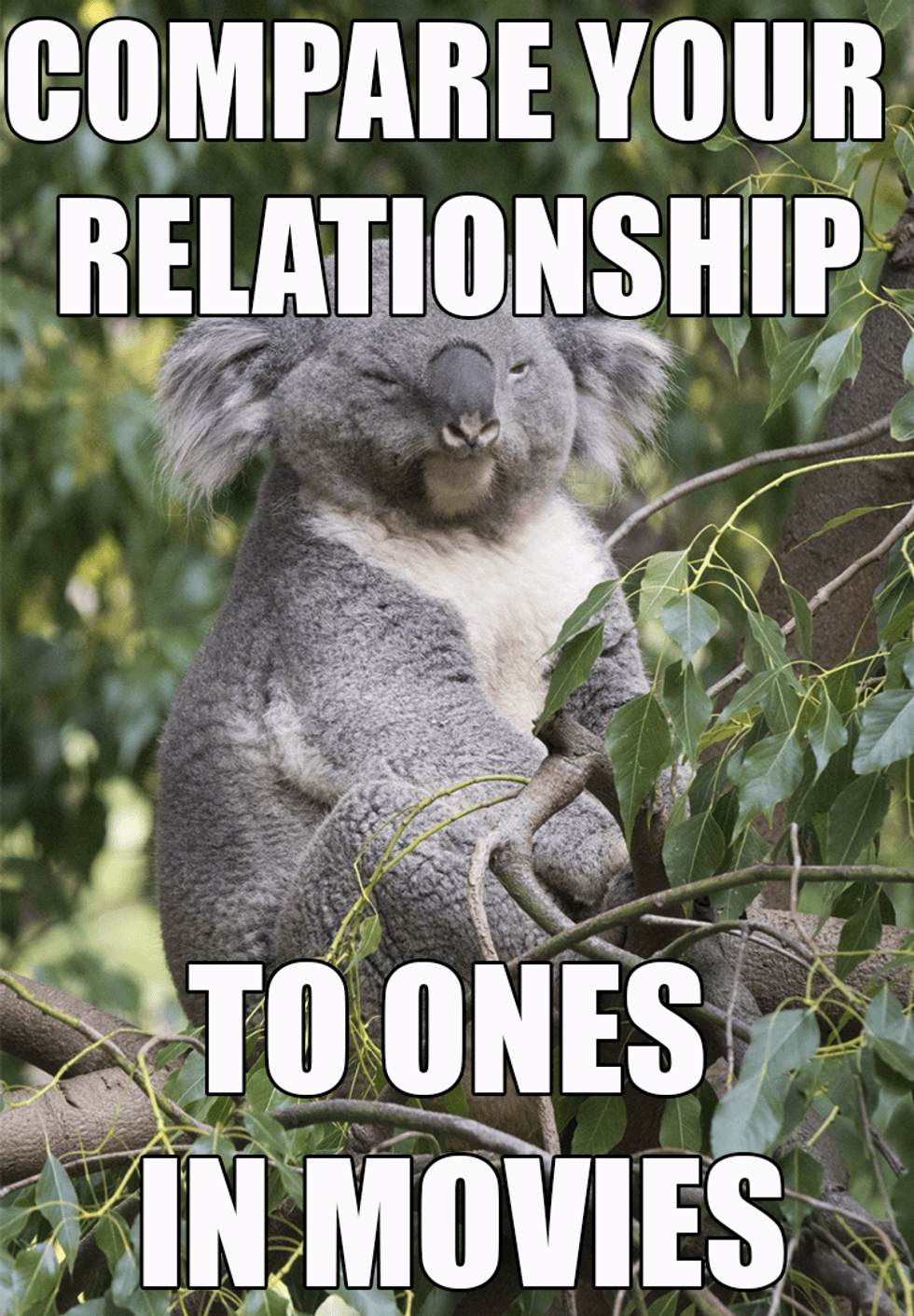
Bad relationship advice koala knows.
Take, for example, “Suicide Squad.” Shortly after “Suicide Squad” came out in theaters, a plethora of gaggling girls posted on social media that they wanted a relationship like Harley Quinn’s and the Joker’s. What these girls failed to realize that many people began to point out is that Harley and her Puddin’ actually have quite the toxic love affair. You see, Hollywood could have very easily made Harley and Mister J’s relationship comic book accurate, but it would have been a horrible tale of violence, sociopathy, and Stockholm Syndrome; in other words, it could have been bad for the box office. Instead, they chose to divert away from the gruesome truth of Harleen Quinzel’s violent lover, and instead paint her and the Joker in a light much more synonymous to Bonnie and Clyde. Would we even want that in a relationship, though? While I understand the concept of letting loose and having fun, but also being devoted to someone, I feel that people who defend this relationship fail to realize or acknowledge the potential fatality of Harley’s devotion as well as the immorality and illegality that constitutes her “fun” with the Joker.
Yes, Harley, you are.

Another film that crosses my mind is Fifty Shades of Grey. Adult portions of the relationship between Anastasia Steele and Christian Grey aside, there is a very extensive list of reasons that wanting their relationship is just wrong. First is Christian’s undying need to always know everything about Ana. Granted, learning her favorite flowers, what color she looks best in, and where she goes to school can all be viewed as quite sweet in a certain love-struck context, but it gets much darker. He stalks her multiple times by illegally tracing her phone, he threatens her with physical violence before she even knows his more secretive interests, he makes her sign a contract where she basically cannot speak negatively of him in any light, and lest we not forget when he “mysteriously” gets her bank account information and puts $20,000 in it. Did I mention that this all happened early on in the trilogy? An insecure megalomaniac with unresolved abandonment issues should never be the ideal partner, rich and handsome or not. Also, no, the excuse cannot be make that all of this stems from his most primal of hang-ups. These types of things do not happen in healthy relationships, vanilla or not.

Abuse is never okay.
So, what gives? Why do we fantasize and idealize relationships that are so cruel? I do not think that girls truly want this, yet we enjoy them so much. When discussing the topic with my team, we all admitted to having a movie or TV couple that we absolutely adored, but we also discussed some interesting points. Baily Johnston said “It’s like we know it’s not good for us, but we still are really intrigued by it. I think because it’s not normal or more so in our comfort zone. None of these are our real life ideas of relationships so maybe that’s why we love them.” Meanwhile, Ansley House asked, “Is it because they actually want a relationship like that or is it because they consider fiction a safe place to explore what they know isn’t healthy in the real world?”
To me, it goes back to what I call the “Anne of Green Gables” effect. We romantic types (women stereotypically, but also people from a slew of other orientations, genders and non-genders) want someone devoted and even partially dependent on us, or so we think. However, it goes even farther than this. In “Anne of Green Gables,” a character named Gilbert Blythe pulled Anne’s hair and called her Carrots. Supposedly he did this because he was infatuated with her and attempting to receive her attention. This is an example of a story girls know all too well, where a boy yanks her pigtails on the playground and someone simply says “oh, that just means he likes you.” This is sometimes the first information a child learns about relationships from a parent, and it is a lesson that can potentially trap us into becoming enthralled with the Christian Greys or Jokers of the world, because “they hurt you because they love you.” What makes it even easier to fall into are the other qualities of the male such as Mister J’s need to have fun, a quality that many people want in a partner, or Christian’s brokenness from growing up in foster care, which manifests in readers a desire to fix, comfort, and please him in an attempt to normalize him. Trust me when I say that the only person who could ever regulate either type of personality mentioned is the person themselves.

Don't try to heal him or fix him or change him. He isn't a leaky faucet.
So, my advice to the millennials out there: enjoy the movies for what they are, and strive for a healthy, happy relationship where your partner is your best friend above all else. Do not vilify a relationship full of control and torment, no matter how romanticized it may be. Break the cycle.