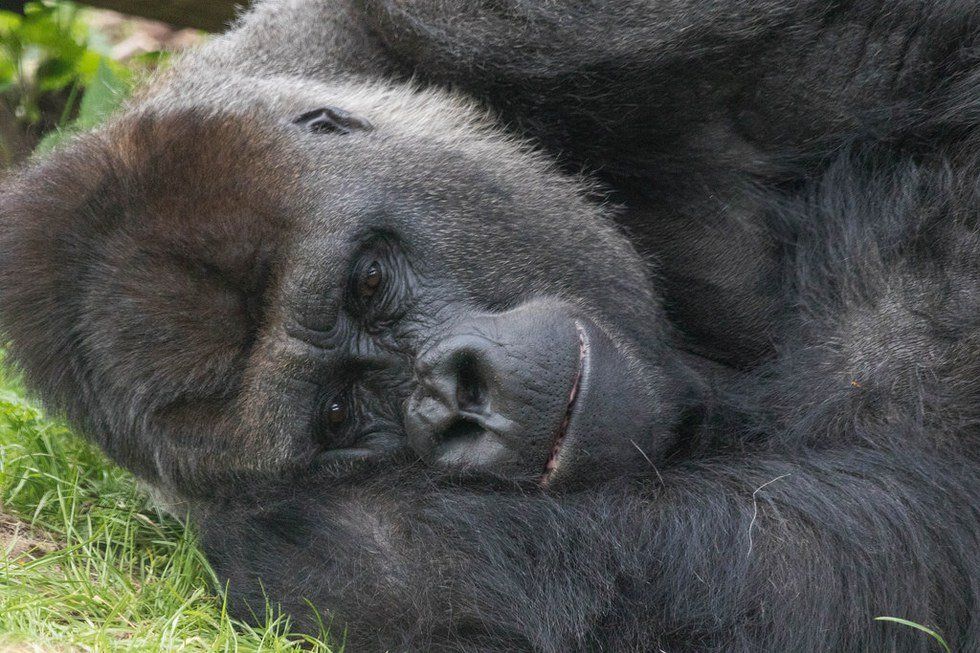
On May 28, 2016, 3-year-old Isiah Dickerson fell into a gorilla enclosure. His actions set the internet on fire.
When Isiah escaped the (un)attentive eyes of his mother, and fell 15 feet through a "secure" barricade into the exhibit of a 450 lb. gorilla, the outcome should've been inevitable: The gorilla smashes Isiah into a pulp, the zoo kills Harambe, the family sues the zoo, the internet gets mad for a couple of days, and we move on. Nice and formulaically easy.
Except, in this case, the child miraculously survives, except for a few cuts and a concussion, but Harambe the gorilla, who had turned 17 the day before, paid the ultimate price for the negligence of a Homo sapien sapien.
In the days proceeding this incident, a video surfaced that captured this 10-minute ordeal, and has been scrutinized, analyzed, and debated over to a ridiculous amount. Everyone has an opinion, with some calling for an investigation into the child's home, and others rushing to the defense of the zookeepers' actions.
When I initially heard of this incident, I wept. I wept uncontrollably. By no means am I a die-hard animal lover, but I found it disgusting that an animal, by no fault of his own, had to suffer because a mother couldn't hold onto her son. But then I came to a realization; a sickening, saddening realization.
Harambe needed to die. Harambe had to die.
For now, let's brush aside the arguments that tranquilizers would've been a better alternative. They only would've angered him, and most definitely resulted in Isiah’s death. Or that Harambe meant no harm (Did no one see the part where Harambe was dragging Isiah by his leg through the water?). Reality check: There was no magical moment where Isiah and Harambe touched hands and realized they were part of the same Earth. What do you think this was, a Disney movie?
Why Harambe’s death has been such a divisive issue is because it has forced us to grapple with our morality, and our place in this world in relation to all other organisms.
This is a debate that targets the very soul of humanity. As a species, we have conquered the world, operating with an intellect unmatched by any species to have ever walked the lands. We have tackled some of the most complex questions of our time, resulting in technological and cultural advancements that have created a marvelous world. All our efforts work towards a justification for why humans rule the Earth, yet at the same time, we have sometimes been rooted in our more primitive desires and actions. At times, the world has witnessed humanity’s propensity for cruelty, violence and death.
Harambe’s death highlights one of our more primitive tendencies: the capture, and enslavement of animals for our own entertainment, AKA zoos.
There was a time in the 19th and 20th Centuries where white Europeans created Human Zoos, or “ethnological expositions.” These expositions put on exhibit non-European peoples, mainly African Americans, in their “primitive state,” for the entertainment of “civilized” humans, i.e. Europeans. It has later evolved into circus acts, putting humans that were different from us on display, so we can ogle them. This practice, thankfully, has been disbanded in most modern countries.
If we, as a people, were able to recognize differences in each other, and work toward a mutual respect, why can’t we do the same for animals? What right do we have to play God? Our subjugation of animals is us making the argument that a higher capacity for thought is God’s way of telling us that it’s OK to subjugate animals. Wasn’t this the same argument Europeans used centuries ago, leading to the colonialism and cultural destruction of many societies?
The very existence of zoos chips away at our humanity. We have all agreed it is perfectly acceptable to wield a God-like power over other organisms, for the simple fact that we have a higher encephalization quotient. It was luck that we have this trait, not the Almighty. We decide when they eat, sleep and die. Our desire for profit has somehow outweighed the indecency of our actions. We have a responsibility, nay a duty, to create a harmonious world for all its inhabitants. Harambe’s death was us playing God. We do not get to make that choice.
Death is the greatest motivator. It spurs us to action, to make our voices heard, to fight for change, to fight for what is right. Harambe is our martyr. Let his death not be in vain. There is a larger issue than just the negligence of incompetent parents at stake. This moment should never become old news. We should not allow this to become the “trend of the week”. This should be monumental. This is where we take a stand: for Harambe, for enslaved animals everywhere, for humanity.