
I’ve never been in love with the idea of school. It was always a place (for me, at least) of ridiculous amounts of constraint.
“You must write this paper about ‘x’ and it must be longer than ‘x’ pages but cannot exceed ‘x’ pages.”
“You must answer these questions about this [extremely boring—they never tell you that] event in history.”
School assignments have always been so closed and they haven’t always encouraged creativity among more creative students. Therefore, school was always very, very boring for me. Why would I write a paper when I could be watching a documentary on...hell, I don't know...SeaWorld? Why would I answer questions I don’t care about when I could be working on my claymation project or learning more Spanish? For me, education has always been a matter of having to do something while wanting to do and learn something different entirely. In the rare cases (which usually happened in my literature classes) that I found the intersection in which I loved the subject being taught and I actually wanted to do the prescribed assignment, the result would be my best work. To me, education when I enjoy it is a walk in the park. I love it. I want to pursue it more and more. It inspires me to be greater.
I think my AP Government teacher said it best when he told me, during the first week of class, that I seemed like the student who “prided myself on doing the assignments that were worth doing, and doing them well.” And those assignments I didn’t think were worth doing? I learned very quickly how to bullshit my way through papers and A.P. style questions.
I think that describes my experience with education very well. And I don’t think I’m the only one, either.
So you can imagine my excitement when, because I’m going to Princeton, I found that my education was now entirely in my own hands. I can choose the courses I want to take. And to make it even better, Princeton doesn’t really have this concept of “core curriculum” that I have to fulfill. Yes, I have to fulfill distribution requirements, but so many classes can fulfill those requirements. I love my educational freedom.
So, upon being home, I naturally tell my parents and my grandparents and friends and basically anyone who will listen about the courses I’m taking. I’m excited, and I want them to be excited, too. However, after the initial “oh wow, that sounds cool” bit when I tell them I’m taking a poetry course, I get the usual questions and wonders. Is that course going towards my degree? Will I be in school for an extra year for all the artsy courses I’m taking? What am I even going to do with an English degree (the answer is: a lot—but that’s besides the point)? I got told the courses I’m taking in the spring sound like a waste of time, that they sound like just more money (even though I’m the one who worked hard enough to acquire my scholarship and my entrance to an Ivy League school so that no one in my family would have to pay).
So now I’m left wondering why the people that are concerned the most with my happiness would say these things to me when I’m the happiest I’ve ever been. I have formulated an answer, and I’ve found that it’s not my family’s fault, and it’s not my friend’s faults either. It’s a product of the middle class/working class/poverty-stricken society in which I was raised. It’s no secret that my family doesn’t have much money, and it’s also no secret that I’m a first-generation college student.
I think, as we stress more and more that college is becoming increasingly necessary for a job, millennials and members of the middle class alike look at college as something that is needed, but not something they’re particularly fond of. And I get that. College is hard. To me, someone who has worked so hard and views college and the freedom it brings as a reward for my time done in high school, these art classes and music classes are my relaxation. They are my time to shine creatively and find where I fit the best in the grand scheme of things. Yes, it’s hard, but nothing worth having ever comes easy.
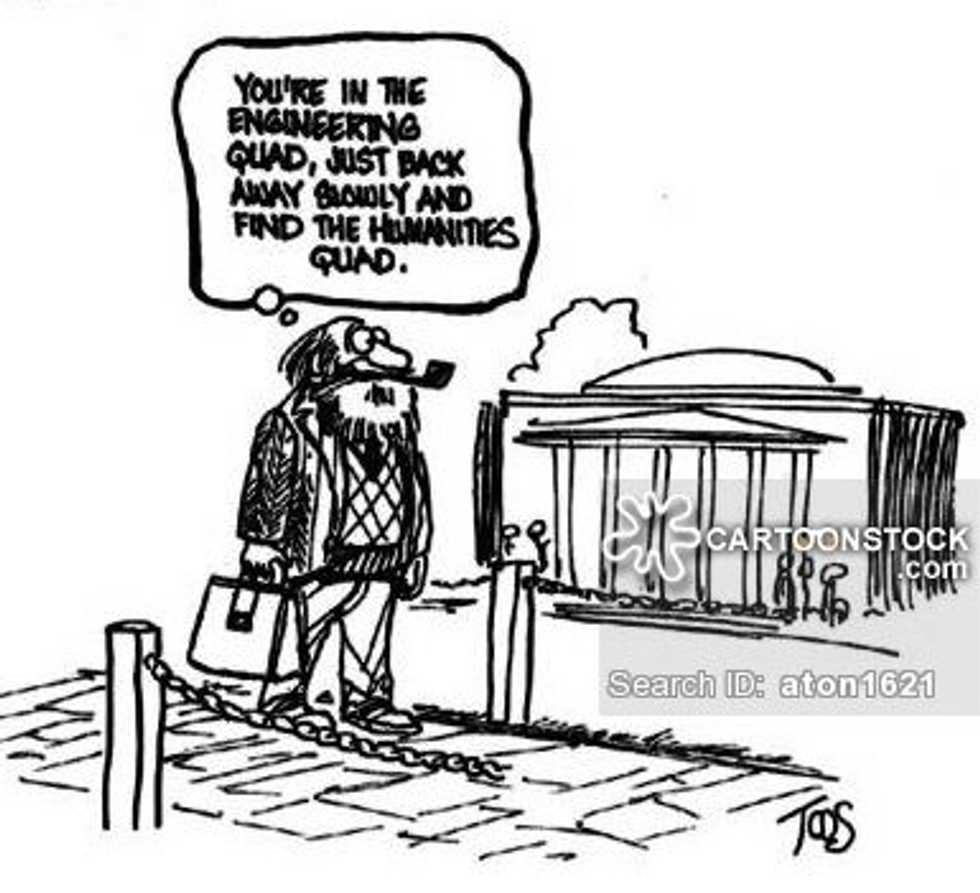
With this mindset, it’s not a surprise that so many students nowadays are now turning towards math and science. It’s a career path that promises many people big payouts for their suffering in college. Engineering, computer science—they’re viewed as more practical majors. Majors that will yield the best results, the fastest. But the engineering majors I’ve talked to? They don’t always enjoy the work they’re doing. Some do, and hats off to them. But some of my closest friends who are majoring in engineering wish they could be more creative, and often have natural talents that they want to cultivate. Why do we seek to suppress these talents? Why can’t we all reward ourselves sometime? Why can't I attain an English degree for journalism and take creative writing courses? Why do I have to work towards a goal of maximum productivity and practicality? I simply don't have to; I simply won't. And you don't have to, either—whether you're majoring in English or astrophysics or mechanical engineering. I refuse to believe that our lives must be work, work, work, work until you die. Pepper in some excitement for your life, if you so crave it. Sign up for the art class you’ve always wanted to take, even if it seems out of place among your hulking molecular biology classes and chemistry labs.
I know this mindset is a product of our society, a society in which practicality is viewed as much more…sustainable, I suppose. But we must remember to feed our souls, people. Not everything is based off of practicality—your happiness, for example.*The author would like to note that this article is more geared toward Princeton students specifically—not every college curriculum is designed like Princeton's and some students may have other demands that simply do not allow for wiggle room in their schedules.