
Whether formally or informally, groups are likely to form within any environment, and a zombie apocalypse is no different. Over the last couple of seasons, the main characters of the "Walking Dead" have banned together and formed a pseudo family in order to survive by any means necessary.
Groups are shaped not only by the people in them, but also by the human interactions that occur within the group and the context in which the group is operating. This group, like all groups, has a distinct personality that is influenced by both overt and covert forces.
The B.A.R.T. framework is a practical tool used to uncover dynamics relating to boundaries, authority, role, and task. These four elements can vary according to the nature and the culture of the group. Let’s see what we can unearth about the boundaries surrounding our favorite group of post-apocalyptic survivors.
Boundary
Boundary is the first element of the B.A.R.T. framework and can be characterized as observable and subjective measures people use to differentiate group members from outsiders (McCollum, 1990). So far, physical boundaries have played a crucial role in "The Walking Dead."
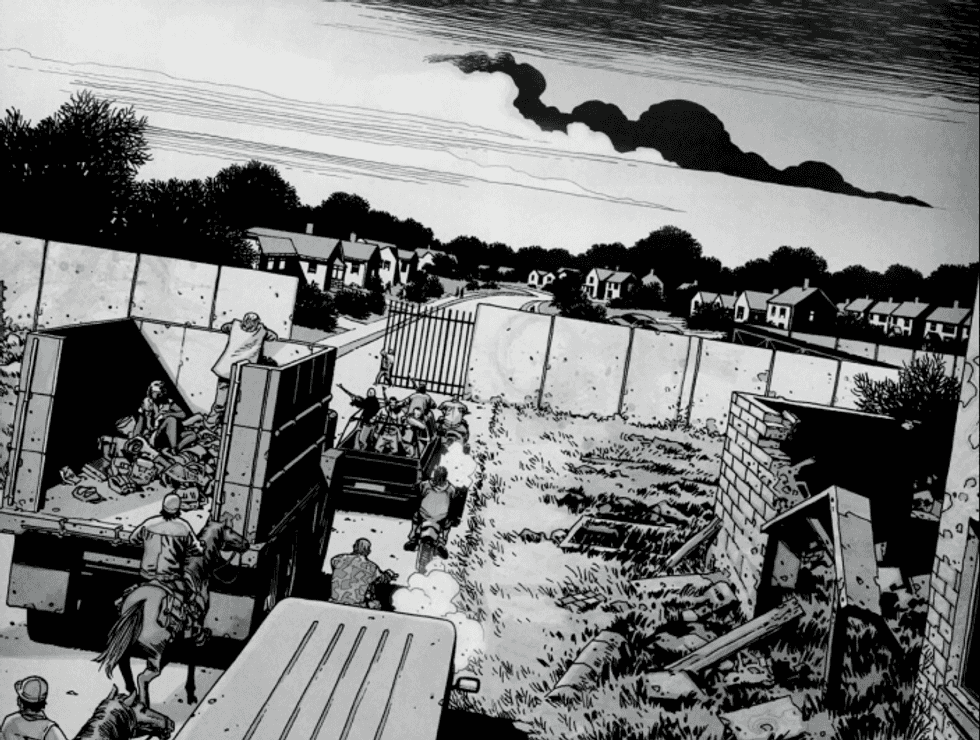
From the Greene Family Farm, to the Prison, and now the Alexandria Safe-Zone, Rick and his gang of fellow survivors have traveled from one place to another looking for a secure place to call home. Group boundaries can vary in permeability, which refers to how easy or difficult it is for non-members to enter the group’s space. Given the fortified walls surrounding Alexandria and the guards patrolling the perimeter, it is easy to make the case that this group’s physical boundaries are rather impermeable.
Due to past experiences, (e.g., the Governor trying to force them out of the Prison and slaughter them all in the process), our survivors are wary of outsiders and rightfully so. Therefore, as a group, they have made a tremendous effort to shore up the boundaries and ensure that they are able to focus on their primary task — survival. In defining their territory, they have created a clear understanding about who belongs and who doesn’t.
Observable boundaries are perhaps one of the greatest indicators that a collection of individuals is a group, since physical divisions can clearly distinguish one group from another. However, boundaries can also be more abstract and psychological in nature.
Psychological boundaries are the group’s subjective understanding of who belongs in the group and who doesn't. Rick’s band sees one another as more than just a collection of individuals who are dependent on each other for survival. They are family. For this crew, group membership is attained through action, which mainly takes the form of hand-to-hand combat.
The original settlers in Alexandria who had limited contact with the outside world since the epidemic began, had to prove themselves in battle before Rick and his gang truly accepted them as apart of their group. However, once they had, this psychological membership in the group led to a greater sense of belonging and identification with their fellow survivors in Alexandria, so much so that others (e.g., the Saviors) are able to identify group members even when there are no physical indications.
Choices about how the boundary is managed can have great implications for how well a group is able to complete its task, which in this case is survival. When boundaries are mismanaged, disaster can ensue. Friends get bitten and foes gain the upper hand. Therefore, it is incredibly important to know who belongs, since knowing who is friend and who is foe is a matter of life and death in this new order.
As we see in "The Walking Dead," boundaries are most effective when they are clearly specified, agreed upon, and adhered to. Keeping the boundaries rigid enough to protect the group from harm, yet permeable enough to accept positive influences from the external world will be a major key to our survivors’ success.