
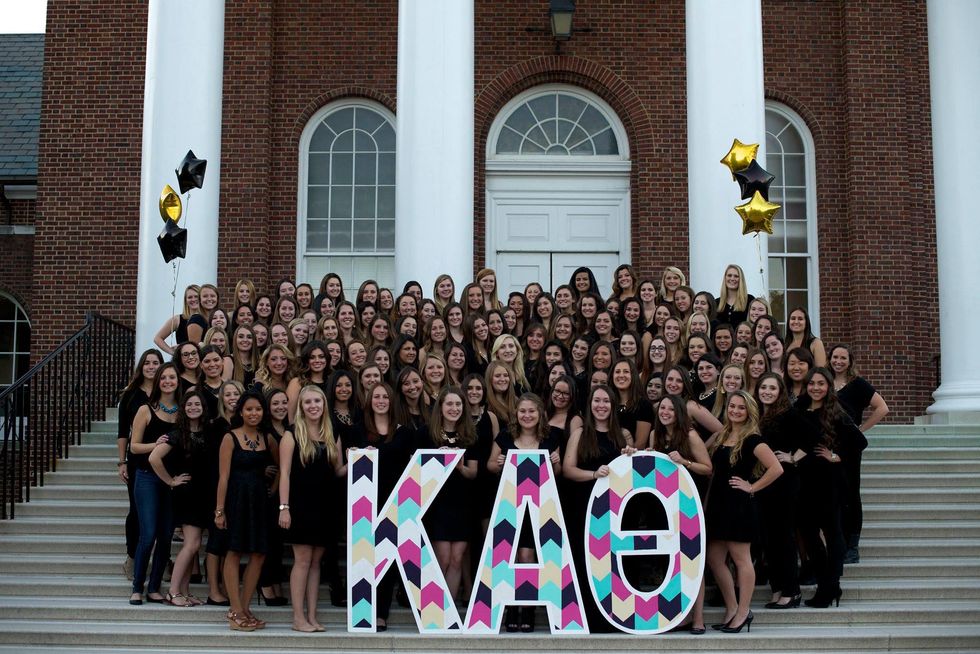
In the midst of girls jumping in heels cheering an upbeat tune all in sync, with smiles, and perfectly pin straight hair, there seemed to be no difference in the room. The room was packed tight with nearly 200 girls flaunting themselves. Although it seemed like girl flirting, it was sorority recruitment.
All I had to do was sell myself with charm, my above average GPA, and a good set of values. This thought quickly felt obscure as I took a glance around the room. I felt different in a room full of girls all in sync.
My whole life I have been forced to check the box “Latino/a, non-Caucasian" as if I am a label. This label does not represent my GPA, the activities I'm involved in, or my values.
The Greek System is traced back to the late 1700's when segregation was a social norm. Currently the Greek system can be seen as the modern day college experience, but the fundamentals of accepting who may join these societies can be uprooted in America's dark past.
Recently at the University of Oklahoma, the fraternity chapter Sigma Alpha Epsilon was banned for their racial chant that landed on social media. The chant, which featured racial slurs, mentioned there would never be an African member apart of the chapter.
The shocking allegations sparked a national controversy on whether or not Greek life has become a form of racism in practice. It made me question how Greek life is viewed at the University of Delaware.
As more minorities are seeking higher education than ever before, the diversity among higher education institutions is increasing.
Currently at the University of Delaware there are nearly 17,000 undergraduate students. Of these 17,000 students, 75.8 percent identify as “white." This leaves 24.5 percent left of the student body to identify as diverse.
The low diversity numbers within the undergraduate population is a straight reflection of different ethnicities being represented or misrepresented in popular organizations.
Junior Giancarlo Martinez member of the fraternity Zeta Beta Tau believes the majority of chapters on campus lack diversity, but inevitably changing.
Martinez describes their needs to be more time for a fully integrated diverse background in chapters on campus. “Seeing how ZBT has grown, personally it's getting to a point where it's more diverse then it was even a year ago."
Scott Mason, the Senior Associate Director of Student Organizations on campus has noticed an increase of Greek life presence according to an email statement, “It is now just short of 4,000, that is almost a 100 percent increase then where it was four years ago," said in an email statement.
Like most universities around the country, The University of Delaware does not track Greek membership by individual race. Mason said by visually looking at chapter membership he has seen growth in diversity.
The University of Delaware currently has 46 Greek organizations on campus. The Greek system is broken down into Multi-cultural Greek Congress, Panhellenic council, Interfraternity Council, and Special Interest. The Greek population is currently stated to consist 3,483 members, nearly 20 percent of the overall undergraduate population at the university.
The University is priding itself over a diverse initiative, but our overwhelming majority of students involved within Greek life have become a mirror reflection of an underwhelming presence of diversity on campus.
Junior, Kristi Thom, who identifies herself as Chinese American, debated joining an Asian multi-cultural organization before joining a Panhellenic chapter on campus. Thom, now a member of Alpha Epsilon Phi, remembers feeling out of place when first going through recruitment. “To me I wanted to break that stereotype, and the multi cultural ones you're automatically labeled," said Thom.
Thom initially felt uncomfortable joining her chapter, as she perceived it to be a pre-dominantly “Jewish" sorority. Although Thom realizes that a good number of her sisters identify as Jewish she also describes her chapter as, “really different, and more diverse than other sororities."
Students on campus who have a perceived notion of a lack of diversity within these social pre-dominantly white chapters have caused many minority students to seek an alternative option.
For students like, Ayana Gill, who serves as the Multi-cultural Greek Council President, and member of Alpha Kappa Alpha a multi-cultural organization her decision was based on values and historical significance. Currently there are 11 multi-cultural organizations on campus with the average size being five members, compared to the overall average Greek community size being 91 members.
Gill thinks the lack of members within the multi-cultural organizations is the admissions process. “I work at admissions and when it comes down to the heart of the matter there is an underlying issue that affects the Greek life here on the campus," said Gill.
Gill acknowledges the University is trying to take action on the lack of diversity within chapters on campus. “One of the biggest things going on now is the Multi-Cultural Greek congress is being pushed by the diversity initiative through the entire university campus to have a set numbers of students in that organizations with the possibility of becoming inactive if it doesn't."
Initiatives around the country have sparked since the racial incident at the University of Oklahoma.
Junior Jen Oler member of Chi Omega feels that diversity within Greek life is inevitably changing as society is becoming more diverse. Oler who identifies as half black and half white doesn't believe she ever felt uncomfortable throughout her recruitment process. “I never felt out of place, I was aware I was one of the few minorities, but never unwanted," said Oler.
At the University of Delaware there may be an acceptance of diversity, but when asking students to name 10 friends who identify as a minority within Greek life there was always a pause.
I am one of the few who considers themselves Hispanic in my own chapter, but I have never felt out of place. What we see in the media about Greek life around the country currently being portrayed as a race issue brings light to few chapters who have disrespected the letters they wear. The racist chant that has caught national attention is a wake up call that there is still ignorance.
The letters I wear represent an acceptance and that Greek life is inevitably changing to reflect a true representation of the many cultures around the country.
Checking the minority box makes me a statistic, but it does not represent my values, or my taste in music, or my love for Chipotle.














