


For this week’s installment of the Auteur Series, which consists of weekly profiles on great and important directors with the hope of encouraging viewers to seek out new movies, I will be looking at the great Russian artist from the second half of the Twentieth Century, Andrei Tarkovsky.
Background
Andrei Tarkovsky was born in the village of Zavrazhye in the USSR in 1932. His father was a famous poet, and Andrei uses several of his father’s poems in his films. He lived as a child during the Second World War, and some of his memories find their way into his 1975 film Mirror. After the war, Andrei studied music and art in school. After a few short films at school, Tarkovsky made his feature film Ivan’s Childhood in 1962 to much laudation. Though his films were never overtly political in nature, he still faced censorship issues from the authoritarian Soviet government. Around 1980 Tarkovsky left Russia never to return. He died in 1986 from lung cancer. Though he only made 7 feature length films, he is regularly considered one of the greatest directors of all time. Ingmar Bergman, another highly acclaimed director and major influence of Tarkovsky, said that “Tarkovsky for me is the greatest (director), the one who invented a new language, true to the nature of the film, as it captures life as a reflection, life as a dream.”
Favorite Films
Andrei Rublev- this historical epic follows the life of Andrei Rublev, one of the most famous icon painters in Russian history. His frescos helped to invigorate the spread of Christianity, which itself was an important unifying factor in morphing Russia into the nation state that we basically understand it as today. However, in Tarkovsky’s hands, the biopic is atypical and laced with enigmatic and poetic flourishes. For instance, the film opens with an apparently unrelated vignette about a man attempting to fly using a hot air balloon. This segment is beautiful, but it is only thematically related to Rublev’s life. Tarkovsky’s cinema is very enigmatic, allowing the audience to make meaning of what they are watching. By avoiding sermonizing or didactic statements with his craft, Tarkovsky has created a pure sheet of visual poetry that each viewer can decipher on his or her own. Personal and existential, Andrei Rublev is one of the greatest investigations into the artistic process.
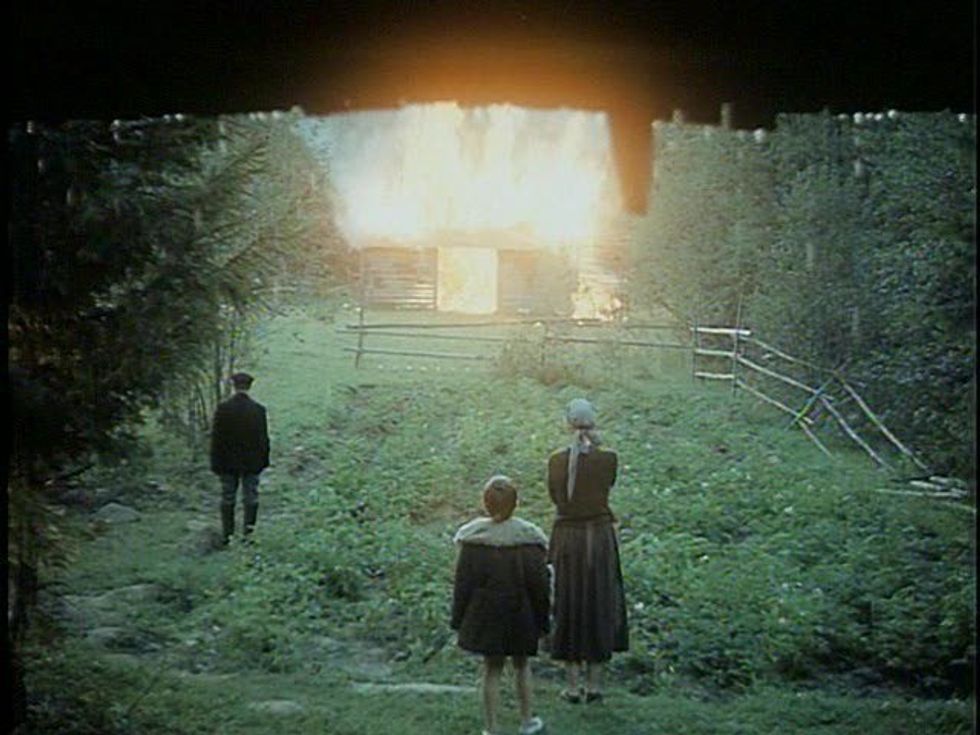
Mirror- Mirror is hard to explain because its story is told through images. If Tarkovsky had wanted to tell a story that could easily be transcribed to paper, he would have written a book. As best I can make out, however, it seems to be about a man in his forties dying of an unknown disease, and the mixing of his dreams, memories and aspirations, as well as the factual events occurring in Russian history circa 1940-1970. Its style has been likened to the stream of consciousness in literature, and it is an intensely personal and specific account of events. This film takes full advantage of the potential of film as an art form, blending the subjective with the objective and the spiritual with the corporeal to hallucinatory effect.
Stalker- Like Mirror, Stalker is one of my favorite movies of all time. In terms of story, it is about a man, a stalker, who is a guide that can lead people through the mythic “Zone.” The government has banned the populace from entering, but legend has it that in the Zone there is a room that can grant anyone their innermost desire. A scientist and a writer enlist the help of a stalker to find this fabled room. What ensues is terrific philosophical dialogue and some of the most breathtaking images ever put to film. The picture is as haunting as it is unexplainable. For me, only Tarkovsky has the ability to make me captivated at the sight of a door with a simple zoom in. I could never explain it well enough to do it justice, but I hope my words have intrigued you enough to find out for yourself what it's like.
Why You Should Watch Him
Tarkovsky is one of my absolute favorite filmmakers, and his work, to me, is the epitome of what it means for something to be “cinematic.” For many of my other favorite directors, I can give fairly lucid analyses of why I think their films are so great, but Tarkovsky always leaves me stumped. His films transcend base interpretations and touch something emotional and complex within me. To paraphrase Robert Bresson (who is a French filmmaker that was one of Tarkovsky’s chief influences), it is more important to feel a film than it is to understand a film. Tarkovsky’s films are raw material for my soul to grasp onto, visual poems to call my own (forgive the hyperbole, it just feels like an appropriate description). In interviews, Tarkovsky has related the idea that true emotion and understanding can only be experienced by the individual. This concept factors into his films being so enigmatic. He wants you to assign meaning to the images in his films. He doesn’t create films so much as tools for mediation that can allow the viewer to reflect and think about his life. More than anything, your relationship with a Tarkovsky film is wholly unto its own and is as unique as you are. And in watching one you may find it to be nowhere as profound as I am proclaiming it is, but I implore you to find out for yourself regardless. I think anyone who wants to take a moment to embrace the beauty of life should experience any of the films listed above.
















