

“After we were there a couple of weeks, a number of terrorist attacks happened. I saw a lot of school children who jumped out of school windows onto the concrete several stories below, rather than be shot by terrorists,” Johnston’s eyes went a shade lighter as he recalled this tragic moment in 1974.
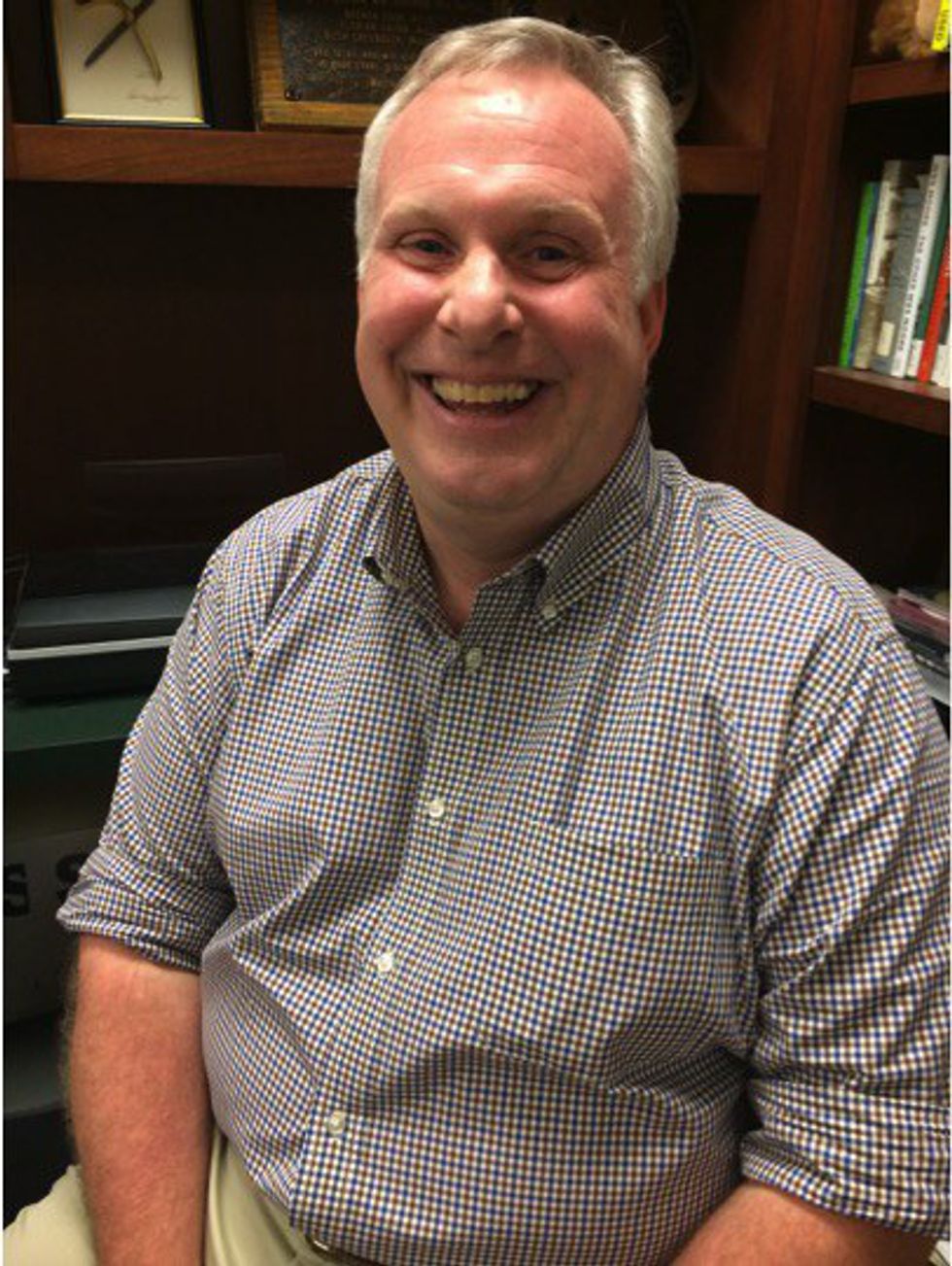
Johnston wore a nice dress shirt with khaki dress pants, and shook my hand with exceptional enthusiasm because I was there to talk with him about his life. When I requested a time and place to meet, Dr. Johnston insisted that we meet as soon as possible, and in the Stevenson Archives, which I later found to be Dr. Johnston’s favorite place, and I got an entire tour around the archives, as well as a glimpse at each glass-cased memory.
Dr. Glenn T. Johnston grew up in Staten Island, N.Y. with a childhood dream to become a soldier. He started out as a young, small, asthmatic, dyslexic, over -weight, uncoordinated child with a speech impediment that didn’t make Johnston’s dream seem even the slightest bit obtainable- that is until he was presented with the opportunity to go to Israel for a student exchange program; a program that was to last many months and undoubtedly changed Johnston’s life forever.
“I was going to be a classical musician; I was going to be a professional trumpet player. I was extremely good in sight reading, but I was totally lost at improvisation, and I realized I was never going to make it if I couldn’t improvise, so then came this huge experience in high school that fundamentally changed my life and it made me realize I wanted to become a counter-terrorist,” said Johnston.
Thirty kids went on this study abroad trip to Israel, and all of the members on the trip were supposed to be Christian kids; however, twenty-nine of them were actually Jewish, leaving Johnston the only Christian child on a trip whose purpose was to get Christians in the U.S to be supportive of Israel. Johnston stated that the trip made him see terrorism in a different light.“When you’re young, you just see the little kids being hurt and you just want to strike back, and as you get older you begin to realize that terrorists are using terror as a last resort, because everything they have tried hasn’t worked, and they are worried about their children too.”
Although Johnston has served as an U.S Army officer with the 2nd Armored Cavalry Regiment, seen death in both adults and children, patrolled, what was then, the German border for Soviet Russian attacks, and helped people escape across the German border while serving in the Cold War, Johnston holds the title of Stevenson University’s chair of humanities and public history, is an assistant professor of the university’s public history program, and acts as the university’s archivist and historian in our very own Greenspring Library.
“I have encountered quite a few quality teachers at Stevenson University, but one professor stands head and shoulders above the rest: Dr. Glenn T. Johnston,” said Michael MacFee, a student of Johnston.
Johnston has obtained a Ph.D. in Education, with a minor in history; a Master of Science in secondary education in social studies, a Masters of Arts in Middle Eastern studies, and has had multiple publications that are famously known for intertwining his history students and outside-of-school case studies, where students are not being taught history, but are rather doing history.
One of the first and most profound publications that Johnston and his students worked on was in May 2008, “Teenagers doing history out-of-school: an intrinsic case study of situated learning in history.”
Johnston, with the help of his students, has spent numerous years devoting doing history, as opposed to just teaching history, and in this progress came many more publications such as “We Ain’t No Heroes: the 112th Cavalry in World War II and The Polish Blue Army, Vol. 1, No.2”, as well as various presentations given at the Flag House Museum in Baltimore, Md., the Southwest Educational Research Association, and more. Johnston has received the Towson Times: “Person of the Year” in 2010, Outstanding Doctoral Student of the Year in 2004, , Educator of the Year, and an award presented to Johnston and East Aurora High School sophomores entitled “Voices from the Past: East Aurorans Killed in World War I.”
“I am extremely happy where I am… I love this institution; I love Stevenson, I love the people with whom I work, and I love teaching…. Scratch that, I love educating,” said Johnston
Four hours later, Johnston asked me to grab his desk chair and read a short excerpt regarding death and war. As I sat at his computer screen, I found that the story gripping and effective in educating, just as Johnston’s accounts of his life had been for me. I asked if he suffered from any disorders after seeing everything he had seen in his life. He smiled at me gently and said “I do not suffer from PTSD [Post-Traumatic-Stress Disorder] because I keep my past where it belongs, in the past… every day is an opportunity to learn, every day is another day to educate yourself, or someone else, why waste your time worrying about what is in the past when you can live in today.”