

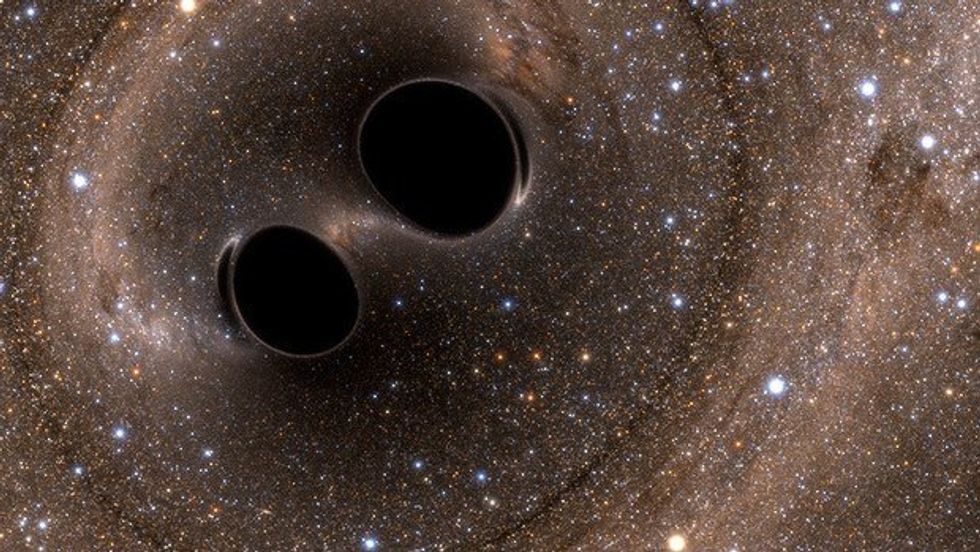
On September 14, 2015, at 5:51 a.m. EST, scientists discovered the first recorded ripples in the fabric of spacetime (spacetime unifies three spacial dimensions with one time dimension). These ripples, known as gravitational waves, are caused by cataclysmic events light-years away from Earth. The waves carry information about the nature of gravity and confirm the existence of black holes -- pockets in space where gravity is so dense that not even light can escape.
Kip Thorne, Caltech’s Professor of Theoretical Physics, says this event “is by far the most powerful explosion humans have ever detected except for the big bang.”
In 1915, Albert Einstein published his famous theory of general relativity which claims that gravity is the warping of spacetime caused by mass or energy. Just one year later, Einstein proposed that gravity can cause spacetime to “ripple” when massive objects move in certain ways. This point in history marks the beginning of the search for gravitational waves in our expanding universe.
The waves detected in September were caused by the collision of two black holes 29 and 36 times more massive than the sun. The collision is predicted to have occurred over 1.4 billion years ago, but the waves from the event passed by Earth just months ago. The black holes collided at half the speed of light and morphed into one, converting a part of their aggregate mass into energy (this is in accordance to Einstein’s revolutionary theory E=mc2). A “chirping” noise was heard as a result of the crashing black holes. The energy emitted from this conversion is what LIGO (the Laser Interferometer Gravitational-wave Observatory) detected as the first gravitational waves ever observed.
LIGO has observatories in Livingston, Louisiana and Hanford, Washington, in the United States and is funded by the National Science Foundation, or NSF. These locations were created and are currently operated by MIT and Caltech. LIGO uses two 4 kilometer long L-shaped detectors called interferometers to measure the minuscule stretching of space and ultimately, gravitational waves.
The waves were captured at both LIGO observatories with a mere 0.007-second delay between signals. The collision produced a remarkable and invisible catastrophe that solidifies Einstein’s precise accuracy of relativity and the existence of black holes in the universe. Following the detection, LIGO researchers published their findings to The Physical Review Letters.
“This observation beautifully describes Einstein’s theory of general relativity formulated 100 years ago and comprises the first test of the theory in strong gravitation,” says MIT’s Rainer Weiss.
Bruce Allen, a LIGO member at the Max Planck Institute for Gravitational Physics in Hanover, Germany, says, “before, you could argue in principle whether or not black holes exist, but now you can’t.”
LIGO’s first observing period ran from September 2015, through January 2016. During this time, there were two confirmed observations (September 12 and December 26) and one prospective candidate (October 12).
“This opens a new window on this vast population of stellar remnants that we know are out there but of which we have seen only a tiny fraction,” says Marc Kamionkowski, a theoretical astrophysicist at Johns Hopkins University.
“Our observation of gravitational waves accomplishes an ambitious goal set out over five decades ago to directly detect this elusive phenomenon and better understand the universe” says Caltech’s David H. Reitze, executive director of the LIGO Laboratory.
Gabriela González, professor of physics and astronomy at Louisiana State University says, “this detection is the beginning of a new era: The field of gravitational wave astronomy is now a reality.”