Multisensory displays pique the interest of the impressionable and the distracted, but also make a perfect coincidence for one with an analytic mind.
If anything can be original: an image. Once the gluttonous stream of creative writing stalls, a dam of visualization will appear. Using the "Theater And Its Double," a book by 20th Century French playwright Antonin Artaud, as an example, language can be pretty damning. Personal psychologies? Snore-inducing. Typical sayings, minus the intonations and other ways of manipulating language and whatnot? A bore.
Theatrics take shape in the installation of music, in order to extend the conflict, the possibilities. Artists can personalize or abstract a work beyond primetime cliché and the filtering of colorful verbosity.
With promotional videos being released since the 1960's (here is Pink Floyd's "See Emily Play" from 1967), obviously, the music video registers nothing new. There is also a (albeit thin) difference between, let us say, The Beatles' film "Hard Day's Night" and Beyoncé's visual album "Lemonade," because of the degree of acting.
Now the visual album has, and will continue to, set the precedent.
One may look to Kanye West's "Runaway" video (released in 2010, as a compliment to the acclaimed "My Beautiful Dark Twisted Fantasy") as the forbearer, at least for the last ten years, of this movement. And, as Kanye has proven that an album can have many reparations, the idea of art as human, it'd be intriguing to see an ever-changing video album.
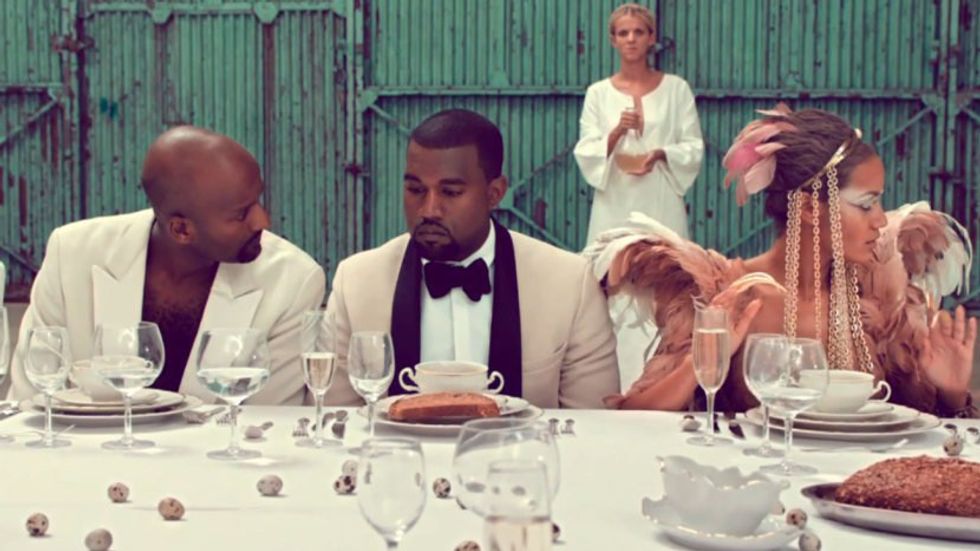
A scene from West's self-directed 2010 film "Runaway."
Yeah, the temporal "behind the scenes" revelations were cool as to how an album was being made, but how short-lived will the visual album be, if at all? Will the distracted generation grow to appreciate a full, non-adulterated showcasing of music, packaged within a 60 minute window?
I think of this transformation, from mere album into visual album, as a declaration for creatives, that have deemed much of the music industry as bastardized. Sure this is another way to profit off the masses, but also another way to make one come off as more uniquely skilled.
The background will service as a pinnacle for analyzing, as symbols and out-of-place workings will occupy one much more. In music, a feeling can never be simulated, but can be pimped by labels such as "genre-specific" songs, or backbones, if you will. Hour-long videos on top of music place the consumer in.
I feel as if this stands as an inverse of the traditional movie (with soundtrack incorporated). People are expecting the music, but the picture can't be an afterthought, since they are seemingly working interchangeably. The background moderates, equally, the aural and invisible ground. Sound and image share the stakes.
This whole introduction, so far, has acted as a linear, story-telling sewage of bare expression, as, for example, in Beyoncé's "Lemonade" film. But I personally can't wait until one artist disrupts that flow and tries to make the human calculus into something that can't be described.
The mechanical meshing of the senses is at work, while there will continue to be limitless ways to approach this newfound method of engagement. Objects can stand as metaphors, and it's so fixed within the confides of an album (one, almost stagnant, box), that attention cannot help but be demanded.
Maybe the physicality of albums has ended, but the abstraction has grown and outlasted all.