
In the past year the rulings of the Supreme Court have caused significant changes in American society. From declaring marriage equality a universal right to upholding the Affordable Care Act, the Supreme Court has become the most productive branch of government in creating widespread social change. Here is a list of the cases that might have a similar impact for the upcoming term:
Affirmative Action
Affirmative action has made its way to the SCOTUS once again. The case slated to be reconsidered is Fisher v. University of Texas at Austin. The plaintiff in this case is Abagail Fisher, who holds that her denial to the University of Texas at Austin was due to her race. Fisher v. University of Texas has already been considered by the court twice: once in 2009 and another time in 2013. Both times the court upheld the legality of the University of Texas’s consideration of race as a factor in admission. The rulings also upheld the previous court cases of University of California v. Bakkee and Grutter v. Bollinger, two cases which essentially abolished racial quotas but allowed consideration of race as means for admission.
Why you should care: This case is likely to affect affirmative action policies across the country, not just those used by schools which receive government funding. Things also look pretty glum for advocates of affirmative action, with the court in a 5-4 conservative to liberal split there is a possibility that affirmative action policies will be considered unconstitutional.
Voting Rights
The Supreme Court is set to hear Evenwel v. Abbott which is a case that is asking the question: who counts when drawing state district lines? The case comes out of Texas where some voters feel their voting rights are being diluted due to Texas’s policy of using the total population rather than just eligible voters when drawing its districting lines. Who don’t they want counted? Anyone who cannot vote--children, inmates, former felons who do not have full voting rights and probably most notably: non-citizen immigrants.
Why you should care: Although it is unlikely that the ruling on this case will affect congressional districts (the 14th amendment lays out a clear plan for that process), the outcome of this case could change state legislature districts across the country. If it is ruled that only eligible voters count in redistricting, it is likely that urban districts will lose in terms of representation. What’s the big deal? Fewer representatives for urban districts will probably translate into fewer representatives being Democrats and make it easier for Republicans to control state legislatures. Whether you think that is a good or a bad thing: it’s a thing that will have serious implications.
Abortion Rights
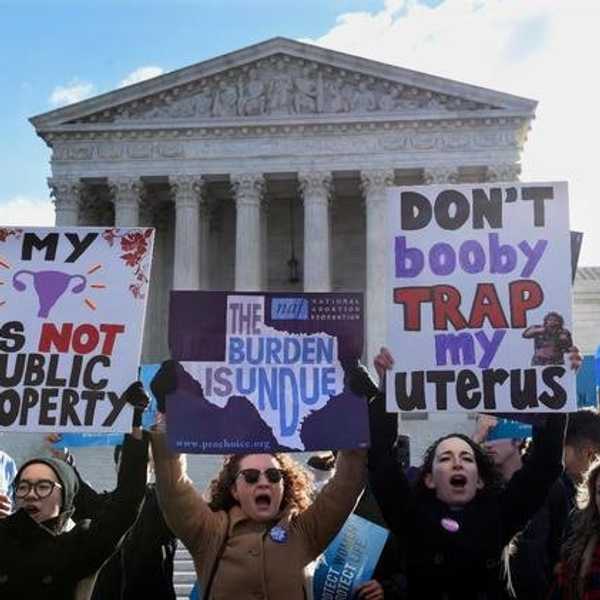
The case likely to be picked up by the court is Whole Woman’s Health v. Cole which deals with a Texas law that puts heavy restrictions on abortion centers. The law states that abortion providers must have admitting privileges at nearby hospitals and be up to the same standards as surgical centers to remain open. And so, half of the state's abortion clinics have been closed. Proponents of the law say they’re protecting women’s health while those who oppose it say its just an excuse to limit a women’s right to an abortion. If the court takes on the case (which many believe they will because they issued an order blocking the law until the court decided on whether or not to review it), they will consider it in the context of Planned Parenthood v. Casey which upheld the legality of abortion restrictions so long as they do not pose an undue burden on women trying to access the procedure. In essence, this case will consider the question: when do abortion restrictions go too far?
Why you should care: If you live in a state that places heavy restrictions on abortion, this one’s for you. The ruling in this case can either overturn those restrictions or allow them--and future restrictions like them--to remain in place.
Affordable Care Act
The court may hear the case Little Sisters of the Poor v. Burwell which deals with religious rights for nonprofits and the birth control mandate of the Affordable Care Act. Currently, thanks to Burwell v. Hobby Lobby Stores, Inc. “tightly held” corporations can opt out of the birth control mandate if their religions views conflict with contraception. Non-profit organizations, on the other hand, can be released from paying the mandate if they sign a piece of paper which transfers the burden of payment to a third party. The nuns of The Little Sisters of the Poor however, feel that signing this paper is forcing them to morally condone contraception and thus violating their freedom of religion. The 10th circuit Court of Appeals however disagrees, and ruled that freedom of religion does not protect groups from having to make statements “they would rather avoid.”
Why you should care: This is just another case part of the larger debate over religious rights. The ruling on this case could affect whether or not your employer has to cover your contraception plan. The implications could extend beyond this case and further ignite the debate over just how far religious freedom extends.