

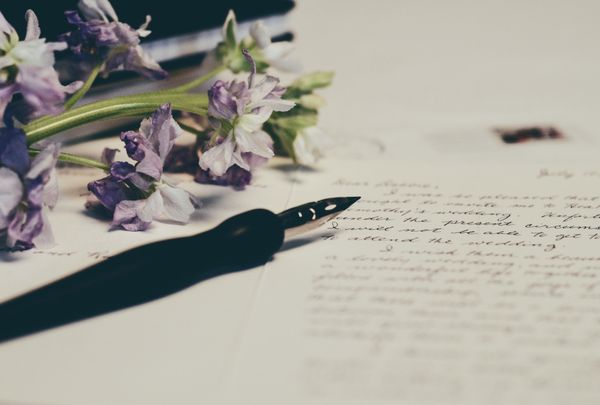

At the age of 25, I still cannot claim to be a master at the writing game but seeing as how most of the masters I’ve read talk as though they’re still beginners, after decades pouring at it, I suppose I shouldn’t complain. The added strain of going halfway through my 20s and still scrounging away at my undergraduate education only exasperates my feelings of ineptitude when it comes to embarking on my chosen vocation. Considering that most of the greats have either forsaken school altogether or have gone down their own disparate and, how shall we say—creative—paths towards education, I shouldn’t remark on that one either. The fact that I’m even writing these words at all, commenting on my following of my literary idols and how they’ve both helped and hindered me in my continued sojourn into this profession of writing comes off as wholly unnecessary to me, and more than a mite pretentious. But here I am scratching away at the scattered pages ex-library editions, screaming at the bug-ridden words of men and women who wouldn’t have given me the time of day had I not understood that we share the same fear of going unknown into that long goodnight.
If you want to become a writer you have to do two things: read and write. You read every single book you can pull off of the shelf, and you eat away at enough pages with the blue ink-stained words as to cause an environmental ruckus at the U.N. There is no compromise on this, and I learned that long before I landed on the solid decision in the 8th Grade that if anything I was going to be one of those hotshots who told stories. What I didn’t realize, however, was how high the price actually was.
If only somebody had told me.
Inside every dream job there’s a bit of dues paying, and as part of the exchange you carve out sizable amounts of your identity to give over to the words of other people who went before you. You have to eat and digest them, crave even more of their souls, in the hope that they can give birth to something worthwhile inside of you. For me it was the same old three-course meals at the beginning, a diet consisting of Robert Louis Stevenson, Edgar Allan Poe, and Mary Shelley—nobody gets a free pass at skipping over these golden members in my book. Between these cats and the low-rent pulpwood logs that poured into my eyeballs the wonders of Batman, the Fantastic Four, and the continuing tales of the Star Wars universe, I found that my appetites were to never find themselves vanquished in my lifetime. If I was to survive in this world I knew I had to find something more, something richer and something with more staying power, to sustain my everlasting flame.
One of my professors in college, a sharp and well-dressed man who came of Russian ancestry and hailed from the far off land of Seattle, Washington, broke the writing game down like this: “As a writer you digest the voices of all the writers you read. Even the great writers realize that for all the strength of their unique and booming-powerful voice, still they cannot be anything more than lesser imitations of the writers who came before them.” At first such a duo of sentences would have deflated my spirit entirely, but now I use them to inflate my main argument for continuing to figure out both myself and my cobbled-together imitations of a hundred different sopranos and altos.
I have spoken before about the shaping of my identity, about the necessity to accurately and succinctly define the parameters of who I am as a person of faith and love and life and joy and work. As far as I can ascertain such a definition cannot be reached, and for that I feel both a deep root of joy and a sharp pain of regret; joy for the fact that at last I have an answer, regret for not receiving an answer I could want or use in any profitable fashion. A part of that, I think, has to do with the job I picked, my zigzagged journey through education as a part of the training for that job, and the thousands upon thousands of words I’ve let slip through the mesh filters in my head, meant to siphon out the dreck and the mud and the bugs and the disease and the senseless nighttime news segments that don’t offer news so much as personal exposes on torture and pleasure intertwined. Nobody told me when I got into the sinkhole addiction of the printed page that all those voices I’ve been listening to would threaten to drown out my own voice and leave me high and dry when I needed it most; by the time I realized there was going to be a challenge it was bordering on the edge of too late.
My beginnings with the gods who led this lone disciple through to the Promised Land were simple enough, but neither Poe nor Shelley could keep me grounded forever and ever. I had to eventually pick up Flannery O’Conner, Ray Bradbury, Zora Neale Hurston, Jonathan Franzen, James Baldwin and William Shakespeare for good measure. If I was to be a lesser imitation of somebody I was going to pick out the ones I thought were the best, for personal reasons just as much as for attempting to impress others. Writers are if nothing else desperate people seeking the approval of others, and I speak from my own experience.
Seeing as I considered myself of noble Southern birth, the son of a mechanic-turned Baptist minister who drove into me all the spirit and charisma of the Mecklenburg red clay, I had no choice but to read the likes of O’Conner, Faulkner, Styron and Hamner. The humor wrapped inside Flannery O’Conner’s “Good Country People” was appropriately dark and twisted, with just enough in the way of Catholic parable to threaten me with eternal damnation if I didn’t take head. William Styron’s Sophie’s Choice gave unto me a narrator of similar birth and need, an aspiring writer who suffered the same lustful cravings as I both in love and in literary acclaim; the tales of woe threaded through the life of the woman only added to my need to redeem myself. With William Faulkner’s Yoknapatawpha County giving me perspective of the character of small towns and Earl Hamner’s Mountain family recalling ancestors from my own family tree I started to embark on new and exciting territory. There have been other writers of other backgrounds who speak to parts of my life not properly expressed by those strongly built Southern roots, but it was those roots themselves that directed me more than any space odyssey or beatnik poem. The walls to my house are concrete after all.
But for all the joy that comes of the words given me by these writers, still I find myself lost in their collective gaze. If I am but a lesser imitation of all these other cats, what use is the dog to come in and bark up the wrong tree? Those who’ve gone on before have already said what has to be said—what do I do but remain silent? And considering I’ve cobbled together so much from so many sources, how can I prove that I am in fact an original all by myself? Good god, but where do I go to address the worry that boils over into the craft that I cannot ever seem to master?
I am a writer. I write stuff, and when I can make it work I don’t feel quite so bad about the delirium of the day. But without a concrete direction, a path by which to cast off my voice and send it off into the sunset, I am not fully the way I am supposed to be. Tell me Faulkner, Hamner, and even Ellison and Vonnegut and Ginsberg and Wodehouse and Dickens—where do I go when my voice has lost its edge given the overindulgence of the words I ate at the all you can eat Barnes & Noble buffet?
Perhaps there’s no just cause to the fear and I’m going off my head a bit. And perhaps to create is to recreate the scene as I see it, because even if I’m not the first to talk about a particular day or a particular need, I am the first to see it with these eyes, hiding behind these glasses which are in desperate need of a new prescription.
I am a writer. I write stuff, and when I can make it work I don’t feel quite so bad about the delirium of the day. Falkner, Poe, and even Shelley got it. I’m just starting to get it myself, and it only took me until I hit 25 to pick up on it. Maybe my own journey was worth the wait in and of itself.
I may be a lesser imitation of all those cats who’ve gone on before, but this old dog still has a bark that needs to be let out when I go out into the yard and let the ink spill out onto the page. The culmination of all that has gone on ends with me, and I lay it down for those who come after me. It’s the grand scheme of the arts, that we continue the lifeblood of the human race and make that life just a little bit more enjoyable.
If only somebody had told me. It could have saved me some more time to reread that new Stephen King novel.

















