

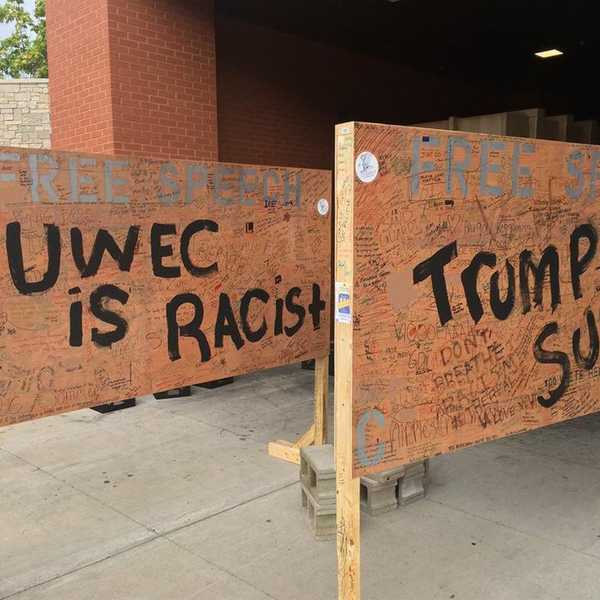
This past election was a huge reflection for the American people, as it taught us that some groups not only hate what others say, but will go to great lengths to censor those that oppose them. Whether or not these groups' messages are correct or not isn't the main focus here, what is the main focus is the ability to express those beliefs.
Last week, I wrote a defense for the Knights for Socialism group, a student group in the University of Central Florida that was ostracized by essentially every conservative blog and the mainstream media. First off, it's not like the university could do anything (they aren't a registered group), so the calls for action weren't going to do much quite honestly. Secondly, they do the rights to assemble and speak freely, no matter the subject (unless it's direct libel, I suppose).
The reactions ranged from good to bad. Some conservatives felt uncomfortable that I, as a conservative, defended a blatantly anti-conservative event (even though they couldn't enforce that). Some socialist students (including two officers of the KFS themselves) felt awkward too but they welcomed the unexpected defense in contrast to the negative press they received (although the president of KFS himself quickly blocked me on social media after that, for some reason).
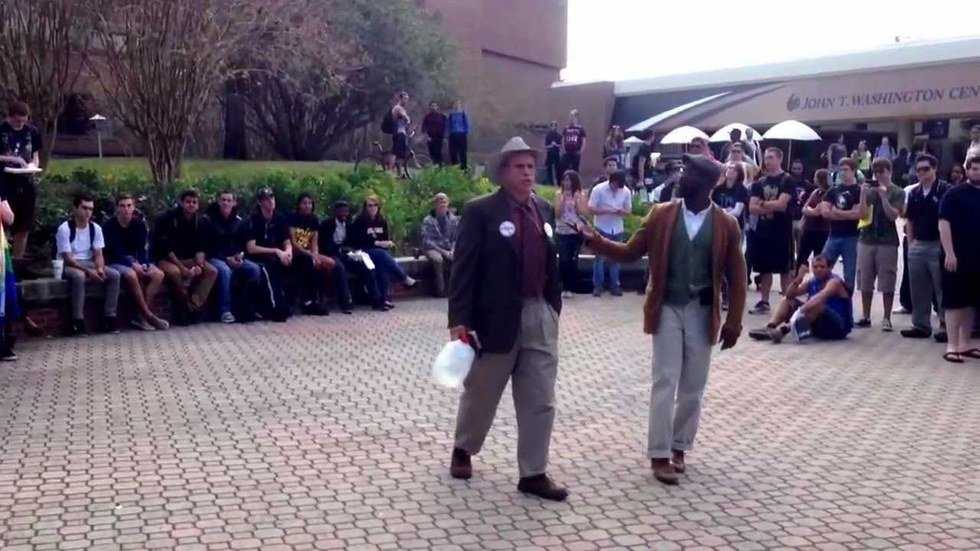
But the reaction from the critics was interesting, as they did keep saying that the KFS event was akin to hate speech. In textbook terminology, they might be correct. But it was a joke anyways, not an actual rule (at least it failed to be implemented). And this week on Facebook, it came up again. On a class page, somebody was complaining about a preacher group that camps outside of the UCF student union building. In past semesters, I have seen them, but this semester I haven't. Either way, I understand the complaints. I do think that the preachers have rights (as they are in a free speech zone), but I realized that I ran into the same dilemma as I did when first defending KFS.
Should hate speech be defended? By law, it is protected. But can this be changed? Is there a difference between threats (that are punishable by law) and hate speech? Aren't they the same? And this is where we must acknowledge the debate over hate speech.
For the defense of hate speech
Like I said earlier, hate speech is protected by law. During the last few decades, in the aftermath of the civil rights movement, there was a push to not only promote inclusion, but to actually end exclusion. A significant legal battle over this was R.A.V. v. City of St. Paul in 1992. In this case, a teenager was arrested for burning a cross on a black family's lawn. He was charged with violating a law against "fighting words" (in other words, legally defined hate speech). In short, he took the case to the Supreme Court, and he won because anti-hate speech laws were unconstitutional.
It is difficult to defend hate speech, because of the obvious reasons. But we must first establish that there is already a legal barrier in its' defense.
Secondly, the principle of freedom still stands. It counts for any and all opinions, as long as they don't threaten anyone. If a person hates a certain group, it is deplorable but they have the right to do so. It is impossible to legislate opinions. Just because we don't like them doesn't mean we can silence them for good.
Thirdly, you cannot regulate the mind of a person. Going back to point number two, a person has the rights to think and act, and even if we crackdown on actions, we cannot regulate what goes inside a persons' head. There is no guarantee to end hate speech.
Whether or not we agree with the message, the person, as an American, has the rights to express that message. And likewise, we have the rights to express disagreement, but we have no rights to silence them. Especially if they occur in so-called "free speech zones".
Against hate speech
The law stems from the will of the people. Although this in turn advocates mob rule, the laws are ultimately decided by representatives of the people. Should the people demand a law against hate speech, it will be up to a democratic process to determine the inevitable passing of such a law. That is a consequence of democracy; should the people will it, it will eventually pass
Secondly, isn't hate speech the same as a threat? Hate speech makes people feel unwelcome and afraid. There are laws against threatening language, so now we water down the debate to whether or not hate speech is threatening, and the arguments to define it as such are compelling (it makes people feel uneasy over their environment).
Thirdly, we must remember that a consequence of hate speech is the ability to radicalize people. The KKK took strong hold in the aftermath of the Civil War, although they were defended by the First Amendment, it led to a massive campaign against blacks and their white allies that took many lives. It is very possible that if we let hate speech re-emerge, we might head on that way.
Conclusion
I already picked my side, whether or not I like it. Hopefully, this will give a better insight into a modern issue, that goes from the wider view of the nation down to the preachers in front of student union. I wrote this in a way where I tried to keep the theme of campus speech consistent, but it seems that if it applies to a university campus, then it applies everywhere else.

















