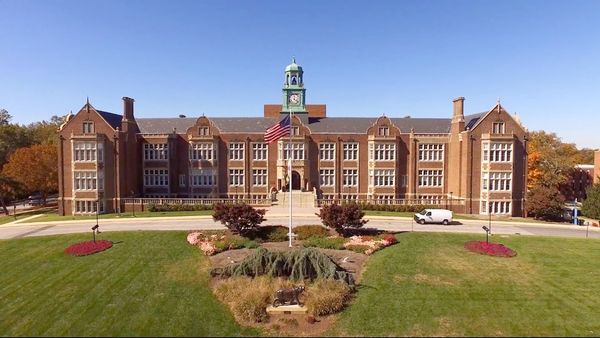
As junior Daniel Smith walked down the barren, freshly cleaned hallways of Ridge Mont High School to schedule his senior year courses, he looked back on his high school career thus far. According to Daniel, he has had a pretty successful life in school. Accruing good grades in all his classes and excelling on the school’s football team as a defensive end, everything seemed to be alright in his world. He then reached the rather decorated door of his guidance counselor. This could be the beginning of the rest of his life. After a half an hour of talking and discussing with his counselor about his requirements for graduation, Daniel finally emerged from the office with a quasi-disappointed look on his face. He was told that he neglected to take a required fine arts course and now has to take one in order to graduate. Daniel was well aware of his lack of participation in the arts because he believed that it was in his best interest to focus on more important academic courses. He could not tell if this was fair or not.
What are the fine arts and why have they become an issue in the context of education? The fine arts are parts of life that generally call for highly advanced methods and skills. They can refer to music, painting, and sculpture, and are presently described as anything that takes skill to do. For many years, it has been the standard for schools and universities to allow students to enroll in courses that involve the fine arts. Recently, many of these educational establishments education have decided to make it a requirement to take and pass a fine arts course in order to graduate. This has created some controversy over time. Two sides on the issue of a fine arts requirement have come about, but they may have more in common than one might think.
For the people who support a fine arts requirement, let us call them “Art Supporters." Much of their beliefs revolve around the notion that the fine arts give various benefits to individual students. One opinion article by Robert Floyd makes the statement that “every student benefits from fine arts courses, even when their future career successes are outside of music, acting, dance or art." This is one of the primary reasons why Art Supporters want such requirements. The arts teach students how to be creative and thoughtful when given a certain task in school in any situation. In fact, many big advocates talk about how the fine arts add to the imagination and ingenuity of many students. They argue that art has a form of visual literacy that allows students to become better-rounded because they can automatically see what they have created. It changes education from being theoretical to something more practical. To them, the fine arts teach resourcefulness, cleverness, ingenuity, and it is all because they keep the wellbeing of the students in mind.
One thing that Art Supporters want to reiterate is that even though most school systems have a fine arts requirement, they still treat them as extracurricular activities. In a journal article, David Oxtoby explains that the difference between extracurricular and curricular activities is hard for people to comprehend by saying, “It is true that the line between the curricular and the extracurricular is not always sharp; the same student may sing in the chamber choir (curricular) and in a student-organized a cappella singing group (extracurricular)." Art Supporters make it clear that not only should the fine arts be required, but also looked upon as equal to classes such as science or math. They back up this case by saying that most of the students who do participate in the arts are the most passionate and eager of learners and should be given the privilege to enroll in them. So, according to Art Supporters, not only do the fine arts help students expand their imagination and creativity, but they also attract the attention of fervent and shining students who want do become better people.
There are, of course, viewpoints that contrast with those of the Art Supporters. The people who have these differing opinions, let us refer to them as “the Art Opposition," believe that while there are fine lines between extracurricular and curricular activities, they should not interfere with a student’s tastes and preferences. One article I have read on the subject says that although it may be a cliché, you can tell which students are the “jocks” and which are the “artists." The author offers the idea that yes, students can have their minds on a lot of subjects they enjoy, but they won’t care as much when they are forced to take them. Some students are not as talented as others so they might become discouraged in an environment that is supposed to be uplifting in their eyes.
Even though they believe that the fine arts offer more discouragement than encouragement, the Art Opposition does agree that there is an association between students’ test scores and their involvement in the arts. Ann Hulbert from The New York Times states, “There is indeed a correlation between, for example, how many years students spend in arts classes and their SAT scores; more art, higher scores…but that doesn’t prove that it’s the added exposure to the arts that boosts verbal or math performance." A common phrase in statistics is: “association does not mean causation.” Incorporating that with the Art Opposition, just because many results say that students have high test scores and happen to take art courses does not mean that one caused the other. Hulbert makes the argument that students from all walks of life take art courses. Whether it is because they are actually talented or they are just smart in general and can learn quickly, art courses are one of many subjects that students can use as an outlet for creativity. The Art Opposition believes that forcing students into an art class in order to graduate can suppress and even discourage the creativity and imagination of those who wish to take their prospects elsewhere.
Can this feud between the Art Supporters and the Art Opposition be solved? Or is the idea of a fine arts requirement too splitting? The answers to both of these questions can actually stem from the core concepts of both opposing sides. Both support the learning and education of students, and both sides have each student’s interests in mind. Each side wants everyone to succeed in life. If a school has a fine arts requirement, why not allow students to also take extra courses that are not related to the arts like science? If there is not a fine arts requirement, why not allow students to get an extra distinction on their diploma for taking additional art classes?
Daniel’s senior year came and went. Even though he was required to take only one fine arts course to graduate, he decided to take an extra course in chemistry, the subject he was passionate about. He decided that one or two art classes would not kill him and taking an extra course in what he wanted to study would give him an added distinction on his diploma. He knew that the school has his best interest in mind and respected him to make a decision on his own alongside the art requirement. It is all a matter of perspective.