CAUTION: SPOILERS ABOARD.
The long-awaited sequel to Disney/Pixar’s 2003 film "Finding Nemo" just opened its theater doors on Friday to piles upon piles of families, young adults, and generally favorable reviews. Although many of the beloved characters from the original movie make brief reappearances (namely, Squirt and Crush the turtles, Mr. Ray the manta ray, and of course Dory, Marlin, and Nemo), "Finding Dory" has a very different feel to it than "Finding Nemo," so much so that it could almost function as a stand-alone film.
But I am not here to review this movie, I am not here to discuss the politics of Hollywood, I am not here to talk about the quality of writing or animation or sound design or any of that. Today, I want to address something very different, something I haven’t seen anyone else mention yet, and something that deserves much more press time and media coverage than it is currently getting. I want to talk about mental illness representation.
We’ve seen Disney and Disney/Pixar address this topic before. Many have argued that Elsa’s character from the 2013 smash hit "Frozen" was representative of those suffering from depression, bipolar disorder, and other mental illnesses. In last year’s summer blockbuster "Inside Out," we literally got inside the mind of 11-year-old Riley, who was struggling with mental and emotional instability as a result of chemical imbalances in her brain. But this time around, things are a little different. For the first time in Disney/Pixar history, "Finding Dory" stars an explicitly neurodivergent character.
Dory, as we all know, suffers from short-term memory loss, and much of the movie explores the lifelong struggles she has had with it— physically, socially, and emotionally. Dory often forgets where she is, who she’s with, and what she’s supposed to be doing at any given time. She has a hard time making friends, because she forgets everything about them within seconds, and most of the other sea creatures don’t have the patience to put up with her for longer than a few minutes at a time. Since she can never remember where she’s going or why she’s going there, she has a hard time taking directions from people, and the movie actually shows her having full-blown anxiety attacks at the realization that she’s lost. Hyperventilation, confusion, derealization, emotional distress—i t was all there.
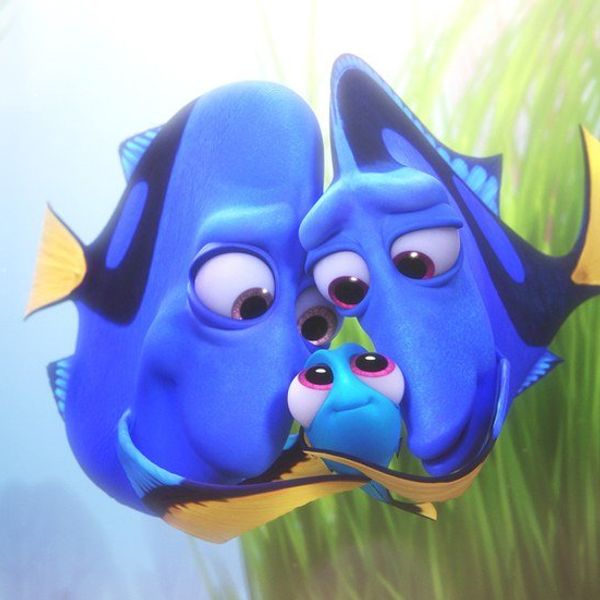
The most profound scene in the entire movie, however, was when Dory was finally reunited with her parents. She breaks down into tears and apologizes profusely for losing them, for always forgetting. And they hold her and tell her that it’s okay, everything is okay, it’s not her fault, everything is going to be okay. Dory’s parents believed in her when no one else did, they gave her a chance when no one else would.
I was expecting the film to be emotional. I came into the theater wearing H2O-proof liquid eyeliner, fully prepared to cry. But I was not prepared to see an accurate representation of mental illness. I was not prepared to see Dory’s parents reacting to her and her illness in such a positive way.
All in all, this movie is exactly the kind of representation of moral implication that every child and every parent needs to see. Mental illness and neurodivergence is never the fault of the patient, and if all parents had the same patience, understanding, and unconditional love for their sick child as Dory’s parents had for her—if everyone had that same kind of acceptance for the mentally ill— maybe then, the mental illness epidemic of recent years would finally begin to subside.