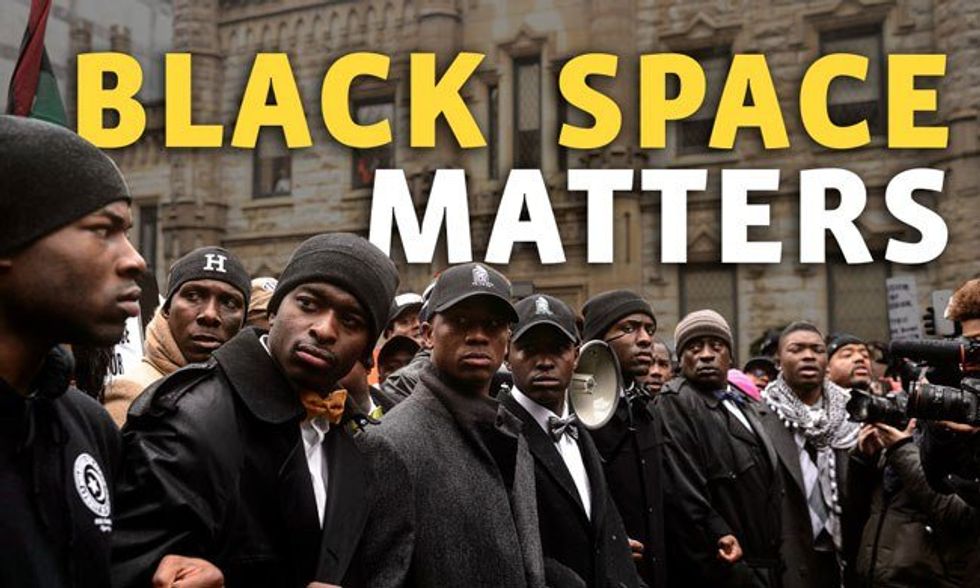
Well, it's that time of year. Martin Luther King Jr. Day was a little over a week ago, and Black History Month begins in less than a week. If you've been anywhere near Facebook or Twitter in the last few days, you have seen the controversy centered around #OscarsSoWhite, a hashtag that is drawing attention to lack of diversity in film awards and Hollywood, in general. But out of this controversy came an interview from Stacy Dash, a former actress, what many may call, an "Uncle Tom". In an interview with FOX & Friends, Dash stated, "...there shouldn’t be a Black History Month. You know, we’re Americans. Period. That’s it.” Back up. Wait a minute. A Black woman just said we shouldn't have Black History month because "we're Americans"? Interesting. Now let's take a moment to enlighten this sister on why Black spaces are necessary.
*gathers thoughts and channels ancestors*
Before the ships of slave traders and colonialists arrived on the coasts of Western Africa, African people lived a civilized, socially and technologically advanced life. The continent of Africa was home to thousands of very diverse tribes, with even more languages to accompany them. But in the fifteenth century, many of the African people, mostly from Western Africa, were sold and loaded onto the cargo ships of their captors. They then faced an unimaginable journey of terror that spread them to all of the New World, and from then on, to be black, to be of any color other than white, was a crime.
Fast forward to the 20th century: blacks are "free" citizens and every right that their white counterparts do...nope. Even in the post-slavery era, Black Americans were ill-treated, under-served, under-educated, and looked down upon. They were not permitted to take pleasure in the amenities of America as many white folks did, at least without the price of their life. They were simply not allowed. They'd had enough, and they figured if the white people don't want them there, black people would just create their own spaces, and they did. Even before this point in time, historically Black universities were popping up across the nation, along with Black sororities and fraternities to cater to the needs of the students and the Black community. And then in the year of 1926, Cater G. Woodson came along with the idea of have a "Negro History Week" in February, which served as the father to Black History Month.
Ever since then, Black History Month has been attacked by people who simply do not understand. They do not understand that these "Black Spaces" are needed. They are needed because only a small fraction of Black history is taught in the general education curriculum, and even then, it is often centered around the token Black figures, Martin Luther King Jr., Rosa Parks, and Fredrick Douglas, the peaceful Negros that America "loves". American students graduate high school expected to know everything about White America, but know mere misconceptions about Black History, riddled with the respectability of white supremacy.
The racial inequalities plaguing the world, including America, have made it even more apparent why these spaces are necessary. When minority groups are not welcomed by the majority population, they create their own. Look at any major city. Every city has areas that are dedicated to, and populated by, certain cultures that just weren't accepted by White America. People of Italian and Asian cultures have theirs, but let a Black space be created and all of a sudden, segregation is back. This is even true on our college campuses. There are organizations to uplift women, the LGBT+ community, Hispanic cultures, but when an organization arises to celebrate blackness, it is often frowned upon? This can especially be seen in the countless protests around the country, even in South Carolina, that followed the #ConcernedStudent1950 protests at the University of Missouri.
I say all of this to say that #BlackLivesMatter. The art, history, accomplishments, beauty, and perseverance of the African Diaspora culture, all matter. They already matter to Black America, but when will they be rewritten to be included in the story of America?