
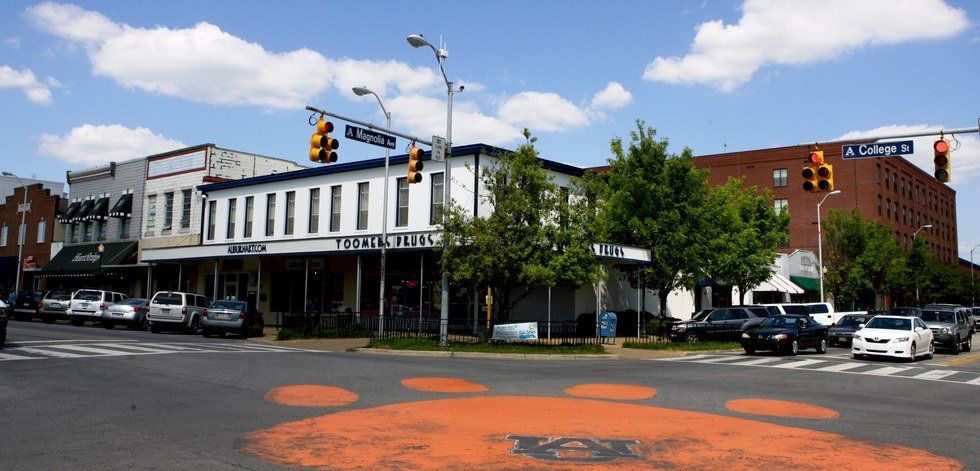
Inching forward toward a development agreement approval and design finalization is the mixed use building proposed for the University Chevron property on north college st in downtown auburn. Deemed as “191 College,” the building is to be seven stories tall and house first floor retail with student apartments above. In addition to its mixed of uses, the complex will feature structured parking, community center with study rooms, and a rooftop pool.
At a recent committee of the whole meeting with the Auburn City Council, construction concerns were raised in regards to traffic and pedestrian safety. The developer is requesting closures of all sidewalks adjacent to his property, as well as a two feet reduction in lane width on Glenn Ave. in order to have access to the building’s north facade. The council seemed decided on the fact that the development agreement would be amended to possibly require the sidewalk to remain open under structured scaffolding during construction times. The Council is adamant that pedestrian access in this crucial corner of downtown remain open considering the high foot traffic numbers in this area. The developer evoked that this project most likely will be delayed to start next summer, and the council is set to decide on this agreement at the next committee of the whole meeting on May 17.
I am excited to see this property become redeveloped into a mixed use urban fashion, but I believe the manner in which it has been presented is far from what Auburn deserves in regards to architectural integrity. There seems to be this notion, given the extremely high value of land parcels in downtown Auburn, that the manner in which a developer delivers a proposal is the only way a project is feasibly possible. I challenge that notion. Some of the main critiques of this development proposal is that its height will block the view of Samford Hall as one approaches town on N. College Street and its facades lack all kinds of architectural elements that make buildings like this more “palatable.”
Here are two proposals that attempt to solve those issues, without faltering on budget and unit count. The structure currently shows a central courtyard that spans the seven-story depth of the building. This courtyard is indeed a void of interior space that holds no structure or income-producing material. Imagine that void of space being reallocated to the exterior east facade of the building as it faces N. College Street. This would step the east side of the building back around 40 feet after it rises to approximately two or three stories. This method would reopen the sight-line to Samford Hall and not alter the familiarity of Auburn's downtown skyline as one approaches the city center on N. College Street. It would also generate an open-air terrace that overlooks a bustling downtown intersection and replace the coldness of the seven-story deep interior courtyard.
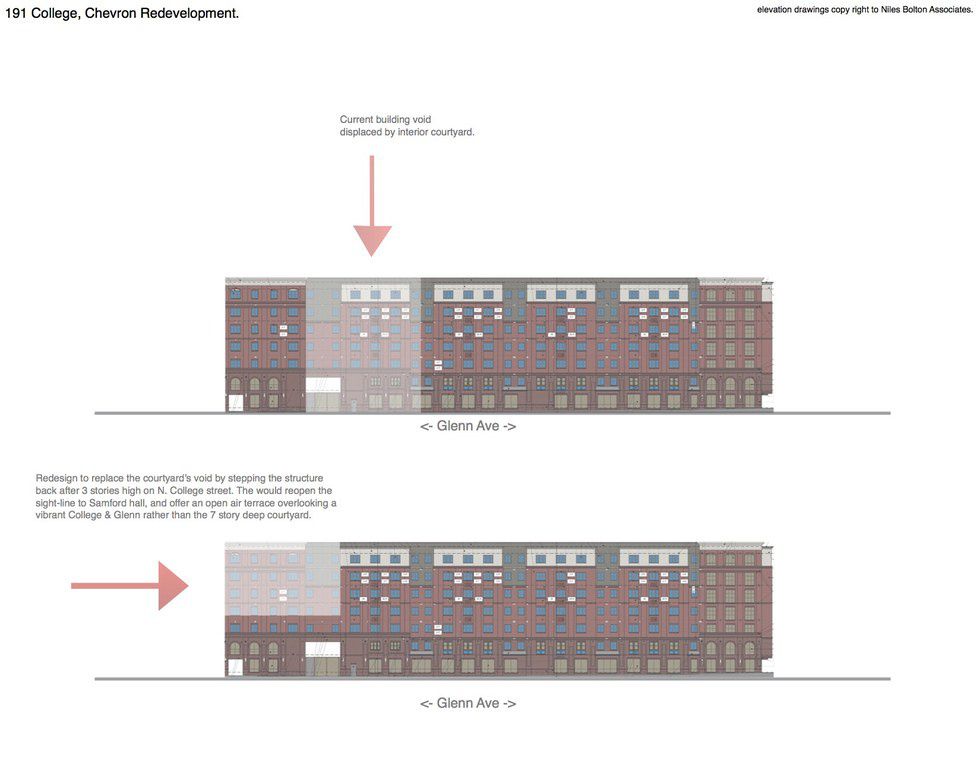
In terms of architectural detail, the city's ordinance that requires an 80% brick facade coverage is a burden to a development like this rather than an aide. It is in my opinion that the 80 percent brick facade coverage requirement makes sense for buildings similar in size to the ones in downtown Auburn today, but as new multi-story mixed-use properties are coming on the line, that ordinance may need to be adjusted relative to the mass of these structures. It is my opinion that an excessive amount of brick on a facade as large as this one makes the building appear larger that it actually is. As the building rises, I believe that the facade should be broken up with different materials that would flatten the building less, and make it appear more interesting.
If the budget allows, I think balconies on exterior facing units are absolutely needed to raise the value of the units themselves as well as generate a lively atmosphere from the street instead of the soulless flat facade of reflective windows.
It is one thing to oppose development because of the distrust of the developer, but it is another to welcome development by lightening developer’s hands and offering them new ideas that may have never have reached the drawing board. Perhaps through an architectural advisory committee? I believe prospects like the ones I have offered here are one’s that will not only aide the value of new developments, but the city as a whole. Those are my final thoughts, feel free to disagree.