
Within the last year, I have stated that I am a feminist a few times while I am casually talking with any number of people and I seem get the same reaction: rolled eyes, a deep sigh, and the dreaded look of "gimme a break."
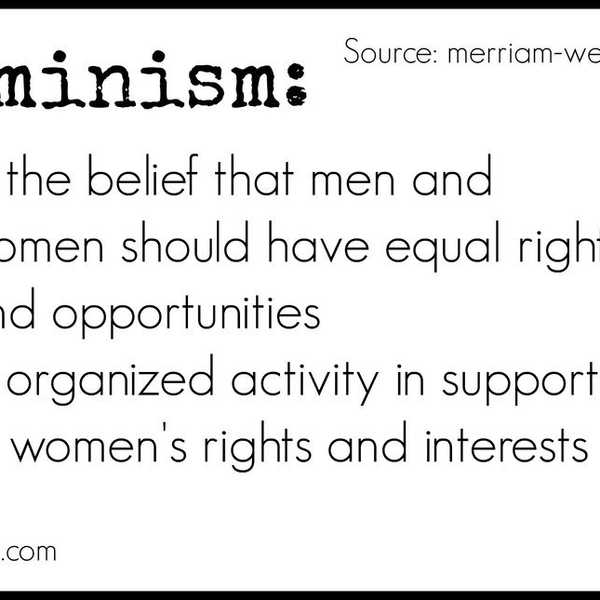
But let’s clear the air here: “Feminism” does not mean woman vs. man nor that women are the superior gender. According to the Merriam-Webster dictionary, Feminism is “the belief that men and women should have equal rights and opportunities,” the key word within this definition being and—women and men should have equal rights and opportunities, I cannot stress "and" enough. Upon discussing my stance on feminism, on several occasions I feel instantly judged and placed in to a category where it is assumed that I am an angry woman who will grow old with 21 cats and hates men; this could not be further from the truth (I'm much more of a dog person, FYI). In all seriousness, the word "feminism" has been tainted with anger and stereotypes that shadow those who proclaim their support for it.
So here's the question I get asked a lot: If feminism fights for equality for both men and women, why is the name partial to only women? Why not be an "equalist"?
The answer has a lot to do with history: the idea of feminism arose in the early 19-20th centuries and from there generated support. The original purpose of the movement was to bring women up to the same political, economic, and social status as men. Life is not a philosphy class where you have to pick one ideal and defend it. Under the definition given above, I stand as both an "equalist" and a feminist. Although different names, both serve a purpose to offer equal opportunity and status to both men and women.
No, this isn't the 1920s: women are, for the most part (in the United States), pretty equal with men. However, some issues are still present today. Just one example: derogatory usage of the words such as, "b*tch" and "p*ssy" are used to describe a weak individual. The issue? These "weak" descriptions are derived from women; where are the words that describe weakness that are derived from men in the popular media?
Now, I am not saying that men have not faced inequality at all, and this definitely should not be a game of "who has faced the most inequality." Instead of pointing fingers and focusing on what happened years ago; why not focus on the now? Learn from the past, yes, but don't dwell on it. Move forward and contribute to equality in the present.
So am I an "equalist"? Yes. Am I a "feminist"? Another yes. All I'm asking for is continuous strides towards equality.