
This week's topic combines two, usually totally separate, favorite topics of mine: feminism and death. An unlikely pairing, but one that in light of recent events needs to be discussed in tandem.
You likely have heard of the term "euthanasia," also known as assisted suicide, physician-assisted suicide, doctor-assisted dying, and more loosely termed mercy killing, means to take a deliberate action with the express intention of ending a life to relieve an intractable (persistent, unstoppable) suffering. Some interpret euthanasia as the practice of ending a life in a painless manner. Many disagree with this interpretation, because it needs to include a reference to intractable suffering.
In the majority of countries, euthanasia, or assisted suicide, is against the law, but as of late the debate about whether or not to legalize it has been making its way through many political conversations across the globe. According to the National Health Service (NHS) in the U.K., it is illegal to help somebody kill themselves, regardless of circumstances. As of October 2015 however, human euthanasia is legal in the Netherlands, Belgium, Ireland, Colombia, and Luxembourg. Assisted suicide is legal in Switzerland, Germany, Japan, Albania, Canada and in the U.S. states of Washington, Oregon, Vermont, New Mexico, Montana, and California (effective Jan. 1, 2016).
The data available on the subject of euthanasia, which is limited due to its relatively scarce legality, indicates in every instance that women are choosing euthanasia at a much higher rate than men. Men and women were almost equally represented in the Oregon cases of euthanasia, for example, but women were 2.5 times more likely to seek Kevorkian for euthanasia than men, and since doctors and analysts have very little data on the subject, what this gender gap means or says about how gender effects this decision is left open to interpretation.
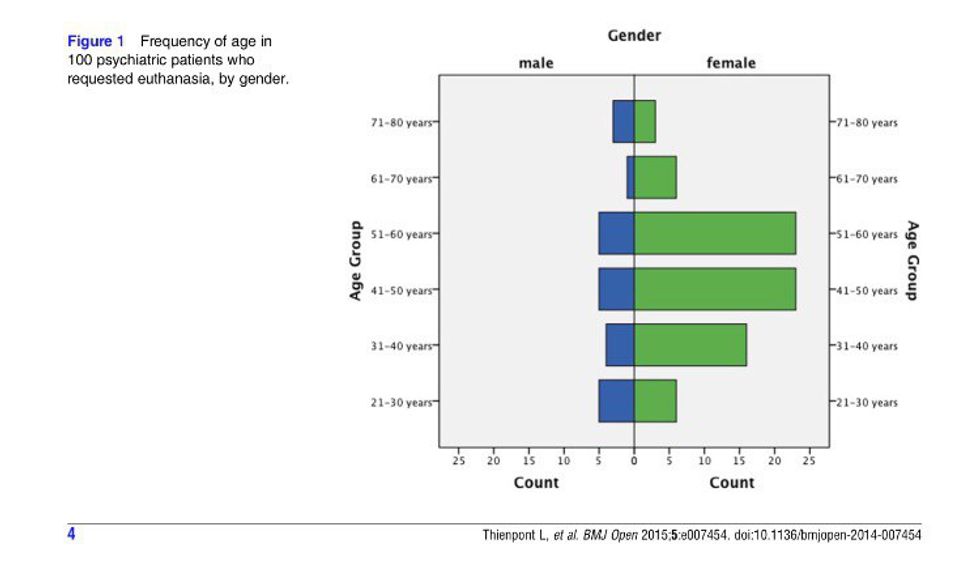
This high representation of women in euthanasia cases is often spoken of as a "disturbing" trend, with many professionals in the industry saying things like, "The factors that made women, particularly older women, more vulnerable to becoming victims of euthanasia..." This is a predictable and understandable reaction given what is known about the euthanasia experience, U.S. mortality data and the low suicide rate in women.
However, the biases implicit here become clear when you see that while it is very, very obvious in every study out there that women are choosing to be euthanized more, I only found one study that even bothered to address why that might be happening to women. This is also the only study which also took their questions and then actually asked these women why they were choosing it more instead of just throwing up their hands and saying, "It sure is a disturbing trend that more women are choosing it..." or calling them "victims of euthanasia," which not only isn't helpful but actually makes no sense. When we view the raw data, the interviews conducted with those about to choose to be euthanized, next to the biased interpretations of the results of such studies, this point becomes even more clear.
Using coded words such as "vulnerable" and "victims" in the context of a discussion about women and euthanasia is strange since by nature euthanasia is a medical decision, a choice. A choice that inherently requires the chooser to have the agency to freely pick to be euthanized or not. This means that women, by definition of the practice, are not "victims," nor are they more "vulnerable" to euthanasia, in the same that I am not more "vulnerable" to being a "victim" of ordering a cup of coffee in the morning or not.
I recognize that this strange manner of discussing the topic of euthanasia and women could stem not only from biases against women, but also from the common bias against euthanasia itself as a medical practice. As a feminist, the latter explanation interests me less, although I recognize its hand in this phenomena. I believe it to be an overall less driving reason for statistics being interpreted and worded in a sexist way when it comes to the euthanasia gender gap, as the evidence to support it being a sexist problem rather than a euthanasia problem is fairly overwhelming.
This discrimination against women in the medical industry is unfortunately nothing new, and doctors have been downplaying women's agency and ability to make decisions about their own bodies medically for about as long as medicine has been practiced.
The factors that made women, particularly older women, more "vulnerable" to euthanasia are difficult to discern from the available data. Many doctors and analysts speculate the availability of a caregiver may differentially affect the end-of-life decisions made by men and women. For example, an Oxford study found that women provide most of the care that is given to dying patients, although women who need care tend to receive less assistance from family members than men, and women are more likely to have to pay for assistance even if married (Emanuel et al. 1999). Wives are only one third as likely as husbands to report their spouses as caregivers (Allen, Goldscheider, and Ciambrone 1999).
These claims all seem valid based on the data, but they also listed reasons for this euthanasia gender gap such as "inadequate pain control" and "emotional suffering" which to me raised a red flag, seemed more suspicious, more based on bias than fact. This interpretation implies one of two things: either that women are somehow experiencing greater physical and emotional pain at the end of their lives than men always, or that they are worse at managing and handling their pain than men, so much so that they are choosing to die more than men at a statistically significant level.
Let's start with the obvious, and let me be very clear here: women are not weaker, or worse, at handling pain (physical or emotional) than men. There is recent evidence to suggest that women are experiencing more pain when they are reporting it to their doctors though, and that that higher percentage of reported pain may be due to the fact that women are more honest about their pain than men (who feel societal pressure be tough) are, and because doctors take women's pain less seriously than men's, and therefore they mistreat them and cause them worsened/extended pain.
Additionally, when I read the raw interviews, methods and statistics conducted by sociologists to those choosing to be euthanized versus those choosing not to be, it became even more clear what was going on. Women and men who were interviewed listed a multitude of reasons for their decisions, personal pain levels, emotional stress (both on the person themselves and on their loved ones) and financial reasons were the most common reasons for both choosing and not choosing to be euthanized. The main difference seemed to be whom the individual was thinking of near their death. According to the interviews, women who chose euthanasia, at a rate of nearly 2 times as much as men, reported above all, an emphasis on ending the suffering for their loved ones as soon as possible, above all else. Interestingly, more than half of these women also used the word "burden" specifically in reference to themselves when discussing this difficult subject, too. Men, on the contrary, when asked why they were being euthanized, reported at a higher rate that the primary reason was pain and/or finances.
Thankfully, there is reason to celebrate. Recent research has begun to target the shortfall in knowledge about women's health, disability and help-seeking behavior that may also be helpful for understanding gender differences in end-of-life decision making and in the medical industry on the whole. Also, very soon, within our life time, more doctors will be women than men, and hopefully with the help of male-feminists, doctors can work to equalize the way that men and women are treated by the medical professionals they trust, bettering the medical field as whole, as well as bettering our society's understanding of women on the whole.