

One of the greatest challenges in our everyday lives as global citizens is acquiring accurate information about the world around us. The great paradox of the world of information we live in is that, unfortunately, most of the material out there is skewed, biased, or entirely incorrect. It is nearly impossible for an American to turn on a major news network without the pundit weighing in on how they feel about the story. Perhaps worse, a common theme in mainstream media recently is leaving out aspects of a story to tailor it toward an intended audience. It is because of this unfortunate shift in how we present news stories that one finds it unsurprising how misinformed the American people are.
Regardless of where one falls politically, most people would defend the claim that an informed public is potent and effective citizenry. While both of these terms are incredibly subjective, the general meaning I am deriving my argument from is that an informed populace can make decisions and cast votes more effectively than people who aren’t. It would be hypocritical to say that one should think a certain way, or that the current decisions made by Americans are wrong, but I do believe that after close analysis of objectively presented issues the American people can make better choices.
We see candidates on the campaign trail who are making general remarks on topics that seem to come out of left field and the public buys into what they’re saying. An example of this might be the argument that the United States is sending too much aid overseas and that we should divert that money domestically to take care of the American people. Most citizens are probably unaware that the United States gave out $37,680,000,000 in foreign aid and spent $718,000,000,000 on its military budget. This is more than the combined military budgets of China, Russia, the United Kingdom, France, Japan, India, Saudi Arabia, Germany, Brazil, Italy, South Korea, Australia, and Canada. While it is neither correct nor incorrect to validate either budget, being more knowledgeable about how the government spends its money would likely change, at least in terms of thinking before voting, how Americans treat their elected officials.
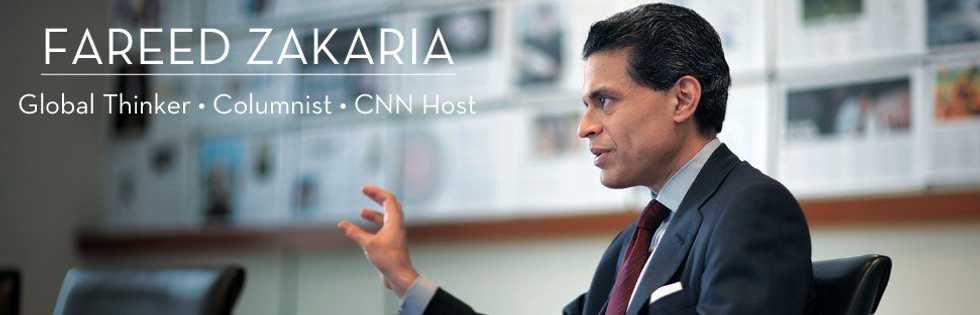
There is no quick fix to this issue but it is here that I will make a shameless plug for a program I think people, especially those studying political science, should watch routinely. Fareed Zakaria GPS is a program on CNN that airs at 10 A.M. (and again at 1 P.M.) on Sundays. Fareed has round table discussions featuring reputable journalists, authors, politicians, political scientists and even celebrities. They discuss the meat of nearly every topic facing the world at that point in time. Conversations are highly moderated to avoid the usual yelling matches that we tend to see on other networks and his guests politely refute the claims that their peers attempt to make. Overall, the atmosphere feels like a scholarly group of friends, spending an afternoon in a sitting room, discussing the latest scrap of information they’d heard. I can honestly claim that no other program on mainstream media provides an outlet for information like Fareed Zakaria presents.
The host himself is a reputable political scientist who, when he does give his take on an issue, provides documentation and a basis for his conclusions. He concerns himself with matters that can’t easily be solved with a yes or no answer and require careful analysis of sensitive, as well as volatile, themes that are challenging leaders and top thinkers. You won’t find him discussing Justin Bieber’s latest attempt to revitalize his public image or the brilliant creation of the selfie stick. If one wants reasoned, informative discussion to formulate their own opinions on global affairs, Fareed is the man to go to.
As a personal anecdote, I must admit I hold a bit of a personal bias toward Fareed and his program. It was a combination of his refreshing style of journalism and Jon Stewart’s satirical presentation of the same material that molded my approach to politics. Many Americans today view politics as a messy bog of people yelling and stamping their feet over things that they don’t really care about. The reality of the situation though, is that the term politics can encompass any kind of decisions, patterns, or thoughts we have about a given topic and why we act in that way. For example, your decision to drink Coke products instead of Pepsi products is an inherently political subject of study. If you have the desire to formulate your own ideas and come up with solutions to existing problems, I highly suggest tuning in at least once. Don’t take Donald Trump’s word, or even mine, as law. Tune in, get information at its raw source, and draw your own conclusions. Who knows, you might even learn something.