


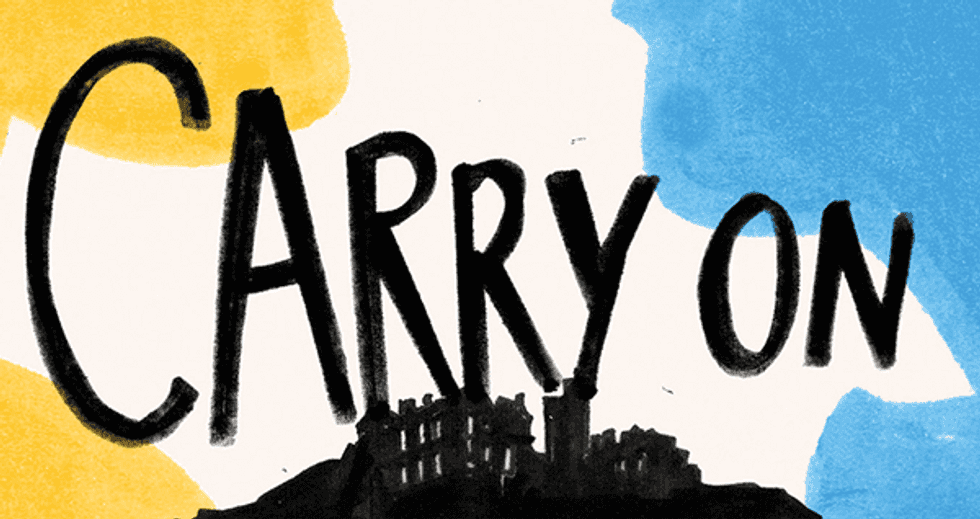
I recently had the pleasure of reading Rainbow Rowell’s latest novel, "Carry On." Those familiar with Rowell’s work will recognize the title from the story her character Cath wrote in Rowell’s previous novel, "Fangirl." "Carry On" follows the story of Simon Snow, the most powerful but also most untalented sorcerer in history, as he starts his final year at the Watford School of Magicks. Simon’s vampiric (and probably evil) roommate Baz is MIA, and Simon is sure that means Baz has something nasty in store for him. On top of that, the insidious Humdrum — a creature that sucks magic out of the world — is growing stronger by the day, and as the Veil weakens, ghosts of the past resurface with some alarming secrets to share. Will Simon find a way to live up to his status as the Chosen One, or will he have to watch as everything he loves is ripped away from him?
Since the book’s origins stem from another book about a girl writing slash (fanfiction focused on a queer relationship between two originally heterosexual males) meant to reflect Harry Potter/Draco Malfoy fanfictions, there is a definite parallel between "Carry On" and "Harry Potter." Both are about a “chosen one” who must fight a great evil in order to defend their world. However, Rowell takes the archetypes associated with this storyline and makes them into something entirely her own. Time and again, I thought I had a character all figured out, only to have them defy my expectations. Even better is the utter moral ambiguity in the novel. No character is definitively good or evil. One character acts horribly to keep people at a safe distance; another has progressive reform ideas, but resorts to terrible means to achieve their goals; another is constantly harming others despite their best efforts to protect them. Rowell has expertly crafted a cast of very flawed, very human characters in a fantastical setting.
On top of this, "Carry On" is a nerdy delight. It is full of references to other fandoms; seriously, there is a simile involving Billie Piper and about a dozen mentions of "Doctor Who." Unlike many of the most popular chosen-one stories, "Carry On" has a more adolescent target audience, meaning swears are more acceptable. There is something wonderful in reading about a boy expected to save the world who drops the occasional f-bomb to help himself cope instead of holding himself up and trying to act like the perfect hero. As previously mentioned, this story started as a fake slash, and the same-sex relationship remains intact in the final product. Anyone who loves LGBT romances represented in literature (or just enjoys reading romance in general) should definitely give this a look, because the relationship between Simon and Baz is a fantastic example.
For the most part, I loved this book, but the perspective shifts would occasionally throw me off. The story is told from so many perspectives while sticking with a first-person point of view that I would occasionally lose track of whose perspective I was reading from. This especially happened with Simon’s and Baz’s chapters, which take up the majority of the book. Since I could always jump back to the beginning of the chapter to jog my memory, this is a small complaint in light of the book’s many strengths.
Overall, "Carry On" is one of the best books I have read in a long while, and possibly my favorite Rainbow Rowell story. It’s a fresh take on a classic story that I never realized I wanted so badly. If you’re a fan of fantasy, "Harry Potter," fanfiction, or romance, "Carry On" is the book for you.

















