


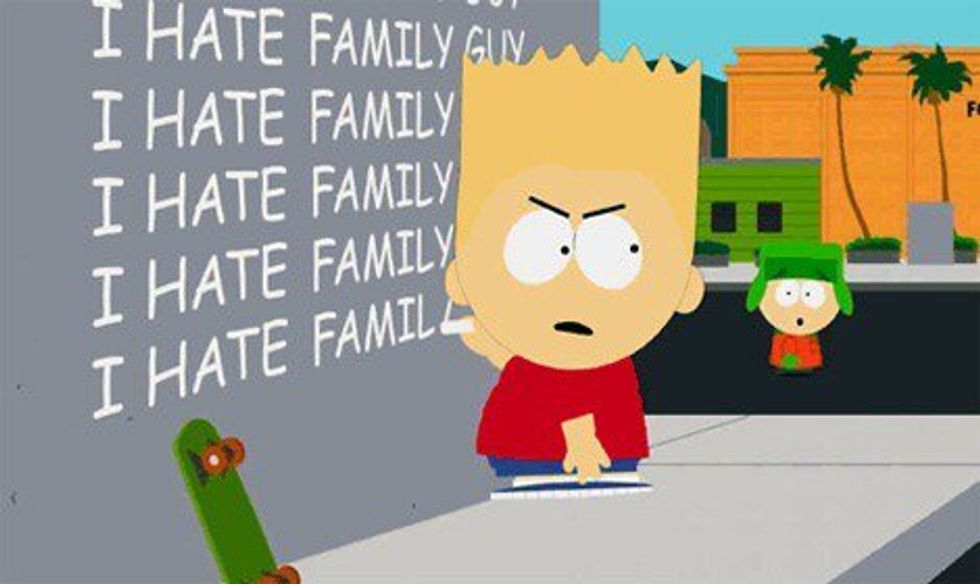
" Family Guy," created by Seth MacFarlane, is an animated sitcom that originally aired on FOX in the 1990s and reached the height of its popularity around 2005. Revered by some as witty satire and blunt honesty, "Family Guy" has been touted by loyal fans and led MacFarlane to create spinoffs, crossovers, films, and a year of hosting movie awards.
"Family Guy" has its critics, too. People argue that the show is raunchy and vulgar, that it addresses issues like underaged sex and drugs in a way that makes them appealing to children. This is not why I hate "Family Guy."
One minor reason that I dislike the show is the pop culture references. Occasional references to a popular culture phenomena, if done well, can be enjoyable. CW's "The Flash" represents the reference drop in a positive light. The show doesn't overdo it, just makes the once-in-a-few-episodes allusion to "Ghostbusters" or other shows that fans will understand. "Family Guy" does so too frequently. Almost every scene draws attention to something outside of the show such as Tom Cruise or Bob Dylan to the point where it derails the plot and does nothing productive to the characters, and even if you understand most of the redundant cutaways, they just are not funny. Many of them don't even mock celebrities in a logical way. It's one thing to call somebody out as entitled or wealth-hungry, but to mock Björk for her Icelandic accent or Rosie O'Donnell for her weight as if they cause legitimate problems for MacFarlane, is uncalled-for and offensive. The media referred to this as the creator "tooting his own horn," or "jerking himself off."
But that is not why I hate "Family Guy." I hate it because of how it affected my personal background. I was oblivious as a teenager, had very few friends aside from a couple whom I keep in touch with more now than I did in high school. But many just bullied me to my face, and I latched onto them in desperation and loneliness, rather than real friendship. So, I did what I thought they'd believe is cool. Got a Snapback and wore my pants low, listened to the angry music of Eminem, and tried to 'pick up girls.'
But my perception of all of these things was warped by the show that I came home to every night, spent my Friday and Saturday nights bingeing on DVR, "Family Guy." Right off the bat, the characters were nothing more than stereotypes. There was Peter, the diagnosed retarded man who drank, complained, and messed everything up. Lois, his wife who no matter how badly she was abused, loved and forgave her husband as if he spoiled her. Chris, the teenage idiot boy who spent his life jerking off and whining. Brian, the intellectual atheist who annoyed all of the other characters for fostering his intelligence. Meg, the girl who received nothing but hatred, listened to her own father yell at her for being fat - not actually even a little overweight, - and silenced whenever she attempted to speak or contribute.
The depiction of Meg manifests a clear problem. Most of the characters, predominantly her own father, tell her blatantly that she does not matter, that she's a burden. As a result, she resorts to self-harm and attempts suicide. In my childhood, when I felt just as isolated and just as hated at home and school no matter how hard I tried, this fueled my depression. If "Family Guy" confirmed that some people could be worthless, I certainly was one in my view.
The one-dimensionality of characters taught me that certain behaviors were evil, too. Gayness, sex, nerdiness, fat and ugliness, "asking for assault or rape," being what people told me I was, and many other harmful stereotypes were all demonised by the show. Anybody who fit into these categories labelled themselves as unfit for life. At the time, I identified as several of these things, and school and relatives boxed me into the others. I learned to hate myself and mask that in hatred towards other people who fit those categories. Slut shaming and fat shaming ensued. People bullied me, I bullied others, and I bullied myself. A trifecta of cruelty and harm.
This infected my outlook and actions towards the people I didn't bully, too, the people I wanted to befriend. Many teenagers are hypersexualised and ignorantly racist, sexist, classist, and ablist. With nobody at home or school to teach me what was right or even what they and their friends really did, I only knew what I saw in "Family Guy." Sex is bad, because only the idiots want it, but to ask somebody out romantically, tell them they're hot in detail, use jokes comparing their race to your Judaism, and outright disrespect them in a way that seems like a compliment to you. In reality, I didn't have a physical interest in women or sex. I was oblivious to the fact that anyone did. But what I did see were roles that men and women were required to fill in courtship. "Family Guy" characters pursued "love" in those ways, so I reasoned that it was the right way to go about it. Depraved of love, something I did have a need for, I sought it in that MacFarlane method. This offended and creeped out at least 14 different girls and their friends, but my lack of positive guidance compounded with substantial influence from "Family Guy" showed there was nothing wrong with this kind of behavior, so I didn't know what I did wrong; just that I repulsed the world and continually isolated myself by making it reject me.
Until I realized that I wasn't failing the "Family Guy" system which everyone around me perfected, that instead the "Family Guy" system corrupted me, my depression reached and plateaued at its peak. Living a life free of the misogyny, bigotry, and self-esteem demolition of MacFarlane's disaster has not cured me of depression nor made me a leader in fighting for human rights and portrayal of minorities in the media, but has made me happier and more confident and opened my eyes to larger problems than the size of a celebrity's nose or taunting somebody's disability. Things that I wouldn't stand for because they're cool or because Peter Griffin did them. I stood for what I wanted, what I thought was right.

















