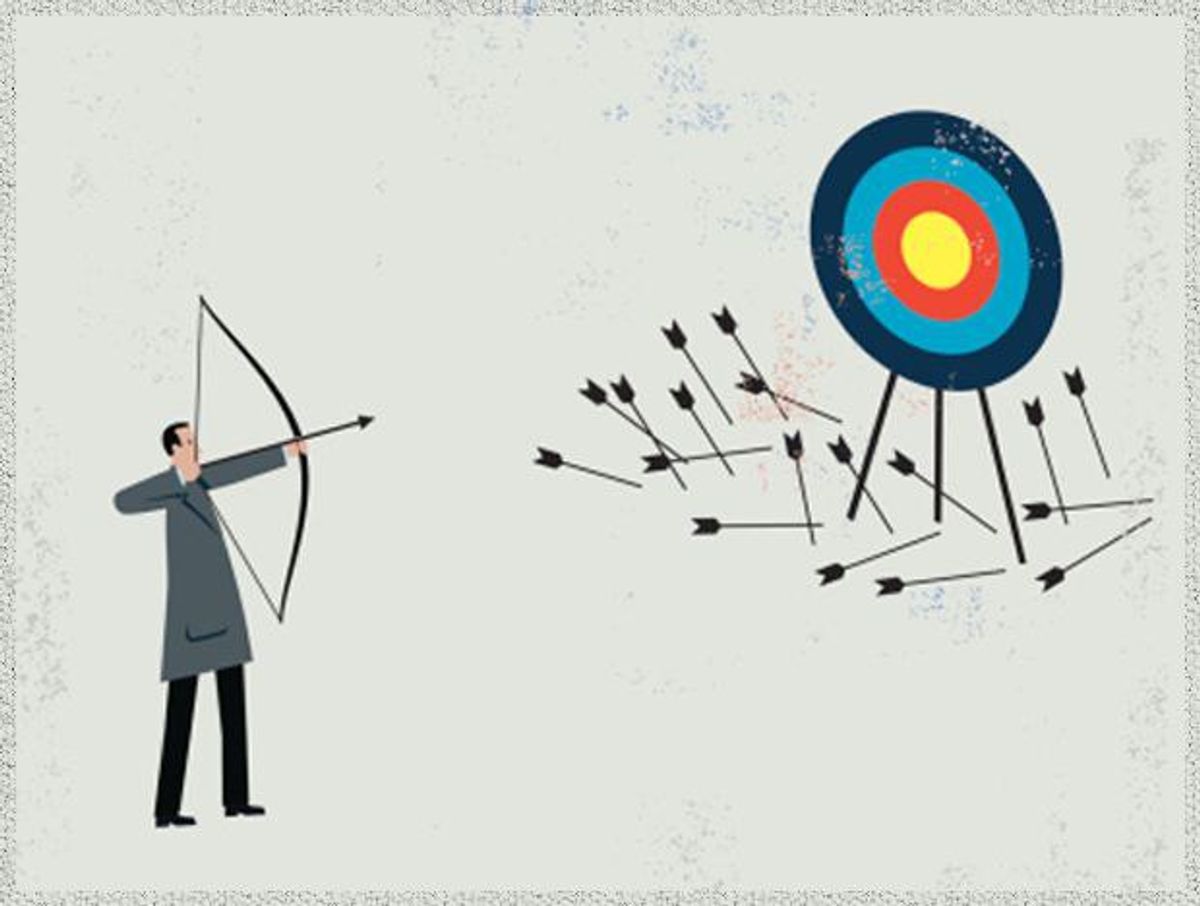
A group of third graders are playing a friendly game of knockout on the school’s blacktop. Child A shoots the ball, it hits the rim and bounces off. Child B, right behind him, shoots the ball; nothing but net. The words, mockingly, cascade from Child B’s mouth, “HA you’re out!”
It’s true, those are the rules.
Child A snaps back with, “Shut up, stupid,” exhibiting his master class in verbal retaliation. Child B says nothing, obviously dumbfounded by the retort, and continues the game while Child A walks to the side of the court, arms folded, and stares, angrily, at the sizzling asphalt where a small weed is poking through a crack. He does so with just enough ostentation that it catches the attention of all those around him, as though his failure, and disapproval of it, should be felt by the entire population of the blacktop.
It wasn't.
This occurrence plays out a million times on a million different blacktops, baseball diamonds, hockey rinks, poker tables, or anywhere the phrase "It’s just a game" is applicable. There is a winner and, where there is a winner, there is most certainly a loser.
Why play a game or a sport in the first place? Or when you do, what’s the benefit? Some may say that it's a satisfaction that comes with winning. I say that's false, the benefit cannot be to win because, plain and simply, winning is not guaranteed. Therefore, the benefit, as the author of the book Top Dog, Ashley Merryman, puts it, is improvement over time. Some of you may think that’s obvious but then why is Child A sulking as he is? Why does he need a hand on his shoulder to guide him through this life-lesson, one far greater than he would get if he were always the victor?
The best answer I can give is that winning is so ingrained in our culture that the younger generations are increasingly focused on not losing. When this is the case, the most valuable of traits is lost; triumph through failure. There is a sense, when you look around at the people surrounding you, that they are afraid to fail. It seems apparent in today's society more than ever, and I’m not just talking about failing an exam or losing a game. I’m talking about the ultimate failure; failing at life.
These fears of rejection, fears of being an outcast, fears of humiliation can be damaging, especially when urged upon an up-an-coming generation of adolescents. What happens when they grow up and these fears have developed to shape the collective consciousness of our nation, or, worse, our planet?
When I first started writing for The Odyssey I actually got a bit nervous because the only people who had read my writing were those that I trusted or asked to read it, or teachers who had assigned the papers. With this platform, being given complete creative control is exciting and yet daunting when considering that people will be reading my work, judging it and so on. This could be a determining factor into why many great thinkers or writers out there may be hesitant to begin writing for a platform such as The Odyssey.
However, if I may, I’d like to try to persuade some of those people. We know that through cognitive behavioral studies that one way to overcome fear is extreme exposure to the thing feared. Take the story of psychologist Albert Ellis, who overcame his fear of women by walking through the Bronx Botanical Garden and introducing himself to every woman he came across. Or take any number of cases (including yours truly) where someone (me) had a fear of public speaking and through forced but gradual repetition realized that one day they were no longer shaking. Now, Ellis did not get any phone numbers that day nor did he get any long lasting relationships. I had my fair share of slip ups and presentations that did not go as planned. What each of us got is something we only could have gotten through failure; perspective. You come to realize that that idea of what being successful means has been a sham. The people who are successful aren’t that way because they never failed, but because they did it a lot. And I do mean a lot. Even Donald Trump, a man who claims to always win, actually has more L’s than W’s. Being a filmmaker, one thing you hear a lot is that behind every great director are a bunch of shitty home movies and behind every great screenwriter is a filing cabinet of scripts that will never see the light of day.
That round of knockout is now over.
Child B has won.
He shoots first in the next round, his ball hits the rim and bounces off. As he runs up to the ball he exclaims, “I could have made that shot but I didn’t want to.”
Ashley Merryman, in an interview, discussed the difference between gain-orientation and loss-orientation. Gain-orientation is about focusing on what you’re going to get form a successful experience. Loss-orientation is about preventing catastrophe that you know is going to come. This orientation can change at any moment that you choose. Child B exhibits the same behavior as Child A did; a fear of failing. Even though he had already proven his skill by winning the game prior, he felt it necessary to preserve his reputation by saying he was missing on purpose, effectively (in his mind) preventing any negative outcome or judgment.
We all play games and we all want to win. Whether we’re an athlete, a politician, a filmmaker, a YouTuber, a writer, an individual, or an entire nation, we have within us a desire to protect ourselves form negativity. We don't want pain, we don't want suffering, we want to get through this life having shed as few tears as possible.
But why?
We all stand on the backbone of a phrase, “history repeats itself,” and we brush it off to mean that bad things are bound to happen and then we cry because we’re right. But not once do we revel in the absolute truth of that statement, that we all, just like those children on the blacktop get the right, every day, to improve ourselves and the opportunity, every day, to fail at doing so. Not to turn this into some meaning of life motivational speech but fuck it, maybe that's the purpose of us all. We’re all organic, we are all natural just like the weeds pushing through the cracks of the concrete, something placed deliberately to stand in it’s way. We were and are bound to suffer. We are bound to lose and lose and lose more than we win. But those wins, when they come, are monumentally greater than anything we could ever have dreamed.
A last thought:
Maybe if we learn to smile in the face of defeat, laugh at the pain, allow the tears to run down our cheeks without despising them, we can, together, build a community, a nation, a world where by accepting loss and failure, we win the greatest game of all; life.