
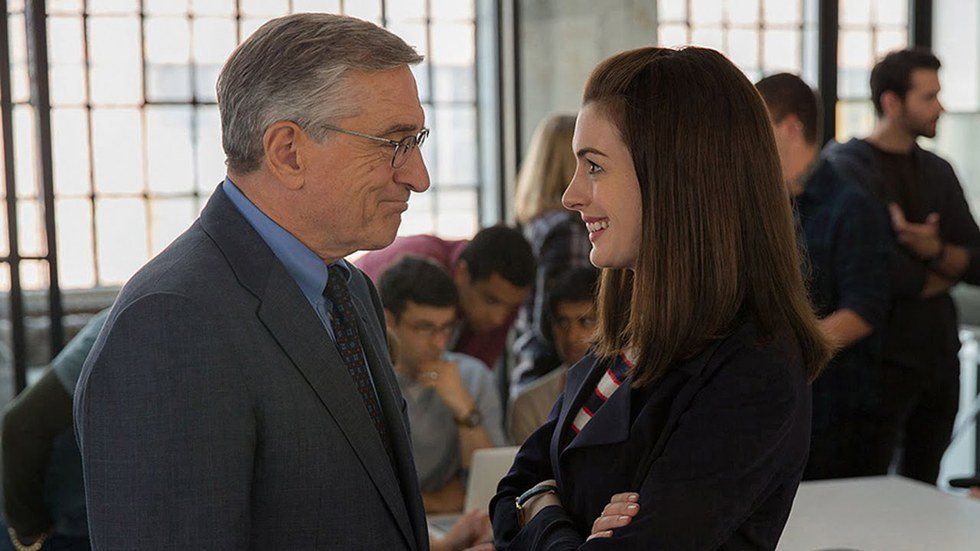
I recently saw the trailer for the upcoming film "The Intern" and I was immediately captivated by the questions this film raises. The premise centers Robert De Niro, a 70-year-old widower who decides to join the workforce again as an intern for an online fashion company. It is such a refreshing concept that both the current generation and all of those who have preceded it can use their knowledge to help each other learn. We continuously search for the next-best thing, thus, we have lost some of the culture that has made us who we are.
At one point in the trailer, Anne Hathaway says:
"Look and learn boys, because this is what cool looks like. How in one generation have men gone from guys like Jack Nicholson and Harrison Ford to... (the camera switches back to the three guys she is talking about, dressed in jeans and a tee shirts)"
And I think this is such a valid question. All generations bring something different to the world. The Millennials have brought technology, support for human rights and the pursuit of individuality, but in the process we have lost so many of the qualities that were important in previous generations. In fact, we have gone so far as to think that this generation is far superior in comparison.
In an interview with Los Angeles Times, Nancy Meyers, writer and director of this film opened up about the story and the roots of it.
Normally when you have a movie with a young actress and much older actor, it's either a romantic relationship or he's her father. This is neither.
Meyers: It came from something that was missing in my life but I never thought of. When somebody's in a stressful situation, wouldn't it be nice to have someone with some wisdom to watch your back, remind you who you are and what you're doing well? Wouldn't we all like that? Most movies are about the flaws, the problems, the difficulties we have in life. But I think it's OK and also necessary to be an optimistic voice. I'm saying, older people have wisdom. Older people have value.
"Older people have value." As college students and upcoming professionals, we think we know everything. We constantly get frustrated because our parents cannot seem to work technology properly or fail to understand the meaning behind some emojis on our phone. But, if for one instant we actually listened to what they have to say we might be surprised at what we find. The Traditionalists (1925-1945) valuedfamily and the work that they did. They wanted to make sure that they provided the best opportunities for their families. The Baby Boomers (1946-1964) valued success and the hard work that came with that. Their highest achievement would encompass leading a successful professional life. Generation X (1965-1980) is the middle child. They are often thought to be the forgotten generation, but their emphasis on balancing their work life as well as having a good family life is something to be admired. In this struggle, they gave rise to the Millennials, who are currently trying to figure out how to accomplish the goals that Generation X set to accomplish. In a way, we are all interconnected. The values from each generation were passed down and modified to fit our current lifestyles. However, it is important to never forget our roots and that those "oldies" were once at the front of the world. Let's take a moment to listen to their lives and to ask for their help while we try to figure out what the future holds for us. After all, "experience never gets old."