


In 1620, the first documented Mulatto was born in the Virginia Colony. During this time, chattel slavery did not exist in the colonies. Consequently, this and the births of more Mulattoes in the coming years were not seen as problems. Upon the institution of chattel slavery and the ensuing colorism, being mixed became a problem, or so people think. People tend to forget that there was a class of Blacks known as "Free Negroes." After the institutionalization of slavery, Free Negroes lived in the north.
Throughout the history of America, a series of laws were enacted to prevent the mixing of races–a process known as miscegenation. These anti-miscegenation laws were first enacted by the Virginia Colony in 1691 and they quickly spread throughout the other English colonies. What must be noted is that none of these laws were enacted at a Federal level. In fact, the states of Alaska, Hawai’i, Minnesota, Wisconsin, New York, New Jersey, Connecticut, New Hampshire, and Vermont never passed anti-miscegenation laws at all. By 1887, the states of Washington, New Mexico, Kansas, Iowa, Illinois, Michigan, Ohio, Pennsylvania, Rhode Island, Massachusetts, and Maine had repealed their anti-miscegenation laws. In 1948, the California Supreme Court overturned anti-miscegenation laws in the case Perez v. Sharp. Nine years later, the landmark Loving v. Virginia case would overturn all other anti-miscegenation laws.
History lesson aside, what does all of this mean in relation to the mixed-race identity? Similar to the identities of other people of color living in the United States, the history has everything to do with identity. Historically, being mixed was not recognized in the United States.
Or so we think.
While in many states miscegenation was illegal, mixed-race people would register as mulatto on the census. The infamous One-Drop Rule was not implemented until early 20th Century. For the readers who are unaware of One-Drop Rule, it was a rule that basically states that if one has even a drop of African blood, then they are Black. It would later be revised to a 1/16th Rule.
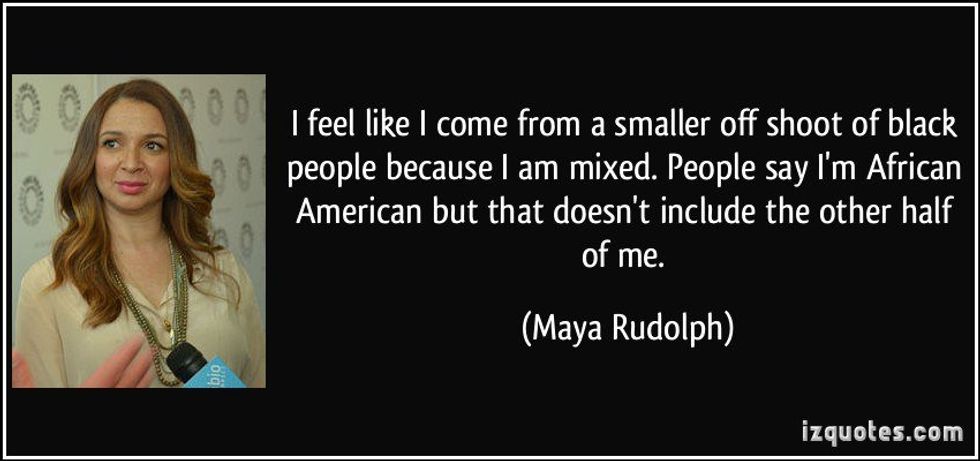
Today, there is a growing mixed demographic in the United States. As of the 2010 Census, 13 percent of Americans under the age of 18 identified as mixed. From the perspective of someone who grew up in the Black community, this has been met with increasing opposition from the Black community. Five years ago, if I said that I was Black, the response would be: “But you’re not really Black, though.” Today, if I were to say I’m mixed –which is how I identify myself–then I am met with varying levels of reaction ranging from acceptance to, “Why do you hate yourself?” I no longer hate myself.
Being mixed is not the refusal of any part(s) of oneself, but the acknowledgment and acceptance of all parts of oneself.
Due to the increasing opposition from groups to the emergence of a mixed identity, I foresee the creation of a separate mixed community. This is already seen in the works with examples such as #growingupmixed, mixed people pages on social media, and celebrities such as Keysia Cole claiming themselves as mixed. Additionally, many of our celebrities are mixed, including Bob Marley, Barack Obama, Ne-Yo, Rihanna, Beyoncé, Mariah Carey, and so many more.
Recently, Taye Diggs sparked outrage by saying that he wants his son–who is mixed–to identify as mixed. People argue that his son will be recognized as Black by the authorities and the world in general. This is false. Many nations have a separate category for mixed people. Additionally, this has not always been the case. Crispus Attucks, the first martyr in the American Revolution, is often lauded as Black. It must be known, however, that Attucks was not Black. He was a mix of Black and Wampanoag and his story is also celebrated in the Native American community. His mixed ethnicity must be acknowledged for the betterment of our national history. It must also be noted that the newspapers of the time did not identify him as Black, but as mixed. With the rising number of mixed Americans, this will happen again.
Until this happens, it is up to us as mixed people to educate others on our history and identity. Until then, it is up to others to listen and educate themselves. May God bless America.

















