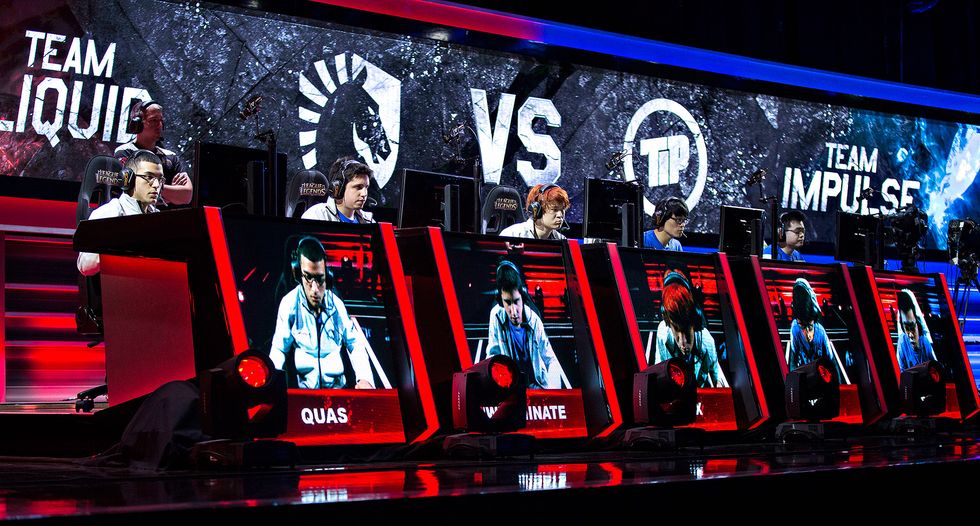
Esports is the future of competition.
It is hard to imagine that something so embedded in our culture could be outshone by video games, but it is happening at a staggering pace.
Competition, in its essence, is older than the written word. Older than spoken language. Primitive life competed for their food, for their mates. Soon that evolved as well. We competed for land, for control. Everything, since the dawn of time, was dictated in some form by competition.
That embedded desire for competition and dominance has extended itself into sports. Athletes train their whole lives to reach peak performance. Whether it’s an Olympic athlete training for their first, second, or seventh run at the gold medal, or a college student that just signed a million-dollar contract with a team in the NFL. Competing at the highest level of any sport or game is exhilarating and that enjoyment radiates into the audience and the fans.
In recent years video games have been sprouting up as legitimate competitions. It sounds ridiculous, and many refuse to acknowledge gaming as a legitimate form of competition or sports. Some will cite the definition of sports, “an activity involving physical exertion and skill in which an individual or team competes against another or others for entertainment,” and use it to shut down the legitimacy of esports.
Honestly, it is time for the definition to change. The time has come to remove the stigmas associated with the competitors, the athletes, competing regularly in dozens of competitive video game circuits. Some professional players earn hundreds of thousands of dollars competing, some nearly reaching the millions.
Here are just a few examples of earnings out of hundreds of players:
- Li Peng (China): $1,923,666.92
- Sang Hyeok Lee (S. Korea): $418,365.33
- Jens Aasgaard (Norway): $319,599.21
- Du Cong Dang (USA): $249,407.37
- Juan Debiedma: $83,885.62
The amount of money made by professional gamers is steadily increasing and more players are entering every day. There’s no shortage of competitors, but what about the potential for growth through sponsors and advertising. Putting aside the fact that "League of Legends", "Dota 2", "Street Fighter V", and a few other games are shown live on ESPN during their biggest events, most of the viewership for esports happens through TwitchTV and YouTube.
Just this past weekend, Evolution 2017, the fighting game championships, happened in Las Vegas, Nevada. 10,000 competitors, spread over 9 games, competed to be crowned as the best of the best. Most of the competitors entered without being sponsored or being part of any well-known teams, but some select few joined well known teams along with the team’s sponsors. Teams like Evil Geniuses, Counter Logic Gaming, Team Liquid, Echo Fox, just to name a few, are all multimillion-dollar franchises with sponsored players in almost every known competitive esport available.
Beyond sponsors, the viewership is astounding. This past weekend, on TwitchTV alone, the grand finals of "Street Fighter V" had 220,000 concurrent viewers. The tournament consistently kept numbers close to 100,000 concurrent viewers on the streaming platform. Considering that ESPN also broadcasted the entire Top 8 as well, it’s expected that close to 500,000 people viewed this single tournament.
If those numbers aren’t impressive enough, how about the numbers from the League of Legends World Championships in 2016:
- Peak Concurrent Viewers: 14,700,000
- Total Hours Viewed: 370,000,000
The numbers are absolutely astounding, especially if you’re an advertisement seeking the gamer demographic.
Esports isn’t going to overtake football or baseball anytime soon. There won’t be a 60 M, Cristiano Ronaldo, salary in gaming any time soon. But, it’s growing fast and no one will be able to stop it. As our society becomes more electronic, so will our sports. Esports is the future of competition, whether you like it or not.