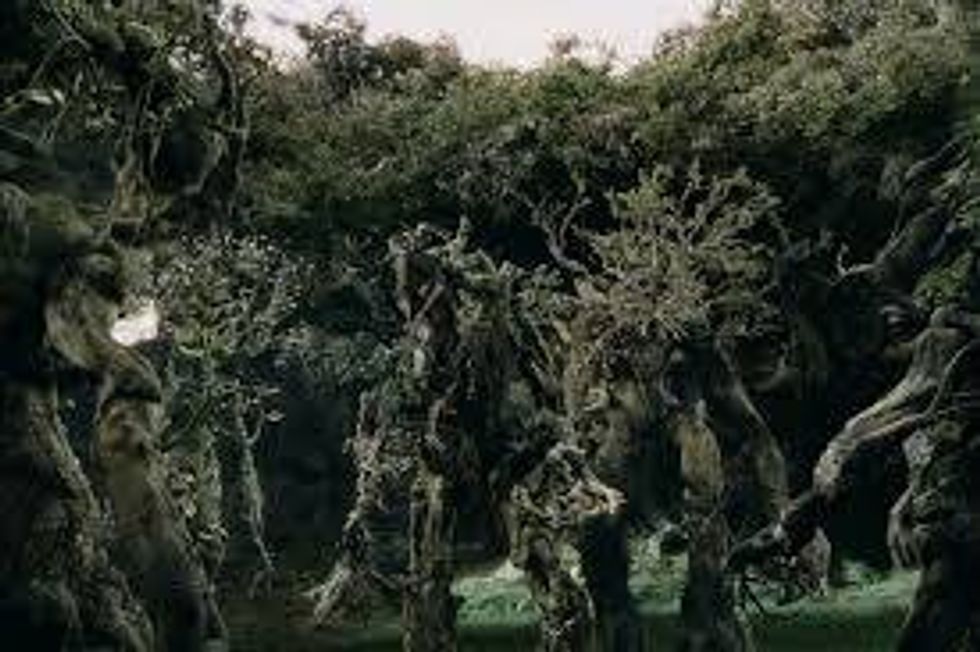
Ents, are a race of giant tree humanoids, first appearing in J.R.R Tolkien’s “The Two Towers,” who happen to get involved in the war for the ring when Marry and Pippin end up meeting the Ent, Treebeard, in Fangorn Forest. His meeting with the two hobbits persuades him to call forth other Ents, who then try to siege the tower of Orthanc by flooding it. This attack leads to the defeat of the wizard Saruman, who had betrayed the Ents by stealing from their history and using their trees to fuel his forges. While an important ally in the fight against Sauron, the Ents history isn’t really explained very thoroughly in the books, and the race sinks back into obscurity almost as quickly as they appeared. Outside of the books, however, Tolkien ended up creating a rich background about the Ents, which helps expand some of the history of Middle Earth itself.
Despite the inclusion of Old Man Willow, a tree in the “Fellowship of the Ring” who we later find out to be a Huorn, Ents were not created until Tolkien wrote the chapter “Treebeard” in “The Two Towers”. According To Tolkien in one of his letters, Ents were a spontaneous invention that came to his mind when Treebeard was being created, which explains why they did not appear in any of his older stories. Tolkien explains that because Treebeard expresses knowledge of Beleriand, where an important part of the war against Morgoth took place, he felt the need to expand upon Treebeard and the newly created Ent race. The first developed part of the Ents history was that they helped Beren defeat the dwarves who had assassinated King Thingol, explaining Treebeards initial unhappy reaction towards Legolas wanting to bring Gimli with him to Fangorn Forest. The Ents are named after the Old English word ent, which means giant.
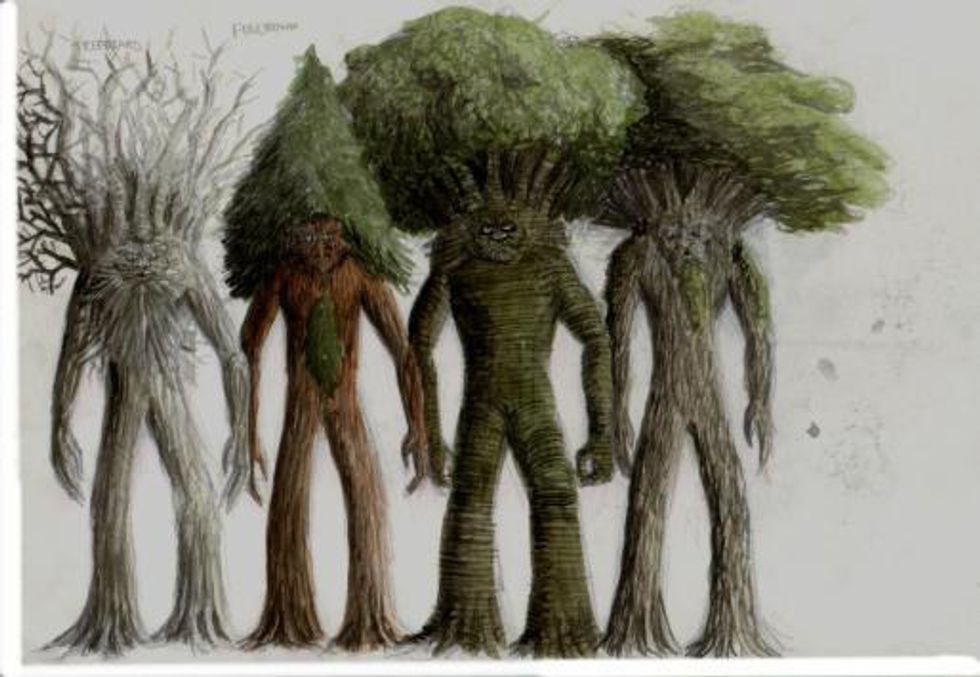
Ents can grow to be about 14 feet tall, and have a figure that resembles the combination of a man and a troll with a long head but barely any neck. Their bodies are clad with green and grey bark, except at some point their arms shift to a smooth, brown skin. Ent feet have seven toes each, and some, like Treebeard, have sweeping grey beards. They were also described as having brown eyes that seemed to emit a greenish light. The overall appearance of an Ent is based upon different types of trees, and individual Ents act as guardians towards the trees they look like. Due to their thick bark exterior, Ents are highly resistant to most weapons, with the exception of axes, and are only really threatened with the fear of getting burned. While they are usually slow thinkers and take a while to take action, when truly awoken or enraged they are quick to act, being capable of liberating the fortress Isengard almost single-handedly. Being giant tree-people, Ents don’t eat food, instead relying on Ent-draughts, a substance comprised of water, for nutrients. Huorns, another giant tree species found in Middle-Earth, appear to be, in some way, controlled by the Ents. They speak the Entish language, a slow and repetitive language involving the distinction between tone and length, which was never able to be learned by any other race. People of Rohirrim gave them their name, and the elves call them Onodrim or Enyd in the Sindarin language.
Ents are some of the oldest living races that survived into the third age, and were created around the same time the elves were. Eru, the god of elves and man, created them when the Valar Yavanna to give life to growing things, like he did to Valar Aule’s children, the dwarves. Trees then began to develop souls of their own, and Ents were the end result. Envisioned as “Shepherds to the Trees” they were created to defend the trees from orcs, dwarves, and any other evils that would harm the forest
Ents were at their prime during the first age, where the elves told them stories and even taught the Ents their language. It was also the age where they roamed throughout all of Beleriand and helped defeat the Dwarves of Nogrod. Trouble started to arise in the second age with the separation of the Entwives. While the Ents gave their love to the great forest and the high hills, the Entwives ended up gaining a preference to small blooming fruit trees and long autumn fields. This change caused the Entwives to go off and cross the Great River, where they crafted new gardens and taught man about agriculture. Unfortunately, they eventually end up vanishing, and their gardens are destroyed and become an area known as the “Brown Lands” in the third age. The third age became a terrible time for Ents; Fargon Forest became the only place left where they resided, and the remaining grow old with very little hope of having Entings. This caused a huge state of depression which ended up making some of the last Ents go into a “tree-ish” state.
While somewhat tragic, the Ent’s tale is a great one. What originally started as just an epiphany in the mind of Tolkien quickly spread to become one of the more famous creatures in the lore’s of Middle-Earth. They are a race, that if done relatively poorly, could have definitely be considered as gimmicky, but end up as an interesting and well-designed race that grew to have a backstory that goes back for thousands of years.