Over the past week, an incredibly amazing discovery has been made once again in the realm of science. Einstein's general theory of relativity has finally been proven; a theory that has existed for over 100 years.
A long time ago, Einstein pieced together the universe with nothing more than his mind and a pen. This week, that universe has finally become a full reality. The most difficult part of Einstein's theory has been proven -- the existence of gravitational waves in our universe.
Before we go into what a gravitational wave is, a little background information is required. When Einstein developed his theory of general relativity, it was the most profound thing to have ever been theorized and still is to this day. Einstein cracked the code to the universe by discussing a connection to what he called space and time. He said that space and time exist together in the universe and that the universe was constantly shifting and bending. This was proven by an experiment done a few years after his theory was published, when astronomers witnessing a total lunar eclipse captured an image of the stars surrounding the sun. Einstein believed that if his theory was correct then these stars would slightly bend in closer towards the sun; this was due to the bending of space-time around the sun's gravitational forces.
That proved that Einstein's theory held true. However, a piece of his theory was never able to be proven, until now. At an installation called LIGO, Laser Interferometer Gravitational-wave Observatory; a place built specifically for testing this theory, the century-long question has been answered. To no surprise; Einstein was right.
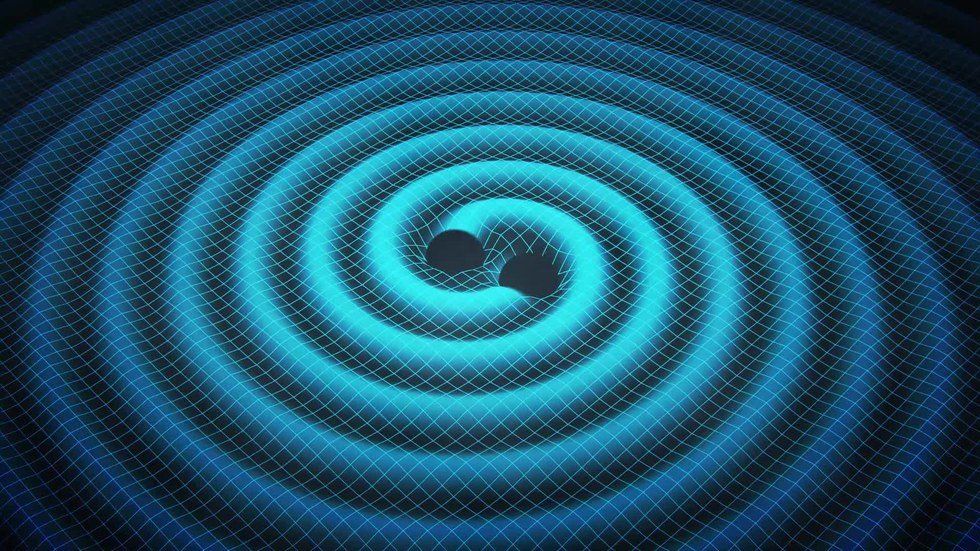
What Einstein got right this time was the topic of gravitational waves. Gravitational waves, as theorized by Einstein, only occur when two black holes do the tango and combine into one giant black hole. These black holes tango because they literally spin around each other due to their immense gravity. This tango happens for quite a while until they get close enough and bond together; when the black holes collide it sends a ripple through space-time. This ripple, otherwise known as a gravitational wave, then echoes through the universe becoming fainter the farther it travels (listen to it here.) They're so faint that it is almost impossible to detect them, the only way scientists at LIGO could was by following the grandmaster's instructions. The calculations Einstein predicted were true and the scientists recorded the gravitational wave perfectly.
All in all, it was a wonderful week for science and for the late Albert Einstein. Possibly the most impressive part of all of it was this: it took a century of human ingenuity and technology to catch up to just one man and his thoughts.