
It’s no secret that we are living in the midst of a technological revolution. The massive supercomputers from a few decades ago, which filled entire rooms, couldn’t hold a candle to the smartphone you now have in your pocket. Ever wonder why older generations struggle with the intricacies of modern technology? It may be due to the fact that this revolution has been so constant and unrelenting, or that the technology born of this revolution would be inconceivable to scientists a few decades ago. Either way, this technology has begun to expand beyond the borders of computer sciences. One new frontier is literature, in the form of e-books — books published electronically that can be read over computers, tablets, e-readers or even your aforementioned smartphone. But is this a bad thing? Could this be the death of printed books, or even worse, of literature?
Before we delve into such questions, I have a confession to make. I’m personally biased towards printed books. It might be due to the time I’ve spent in libraries and bookstores or that (as proven in embarrassing home videos) I spent a good portion of my childhood reading a book in a corner while my siblings would watch cartoons. What’s interesting is that my father actually has a Nook tablet and prefers it (he’s a bit of a technophile), despite being of an older generation. He attributes my preferences to some sort of perversion, of relishing the turning of pages or the smell of books. And while I’m pretty sure he’s joking, I can’t say that he’s completely wrong. I read to lose myself in whatever I’m reading, to experience something other than the reality I live in and to improve my own writing. My point is, that reading has always been something deeply personal to me. I guess that, in a way, the sensation of turning pages and the unique aroma that wafts through the halls of libraries and bookstores both contribute to that personal experience for me. And while I insist on buying my father print books instead of e-books for his Nook, I still envy the convenience of e-books. While I would need a backpack to haul around "War and Peace," "Ulysses" and "Infinite Jest," my father could just carry all three of those on his Nook.
So, will e-books mean the end of printed books? Personally, and begrudgingly, I believe so. Printed books cannot compete with e-books in terms of convenience. I can’t count the number of times I’ve gone to a bookstore looking for a specific book only to discover it was sold out or never available there in the first place. Granted, this isn’t necessarily a bad thing, as it gives you an excuse to go to more bookstores or find an alternative or a totally unrelated work, but it’s still an inconvenience. Even if you order books online, you’ll still have to wait several days for them to arrive. With the advancement of technology, we have become accustomed to instant access for information we need or desire. Has this made us impatient? Perhaps, but this has also contributed to the major pitfall of printed literature today — the lack of immediate reception and therefore, convenience.
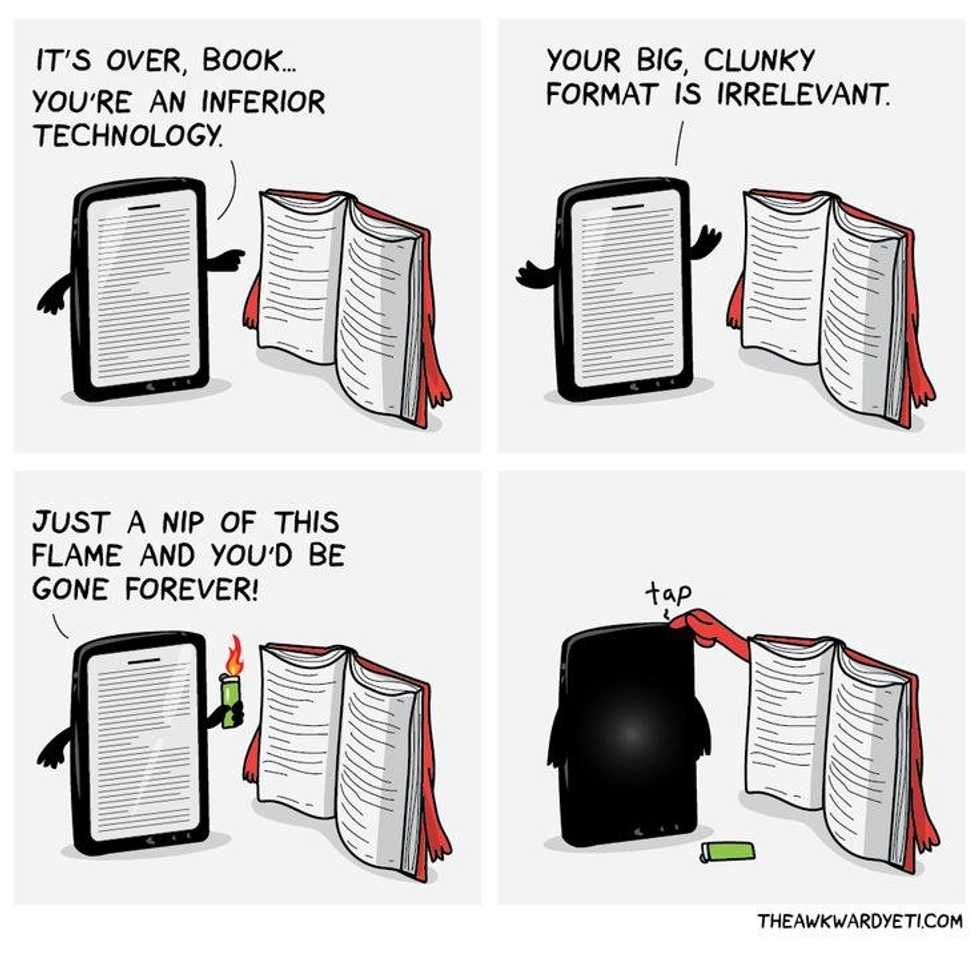
Will e-books will be the death of literature? I think this is an overreaction. Just because the means of accessing content are changing, does not mean the content itself is changing or being considered obsolete as well. If anything, it might lead to a boom in literature being much easier to self-publish online than before with conventional methods. Now, while I believe that the future of literature isn’t threatened by this technological revolution, does that mean I will fully embrace e-books? As a stubborn and occasionally irrational human being, the answer is still no. I will always prefer printed literature to e-books, and I will still brag to my father that my books don’t rely on battery life. However, just because my preferred method of reading may become outdated does not mean that literature itself will become outdated as well.