With movies like the “Dark Knight” trilogy, “Inception”, and “Interstellar”, Christopher Nolan has been hailed as one of the most prolific modern filmmakers of our age. Nolan continually surpasses the quite frankly low standards of Hollywood filmmaking through his persistent perfectionism and love of the craft, while also possessing unparalleled storytelling abilities. Not only that, but Nolan’s films spark interesting discussion for film and music aficionados alike. The best example of this would be his latest release “Dunkirk”, a war drama that rather faithfully depicts the evacuation of Dunkirk beach during the Second World War.
Upon my first viewing, it became fairly apparent that “Dunkirk” was a slight departure from usual Nolan films for several reasons. Like his previous films, Nolan is successful in defying the tropes that the war-movie genre entails. Yet, whether this hinders the overall movie experience is entirely up to audience's foreknowledge of Nolan’s distinct style and what audiences expect to see in a movie of this particular genre. From the first frame, you are immediately immersed in the occurring battle.
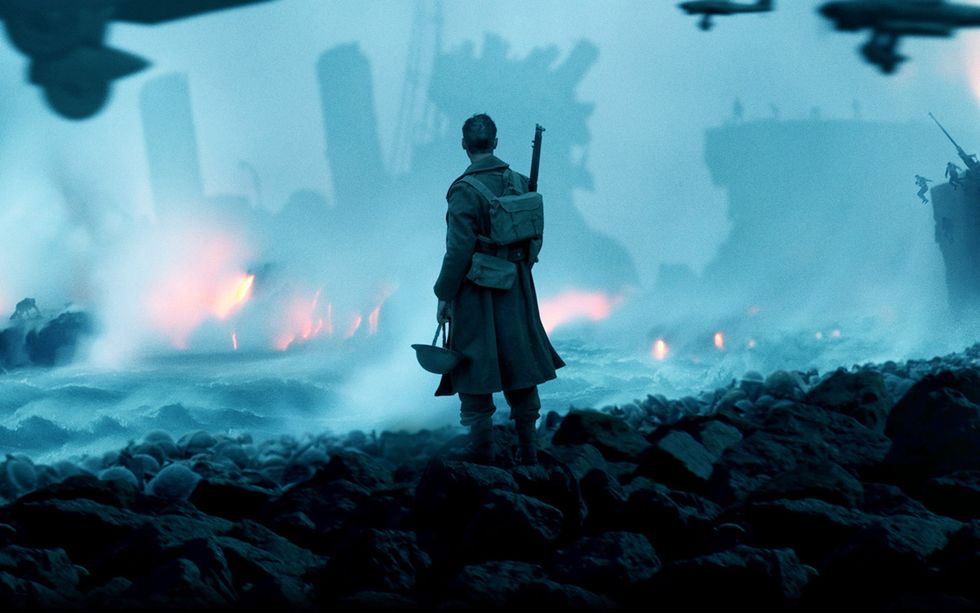
There’s no time to catch your breath as you are completely overwhelmed by the unexpected sound of harsh gunfire and the screeching wail of German fighter jets. Additionally, this movie looks absolutely gorgeous. The tone and color pallet Nolan decides to utilize for the film, the harsh greys and blue of the water and sky, and the bleak white of the beach sand to contrast it is extremely visually impactful. While for me personally, a film’s “look” doesn’t dictate whether the film or plot is inherently effective or not, it certainly helps in the overall scope of the project.
Seeing as the film is pretty much entirely comprised of episodic situations with very, very little dialogue, there is little to no characterization of any of the soldiers or anyone else we meet throughout the course of this film. I truthfully couldn’t recall more than one or two names, and it’s because of this that I am fairly ambivalent about this movie as a whole, as I was slightly bored watching the film taking its time to take off. One thing people make the mistake of thinking is that this lack of connection to the characters is a fault on the writers or even Nolan himself.
However, we have seen in his previous films that he is fairly skilled at establishing characters, character arcs, and finding ways to make the audience care about the people on the screen. The lack of all three of these factors was, in my opinion, completely intentional. Despite the lack of connection between the audience and the characters, it was still very easy to sympathize with these soldiers in this very unfortunate situation, and the question of whether or not they would be rescued or not definitely kept you interested. While I overall understand why this direction was taken, strong characterization is a must for any movie that I personally watch.
Nothing in this film resembled your typical action blockbuster. In fact, this film at times felt like something out of the horror genre. The seemingly helpless situation, the lack of CGI, along with the screeching and roaring sound design definitely made the hairs on my neck stand up. Nolan effectively keeps a consistent tension in every scene to mirror what this situation would actually feel like, and he wastes no time in completely immersing the audience into the event, making us feel like we were drowning along with these soldiers.
What is a Nolan film without an expertly executed score by Hans Zimmer? Listening to the score as the movie progressed, I could practically already hear the film score naysayers (typically die-hard John Williams fans) condemning Zimmer for his “boring” minimalistic style and his lack of melodic and memorable orchestrations.
Even worse is when these criticisms are made without even watching the movie that the music accompanies! If you watch this movie, it is quite clear that a bombastic and melodic score would stick out like a sore thumb. It’s not what the film needs, which, as far as I’m concerned, is the only thing that matters when it comes to film scoring. Zimmer usually takes to creating an individual soundscape to the film he scores to, solely representing the mood and the situation of the film. No, there are no character themes or “hummable melodies” that stick in your head as you walk out of the theater.
Rather, Zimmer establishes these extremely tense motivic lines that are repeatedly played throughout the film. The most interesting thing about this score is that it effectively contradicts itself. In one scene, you can hear the ticking of a clock, upping the ante and subliminally saying to the audience that these soldiers are running out of time, but keeping a steady and strong tempo in the scene. Yet, in the next scene, you have fairly noticeable lines that are constantly changing the tempo of the scene, usually played in scenes of action or other pivotal story moments.
While I won’t go as far as to say that this film surpasses any of Nolan’s previous films, it certainly finds its place in his professional repertoire. And I, as ever, am crossing my fingers that other Hollywood filmmakers are taking notes and imbuing the art form with a sense of sophistication and love for the art form as Nolan does.