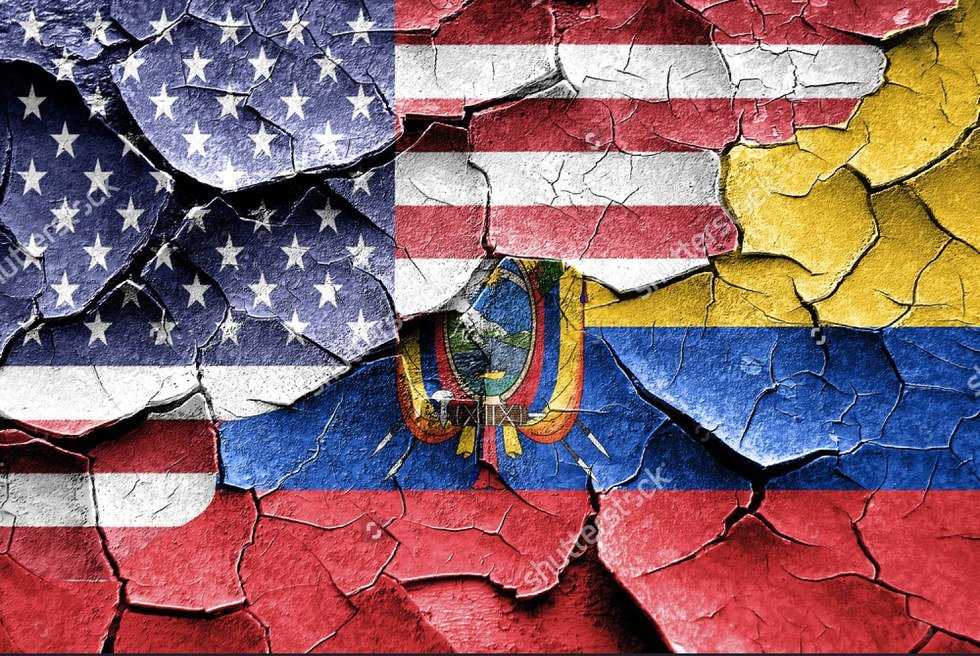
“No soy de aqui ni de alla,” (I’m not from here nor from there) is how I responded when I was asked where I was from. Being born in New York, with parents descending from South American countries only complicated my answer to this simple question. My dad was born in Ecuador and my mom was born in Bolivia, however, being born in the United States only hindered my relationship to my ancestors and heritage. I couldn’t relate to anything, which left me feeling isolated much like how I felt the first time I went to Ecuador.
“¿Eres Ecuatoriana?” (You’re Ecuadorian?) she questioned in fluent Spanish. The words flew off her native tongue effortlessly. I stumbled to explain how my father was Ecuadorian and moved to the United States where I was born and raised. Each mispronounced word and lack of accent only further validated her next statement, “Entonces, de verdad no eres Ecuadoriana,” (So, you’re not Ecuadorian). My ten-year-old self was speechless, as I lacked the vocabulary to defend myself, however, I was still confused on what exactly made me less Ecuadorian. Was it because I failed to roll my r’s in words like ratón and ropa? Was it because Spanish wasn’t my first language and therefore I often paused mid-sentence to remember a word? I remained confused.
My upbringing included religiously attending the Ecuadorian Day parade where my whole family proudly sported our jerseys and afterwards indulged into dishes like ceviche and seco de pollo. On New Year’s Eve, we never failed to follow my abuelita’s sacred tradition, the making and burning of a paper car to get rid of bad luck. I followed all the same traditions as my cousins, so why was I perceived to be less Ecuadorian? My mispronounced words and lack of fluidity in Spanish was apparent enough to not be deemed from Ecuador as they only connected me to my birthplace, the United States.
It was a double edged sword as I was labeled immigrant or foreigner, in a country I was born in. To the public eye, I was the farthest person to be associated with the word “American” due to my ethnicity, but I still celebrated Thanksgiving and proudly recited the Pledge of Allegiance all throughout elementary school. The country I so dearly associated myself with didn’t recognize me as American. My second language and traditions once again were the ultimate obstacle that separated me from yet another country. I did not belong.
I could not pinpoint the moment when I suddenly felt as if I belonged to both my country of origin and my birthplace, but rather it was a gradual process. Day by day I began to realize one of the many advantages to being Hispanic-American. I was able to help lost tourists navigate their way through the city, as they were more than delighted to find someone who spoke Spanish. Being bilingual gave me the opportunity to communicate with twice as many people even if I sometimes mispronounced words or made grammatical mistakes. Thanksgiving at my house meant having empanadas as the appetizer, turkey and pernil as the main course, with pumpkin pie and dulce de leche for dessert. I was fortunate enough to celebrate both April Fool’s Day and Carnival, holidays of harmless fun. Choosing to associate myself with both my countries and not selectively one only expanded my world as I was exposed to twice the culture, twice the moments and twice the people.
Yo soy de ahi y de aca (I am from here and from there), I tell myself because I am Ecuadorian as much as I am American.