

As we walked through Family Video toward the videogame section, my girlfriend and I passed by Oscar-winning movies and b-horror flicks—fantasy, comedy, and drama of all sorts. We stepped into the video game section. Under fluorescent light, I asked my girlfriend to pick out a video game that she would want to try.
I spent most of my childhood inches from my computer screen tapping the lettering off the "WASD" keys and massacring enemies with left-click. Video games were a part of my life, and I wanted to share them with her. She looked through the games as if they were unappealing items on a menu. “Which ones aren’t violent?” she asked. I looked over the green cases covered in male protagonists and tried to find a suitable title.
I skipped over series like Call of Duty (grizzled American or British men killing "bad guys"), Halo (a grizzled superhuman man in a power suit killing aliens), and instead turned to a few of my favorites: Far Cry, Bioshock, and Fallout (American killing island native bad guys, Steampunk grizzled white guy protagonist killing Steampunk bad guys, and a protagonist raised in “the vault” killing the Wastelander “others,” respectively). I even looked to series like Mario (Italians killing turtles) and the Lego franchise (Legos wrecking Legos).
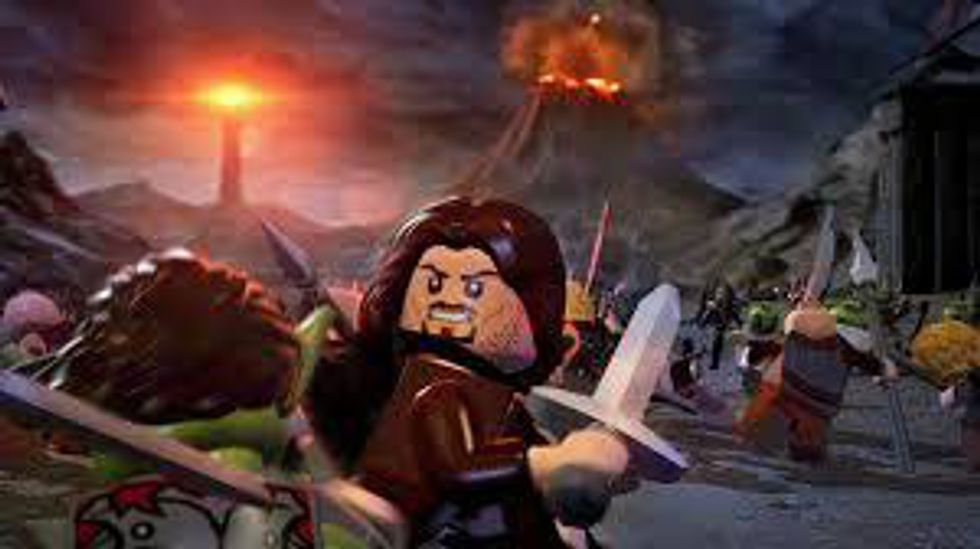
The only games that didn’t involve killing were non-narrative focused sports games like FIFA and Madden. All my life I’d understood that there were a lot of violent video games, but I’d never realized how hard it is to find good, narrative-driven, non-violent games.
The Forbes list of top selling video games of 2014 reveals much of the same:
- Call of Duty: Advanced Warfare (violence)
- Madden NFL 15 (sports)
- Destiny (violence)
- Grand Theft Auto 5 (violence)
- Minecraft (Not really violent, but non-narrative)
- Super Smash Bros (gladiator-style violence of beloved Nintendo characters... so violence as sports)
- NBA 2K15 (sports with a token narrative mode)
- Watch Dogs (violence)
- FIFA 15 (sports)
- Call of Duty Ghosts (violence)
I am not against violence in video games. As I’ve already said, most of my all-time favorite games are violent. But, why is almost every game violent? Sure, violence sells, but so does pornography, and there is rarely nudity in video games. So what is it? In an episode of Game/Show entitled “Why Killing is a Fundamental Game Mechanic,” Jamin Warren asserts that video games are violent because violence is a universal plot motivator. Violence is an easy way to up the stakes and move the narrative.
I think from a non-moralistic view, this is a pretty spot-on reason. However, as the video continues, Warren provides additional explanation that further shows gaming’s problems so far. He explains the existence of these basic motivators by stating that video games were born in binary code and, in a world comprised of 1s and 0s, life and death are universal, translatable metaphors for the a “1s and 0s” view of the human condition. However, this is the problem.

In the video, Warren also quotes Alfred Hitchcock saying, “Drama is life with the dull bits cut out.” I agree with Alfred Hitchcock. Drama is life reconstructed without banality. However, what percentage of life focuses on stealing cars and murdering prostitutes? What amount life is spent shot-gunning aliens while wearing power armor? How often do terrorists successfully set off nuclear weapons and take over the White House? Violence is an indisputable part of life, and some of these examples do, in fact, happen. But most violence in video games is not “life with the dull bits cut out;” it is humanity hyperbolized into fantasy. If the videogame market were a movie theater, they’d be showing Die Hard 15, Lethal Weapon 27, and Lord of the Rings 9.
The problem with violence in video games is not that it is violent, but that the use of violence is clichéd. Good Will Hunting and Catcher in the Rye progressed fine without a gravity gun. Warren’s explanation of violence as a “lowest common denominator motivation” is a good explanation for the existence of violent video games; however, it does not justify the ratio of violent to non-violent video games. Video games cannot progress as a medium without dropping the weapons or learning to use them right. Binary motivation was excusable in Pong, but we have moved on. We need more unarmed narratives. Or, at least, if violence continues in video games, the writers must think bigger than “1s and 0s.”
In Spec Ops: The Line, there is a moment when three protagonists are bottle-necked by a platoon of rogue American soldiers. Lieutenant Adams suggests using a nearby white phosphorus mortar to eliminate the enemies. Staff Sergeant Lugo begs with Walker, the player-character, to try and find another way around. But, despite Lugo’s humanitarian pleading, the only way to progress the game is to firebomb the men.
While you are burning humans, the point of view shifts to an overhead thermal camera that illuminates enemies as points of light. This section is extremely derivative of Call of Duty. There’s gunfire. The characters shout “standby,” “fire on my target,” “we need to hit those RPGs,” “Hummer disabled,”—the standard audio backdrop for any clichéd moment in any violent game. You blow up tanks and extinguish lights. Then, toward the back of the camp, there is a large cluster of light. The player must press the button on the controller to incinerate the people in order to move the story forward.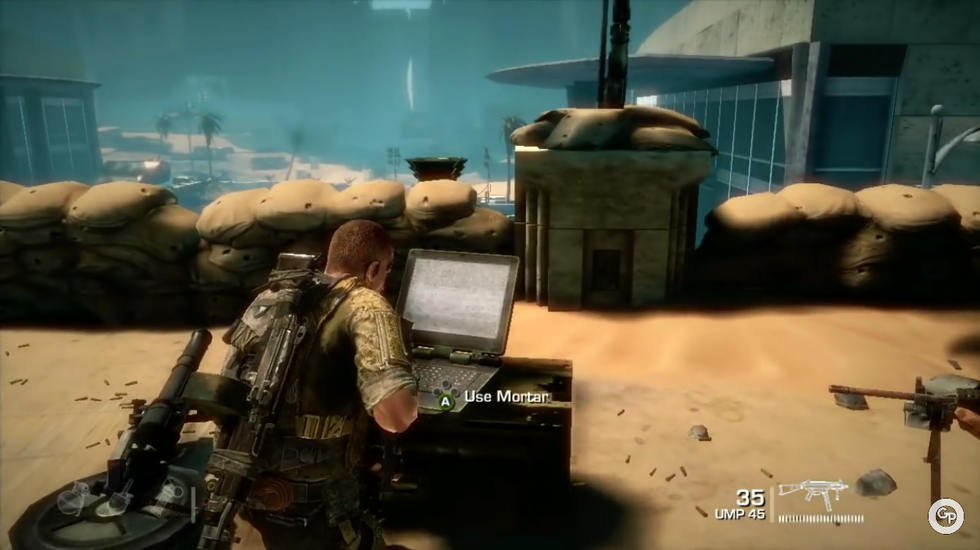
After murdering hundreds of American soldiers, the game walks you through your destruction. There are men crying, burnt corpses, limping soldiers wandering through fire. You walk through the hot carnage to the back of the camp where you’d fired on the cluster of light. You learn that you’ve incinerated the group of refugees the game asked you to protect. By playing on the clichéd notions of violence in video games, Spec Ops: The Line makes you a war criminal. The game anticipates the assumption that it’s a standard third person shooter and, instead, subverts the genre to blame the player character for enjoying murder.
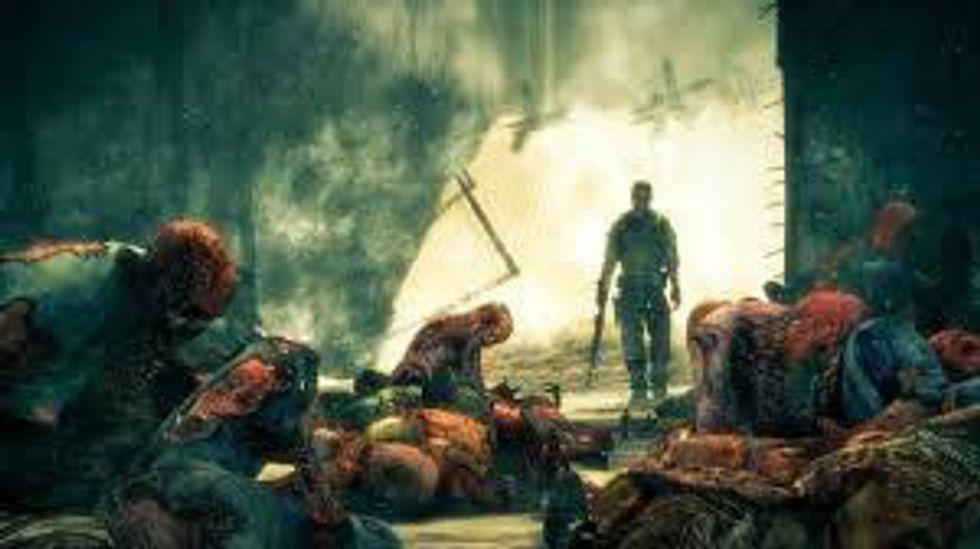
Although the gaming public does not actually kill people, Spec Ops: The Line realizes gamers pretend to kill 1s and 0s. By dehumanizing the targets to points of light, then scorning the player for advancing the narrative, Spec Ops: The Line comments on reality through violent clichés. This violence is justified. It is integral to the philosophy of the game. However, most games aren’t Spec Ops: The Line.
I hope that one day, I can walk into a game store and when my girlfriend asks me “which ones aren’t violent,” I can scan options that reflect humanity: some games about loss, some about joy, some that hold a gun to the head of the player character and force them to feel like a victim, some that comment on what leads a person to hold that gun, some that speak of humanity in a way that actually represents humanity. Currently, the market is saturated with mindless violence for violence’s sake. These games are not good. They are boring. They reduce both humanity and plot to 1s and 0s. We need better writing and better games. I will not buy another Call of Duty. I will support smarter games, and hopefully, I won’t be alone.