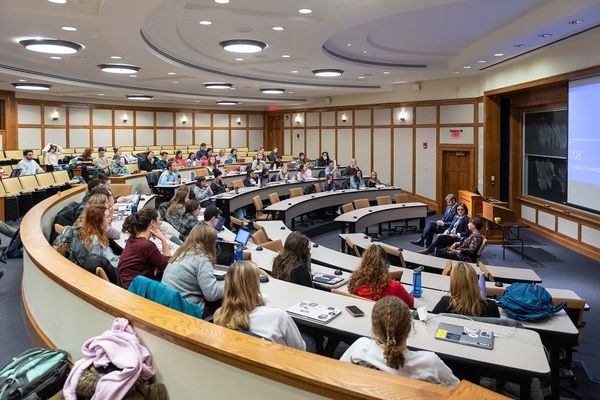


The foremost question on most people’s minds when I discuss my liberal arts education manifests itself into what has become a common mantra in the background of my own conscience: “What do you plan on doing with that?” The question rests compulsory on the tongues of most adults today.
My own college’s mission statement, “Think critically, reason wisely and act humanely,” presents at the forefront of its image the buzzwords of contemporary academia. However, the contemporary college student’s experience hardly revolves around the two prior pairings—critical thinking and wise reasoning. Rather, this statement—or better said, slogan—stands as a tribute to a clever marketing scheme manipulated by liberal arts institutions everywhere.
Before my degree was even imagined, its worth was ascribed a price tag. My education has been summed up by its value in the marketplace before I even walk across the graduation stage. This is where neoliberalism meets the liberal arts.
College—and simply education for that matter—used to be a thing of wonder, a place to cultivate creativity, to learn for learning’s sake. The 1960s witnessed this height of the liberal arts, and for the first time in history students across the class spectrum could get a taste of the elite education previously only accessible to the white, aristocratic, Protestant class. Students of all likeness were taught the classics, read Melville and peered through telescopes. They were endowed with a whimsical wonder of the universe and all its contents. Education was for everybody.
However, this longing for learning and knowledge is nothing but a distant nostalgia in the contemporary classroom. The fields in which the end goal is the production of knowledge—philosophy, religion, linguistics, political science, anthropology and sociology, English—face utter scrutiny in an age where a diploma is underwritten by a market value. Rather than a search for knowledge, the mission of our education system contends evermore to meet the needs of the workforce. Producing producers rather than cultivating cultivators.
Moreover, those students who attend liberal arts colleges have at one time or another been confronted with a slogan hailing from the communications department promising them that their college will turn them into a “leader.” This promise of producing leaders, teaches students not to interact as a community, but rather divides them into sects of “leaders” and “followers.”
This leader-and-follower caste system manufactured by neoliberal education hardly seeks to engage students with ideas that will produce real change. Instead, this system entrenches students in static social and market frameworks, where solutions are contrived for predetermined problems.
Yet, in a world that faces challenges such as climate change, humanitarian crises, racial injustices, depletion of natural resources and prolonged warfare, why don’t our centers for higher education cultivate the thirst for knowledge in students? A craving for creativity and curiosity that will propel learners to face the problems inherited from previous generations? Why are adults so critically concerned with the tokenization of Millennials’ degrees through monetary sums? Can they not handle taking responsibility for the problems their generation produced? Do they think by monetizing our academic achievements, they can cushion the blow of this harsh reality?
Education should be empowering. When entrenched in the language of economics, however, a degree becomes worthless. By assigning a price to my diploma and my experiences as a learner, my education becomes undervalued. While my peers enter a new found energy of political engagement and social justice across college campuses, I can tell hope is not lost for us. We are becoming more resilient when asked, “So, what are you going to do with that?”
We have protested and revolted and revolutionized. We are proving that despite the future can, at times, look bleak, we can move forth together. Despite the hesitation and overall reluctance for academia to look hopefully at the future with us—rather than pessimistically and compulsorily prepare us for the worst—we are learning to learn from each other’s experiences and narratives. And that kind of knowledge is priceless.