

I still sleep with a nightlight.
It’s not that I’m afraid in the dark of my room; for the most part, I know there’s nothing within its confines that I need fear. Rather, it’s the darkness of the window above my head—for when the lights are off, and the phantom reflections on the glass dissipate, an unsettling void opens up in the night. It’s like I’ve left the door open, allowing a paralyzing miasma of possibility seep into the security and certainty of utter seclusion.
It’s something akin to riding a helicopter above the tumultuous, dark expanse of the ocean at night, gazing at, as described by Aldous Huxley’s Brave New World, the “rushing emptiness of the night…the black foam-flecked water heaving beneath…” The fear is not of falling, but of being swallowed whole—to have the sharp boundaries of what can and cannot be annihilated by the expansion of possibility offered by the dark. The world has become too large to be circumscribed, almost threatening in its blankness. In the backdrop of this benign horror, it’s like staring into the sun, fearing that you’ll go blind from focusing too hard on the hidden, throbbing vitality of the darkness. The constraints of clear boundaries is comforting, and the total liberation of open space sinister. It’s much easier to remain in the certainty of the helicopter: to close the doors, turn on the lights, and turn up the music to forestall the sounds that silence makes. To not move. Stay in place.
This is more than a fear of the unknown, but the fear of uncertainty and possibility. The threat is not the failure of the imagination, but its overproductivity—there are simply too many monsters and enemies to contend with, too many angels and heroes to fight for. Innumerable paths open before us: we slay the dragon in one and are slain in the other, kiss our lover here and kill each other there. Anything can happen, everything can happen. With this black screen before us, stripped of the limitations of inhibition and law, we can become anything. And that’s a terrifying concept to behold.
But why should we fear walking the night, when we walk fearless in the day?
We have very defined comfort zones, spaces that we let ourselves run around in circles in simply because we believe they are firmly in our possession—identities we are certain of, behaviors we can easily repeat. We have our profiles ready at hand, and police our lives within these boundaries: I am a [ethnicity], [gender], [sexuality] [vocation] who hangs out with [group of people]; I am good at doing this and bad at that; I would never do this, I will always do that. It’s an incredible feat to be so clearly delineated, or to make it a point to have all these blanks filled at some point in your life; “Know thyself” is the fundamental condition to being. But there’s a kind of beauty in the struggle of losing yourself—of getting lost and not knowing where you are, who you are. Life is no longer stagnant, but gains a kind of intensity in the harrowing search. Under the inexorable pressure of time, we are set in motion—a race to ascertain the possibilities stretching before us, taking our pick under the careful watch of collective values and norms. But even this framework is too limiting to capture the frightening freedom of being an autonomous individual in the ether of night, for we are yet operating within the confines of history, culture, society.
We can stand up and walk out of these doors right now. We can push our friends off the cliff side, punch anyone in the face. We can overturn all these desks and tables, drop all responsibilities, and become a monk on the other side of the earth. Our possible actions are innumerable, the possible reactions infinite. What’s frightening is not the darkness itself, but phantoms we see reflected on the windowpane.
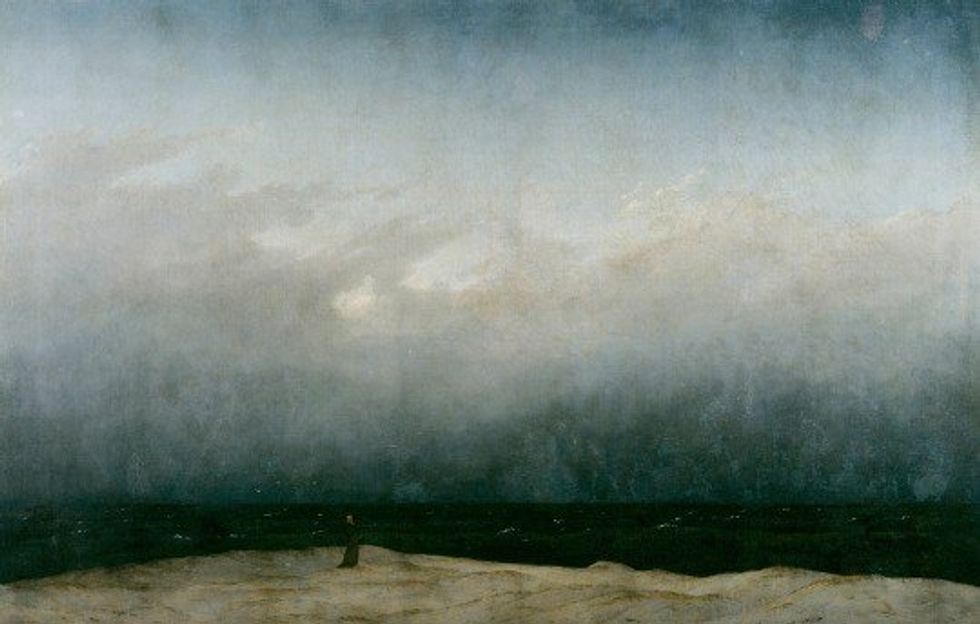
To overcome this fear, we must become the lone figure in Caspar David Friedrich’s The Monk by the Sea, staring open-eyedly at the ever expansive world stretching out horizontally beyond our reach, to reach for something that can never be circumscribed. We must, as Heinrich von Kleist posited, stare into this darkness, the tumultuous dark waters swirling before us, as if our "eyelids have been cut off."
Do not be afraid of the uncertainty of the night, for this is where we are free—simultaneously swallowed by the world, and swallowing the world. Do not be afraid of the unbearable intensity of possibility, for this is the only place we can become human—embracing the boundless iterations within humanity.
Turn off your nightlight, and let the blanket of the darkness drape over you, comforting. A certain uncertainty.
Walk with trepidation, but do not tremble.

















