


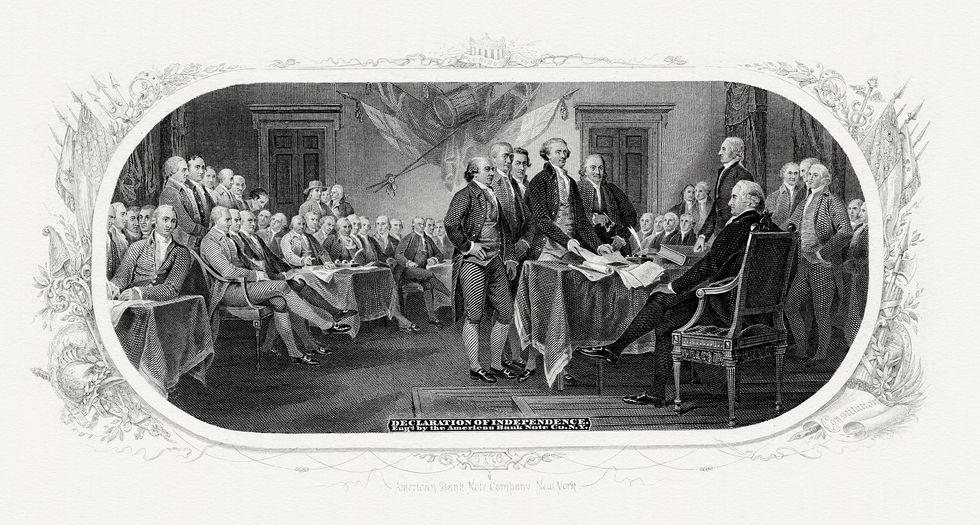
The Founding Fathers of the United States not only authored one of the most infamous document known to any American citizen, but it gave way to many retaliations for independence. The societal class of the eighteenth century gave way to those who made significant intellectual contributions to the Constitution and Deceleration of Independence. The fathers discover their ideas regarding the new government to be launched in the newborn country. The immersion of multiple different societal class backgrounds led the fathers of this great nation to frame how independence can be achieved.
The video alludes to how differing backgrounds of the fathers came in handy when declaring independence from the greatest military empire on the face of the planet. It shows that the United States was not founded on a “common ethnicity, language, or religion that could be taken for granted as the primal source of national identity.” Instead, it was founded on a set of beliefs and convictions, what Thomas Jefferson described as self-evident truths. Not only did the framers embrace other ideals and values, but they moved away from the bloodline or genealogy that had previously prevailed in the societal structure. This can really be supported by the personal background of some of the founding fathers. The video opens with straight up criticism of the fathers for some having too much debt, some were alcoholics, some bore illegitimate children, etc. This video not only sheds light on personal background of the fathers, but it humanizes them.
Samuel Adams, initially a tax collector, gets his hatred for the British at a young age of when his father was incarcerated due to his ‘illegitimate investments.’ Not only did this fuel his hatred, but it will later be a cornerstone spinal cord for his retaliation for independence. He was commonly described as being the people person because of his lower societal class standing. His disorganized, radical personality will fuel his ambitions for equal representation in the British parliament. The man didn’t dress very high class, but he could coincide with those of the lower classes because they felt as if their representative was one of themselves. His cleverness is soon viewed upon by a very wealthy merchant, John Hancock. The difference between the two men will later invest in the colonial relationship of independence. Hancock was the richest men in the northern colonies and was very well educated. The differing backgrounds and class will give way to them being the most wanted men by the Royal government at the start of the Revolutionary War. Their ideologies were radical, and unheard of.
John Adams was clinically depressed, and often times caught himself being paranoid of other’s opinions of himself. The video mentioned multiple times that he would have to be on Prozac in this day in age. His wisdom of the law alluded to him becoming one of the best attorneys within the colonial era. His brilliance led him to defend the British soliders solely responsible for the initiation of the most popular pre-Revolutionary War conflict, the Boston Massacre. Adams was faced with much backlash as a colonial men defending the royal government. His background and societal class was more of a honest and truthful personality that led him to become one of the most influential men in our history, and the second person to lead the new country completely. While Adams was more pompous, Patrick Henry was described as a radical who influenced many due to his public speaking skills. His participation in the lower-middle class will give way to his radical ideologies that will catch the eye of many revolutionaries. He will forever be coined with the term “give me liberty, or give me death.” He argued that the war was inevitable, so might as well just let it come.
Arguably the two most famous characters of this time period immerged from the cracks of independence, and those two gentlemen were Benjamin Franklin and George Washington. Franklin came from a low class family that will later allow him to become the colonial representation, or peacekeeper, between Great Britain and the colonies. His direct relationship with all of the high powers in England conflicted the ideologies of his constituents, and will give way to how behind the times he was as he came back to charter this new country. The ambitions of independence being a necessity for survival will be crucial to his contributions to the framers. George Washington, an arrogant man with a large temper, led the war efforts of the little to none men in battle against the largest fleet in the world. His flamboyant wardrobe of wearing his uniform from his previous battles during all of the congressional meetings allude to his leadership and how he desired it. The man was quiet, and his pessimistic views on the war will eventually lead this country into the most critical conflicts ever fought by Americans.
The background of these men prevails throughout the debates in making legislation for the new country post-independence. The video puts a spotlight on how these men were humans, and also made many mistakes. With multiple classes of wealth and education on the line for doctoring this new country, the debate room filled with more and more optimism as independence gets closer and closer. The educational backgrounds of the fathers were from Harvard, some from King’s College, and some didn’t even receive a formal education. With the safekeeping of authoring the declaration, one would presume a formal education would be a necessity. The influx of differing classes, however, prove to be more evident on how this new country wouldn’t be founded on a genealogy trait, but more on merits.
The Second Continental Congress will forever be seen as the meetings that would eventually find the most powerful nation on the face of this planet. John Hancock would be elected as the president of the congress, and it eventually provided minimal threat to the British authority in the colonies. It will later, of course, be known as the focal meeting hall where the Declaration of Independence will be authored. The differing class backgrounds of the fathers will be evident in how fair and equal this country would be founded on. The elimination of natural aristocracies will become the governing body of this country. To become an American citizen one must not a matter of bloodlines or genealogy but rather a matter of endorsing and embracing the values established at the founding. The founders are depicted as heroic icons or the creators of all that is right or all that is wrong with American society. The criticism among these fathers will forever be evident, but it also brings up the debate on how fair and just they actually were.
The video shows how the humanization of these founding figures allude to modern debate is held. One may present an argument that the differing classes in the colonial time is evidence enough that the suppression of major events will forever be evident. The difference in wealth status can allude back to how not one society dictated the terms on the founding of this country. The difference in language and poise can be brought back to how the differing educations can be not very significant in the authoring of our foundation. For example, our very first leader of the free country, George Washington, actually didn’t receive any formal education. He only received a surveying certificate. Not only is the significance of education debated on, but it is a focal point for criticism in modern times of the founding fathers.

















