


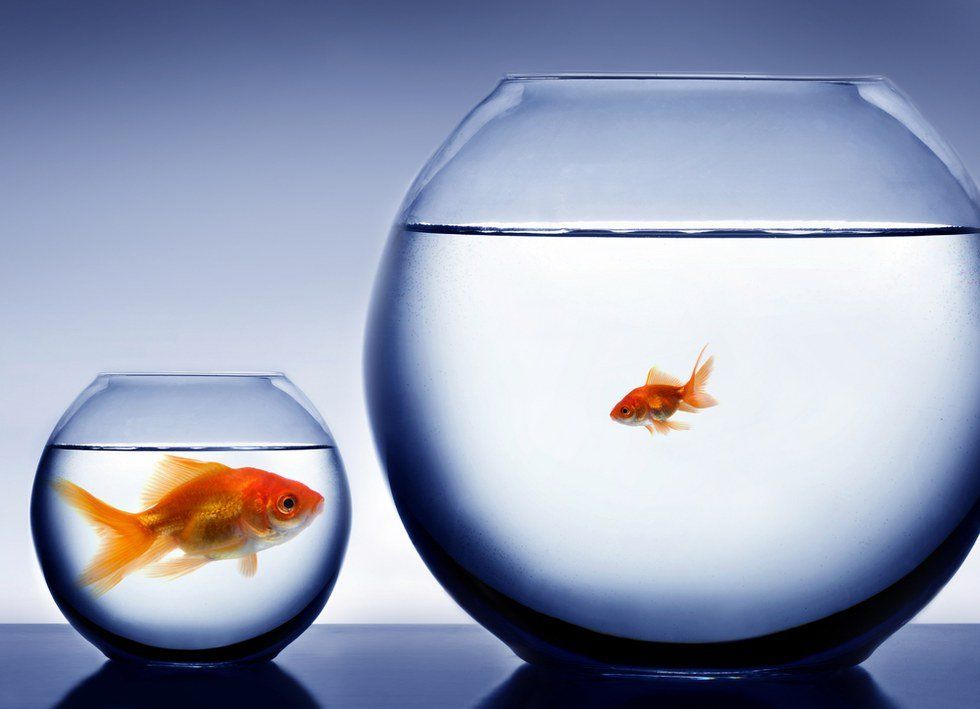
I’ve always been fueled by competition. While my competitive nature definitely did not manifest itself in my short-lived athletic career (I have about a million “Sportsmanship” awards somewhere in my closet), I found my knack for competition in academics at an early age. In fact, I can attribute most of my academic success to the fact that I have always worked to “keep up” with my brilliant peers. While competition has helped me on a superficial level, I now recognize the harmful effects of comparing oneself to others.
I’ve always surrounded myself with the overachieving, neurotic, honor-student type. Since fourth grade, I’ve taken part in special honors programs. In such programs, kids are taught very early on that school is one big competition. In fourth grade, our teachers awarded us with candy for every good grade we received on a spelling test.
The kids who were successful spellers got large Hershey chocolate bars (a system that was definitely not Michelle Obama-approved) and those who weren’t, looked on with jealousy. They learned that in order to be rewarded, they must improve and catch up to the other kids. This idea of “keeping up” continued throughout middle school and high school while the stakes became higher than just a sugary reward. When I started my freshman year of high school, I was immediately informed that everything I did in my next three years would be extremely important for my future.
On the first day of ninth grade, all the incoming freshmen were seated in a large auditorium and subjected to what felt like millions of tedious speeches from the principal, guidance counselors and upperclassmen. It was made crystal clear to us students that class grades, extracurricular activities and SAT scores were equivalent to success in life. Where you went to college would make or break you and you were in direct competition with your friend who sat right next to you in class. “But remember to have fun and enjoy your golden years,” was also slipped in there somewhere. There was a clear message that success in school was imperative for future stability. There was a hierarchy of ability in which it would be advantageous to claim a spot at the top. It seemed similar to "The Hunger Games," only perhaps with a bit less gore.
In ninth grade, when I found out that all my friends were signing up for honors chemistry, I knew that I had to as well despite hating science. When I saw that my peers were sacrificing hours of sleep to study for exams started in my sophomore year, I decided that I had to stay up to ungodly hours too. I was not going to be the dumb and lazy one. I felt a need to keep up with them and even surpass my friends whenever possible.
For a while, everything was going fairly well. Sure, I was burnt out, anxious and obsessed with being perfect. Yeah, I silently resented my friends every time they did better than me on a paper or got a spot on the high honor roll. But, I had very good, comparable grades, extracurricular activities, and a job. I wasn’t as exceptional as some of my friends and while that fact haunted me from time to time, I was still fairly satisfied with my academic achievements.
My feelings began to change drastically at the beginning of my senior year. I started to feel the weight of my inadequacy when I first heard my friends talk about their college plans. Several of my friends were applying to Ivy League schools. Of course, when you’re a try-hard nerd, going to an Ivy League is “the dream.” Now, I wasn’t genuinely set on going to one of these historically elite schools. I knew I wasn’t interested in being a small fish in a big pond, only to be eaten by bigger, richer, Vineyard Vines-wearing fish. But to me, getting into an Ivy would be like getting into Hogwarts; I wouldn’t quite fit in, but I’d love to have the bragging rights.
I started to realize that my friends and peers were actually probable candidates for these prestigious schools. I was no stranger to forfeiting hours of sleep, studying myself to tears and completing extra credit projects to boost my grade to that 95+ range. I had overextended myself throughout high school, often sacrificing my social life, but somehow, it wasn’t quite enough. I had been beaten at my own game. I began to wonder when I had fallen so far behind them. They had turned into wizards while I was under the impression that we were all living the Muggle life together!
While it was hard at times, I ended up getting past my jealousy once I found my current school. It wasn’t an Ivy League, but it felt like a perfect fit, and I was genuinely happy to be going to Hunter. It stung a bit to hear people’s acceptances, but I was able to throw aside my jealousy and feel genuinely happy for those who had busted their asses throughout high school. Unfortunately, I’ve learned that the comparison demon does not cease rearing it’s ugly head after high school graduation.
Now, at Hunter, I am in an arts scholars program with some incredibly talented, smart, artistic people. It’s easy to feel inadequate when I see people absolutely excelling at their art forms while I still struggle to understand why I got in the program in the first place. However, I am actively trying to limit comparing myself to my friends and instead work on being fans of theirs without putting myself down. I am trying to find ways to make competition healthy, not destructive, by reframing my thought processes. Many of my friends are actively creating art more than I am and sometimes I feel myself worrying that I’m not as talented, well written or ambitious as they are. Right now, I’m working on channeling my self-doubt into inspiration to create more and find my artistic voice, instead of continuing to view myself as being “less than.” When my friends succeed, I want to be able to be 100 percent selflessly happy for them. Comparison impedes one’s ability to celebrate others. In learning to stop these comparisons, I am learning both to be a better friend to others and to myself.
Throughout my life, I’ve heard the quote, “Comparison is the thief of joy.” It’s a sentiment I’ve heard many different ways from many different people. While it took me a while to recognize the harmful effects of comparing oneself to others, I can now attest to the truth in this cliche. While there are ways to channel feelings of competition into motivation or inspiration, jealousy is toxic and often counterproductive. I hope to always strive to better myself and I will surely draw inspiration from my incredible peers, but I hope to start viewing myself not as a lesser person/artist/scholar, but as a work in progress.
















