
In this year’s election, criticism has flown in every direction, spanning both parties and ranging from extremely serious issues to completely irrational statements. No matter what an individual believes, a colorful meme probably exists attempting to butcher that individual’s position, and while an election like this might seem almost entertaining in theory, the amount of real, important issues floating about as the candidates stir up the water are starting to catch the eye of the American people. With the Republican primaries all but decided at this point with Ted Cruz and John Kasich suspending their campaigns, the Democratic Party nomination is still for a heated race, and one of the biggest issues on the minds of a lot of Democrats is the debate surrounding superdelegates.
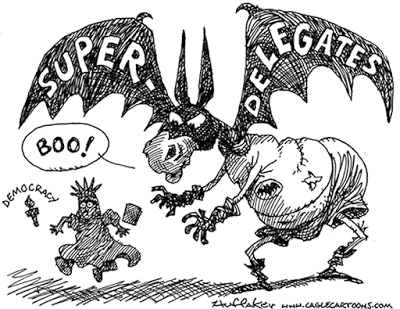
Superdelegates are unpledged delegates in the Democratic Party made up of various big name party leaders, including members of the Democratic National Committee, Democratic members of Congress, Democratic governors, and so on as listed by Rule 9A of the 2016 Delegate Selection Rules posted by the DNC. Their unpledged status means that regardless of how the party members in their particular districts vote, they can vote for whomever they see fit, and because they make up 714 out of 4765 delegates, they represent almost fifteen percent of the total delegate count, and almost thirty percent of the 2382 delegates needed to secure the party nomination. The full set of party rules can be found here.
According to DNC chair Debbie Wasserman Schultz, the reason that superdelegates exist is to give grassroots activists a real chance at becoming delegates, as opposed to running against big name politicians who would have incumbent advantages over them.
Supporters of this system also add that the ability for the party to sway the election results this way can help fend off unscrupulous candidates who might otherwise win and hurt the party. These proponents point out that the people who hold these positions are people who have already been elected into high level positions and entrusted with the future of the party in other ways.
However, critics of the system note that superdelegates can influence or even overturn the outcome of an election, which is a fact deemed by some to be undemocratic. Even Hillary Clinton, whose current lead in the primaries is comprised of more than half superdelegates, stated in 2008 that the Democratic Party needed to rework the nomination process so that it “reflects the desire of the voters.”
Currently, the debate rages on about whether or not superdelegates should continue to exist, but in some places, that debate seems to be resolving itself. In Maine, the state convention passed a ruling that will make the state’s superdelegates follow the same rules as its pledged delegates, voting based on the percentage of the popular vote that individual candidates earn, and has resolved to petition the national party to make the same changes across the board.
While these changes won’t take place until the 2020 election in four years, Maine has still managed to set the stage for bigger changes to come in the Democratic Party nomination process.