As a disclaimer I should point out two important facts about my experience watching this movie and then writing about it. First, I have never read the classic book and am solely basing my review on the movie as a separate artistic work. Secondly, I will promise not to spoil essential plot points that would otherwise ruin additional audience members' experiences.
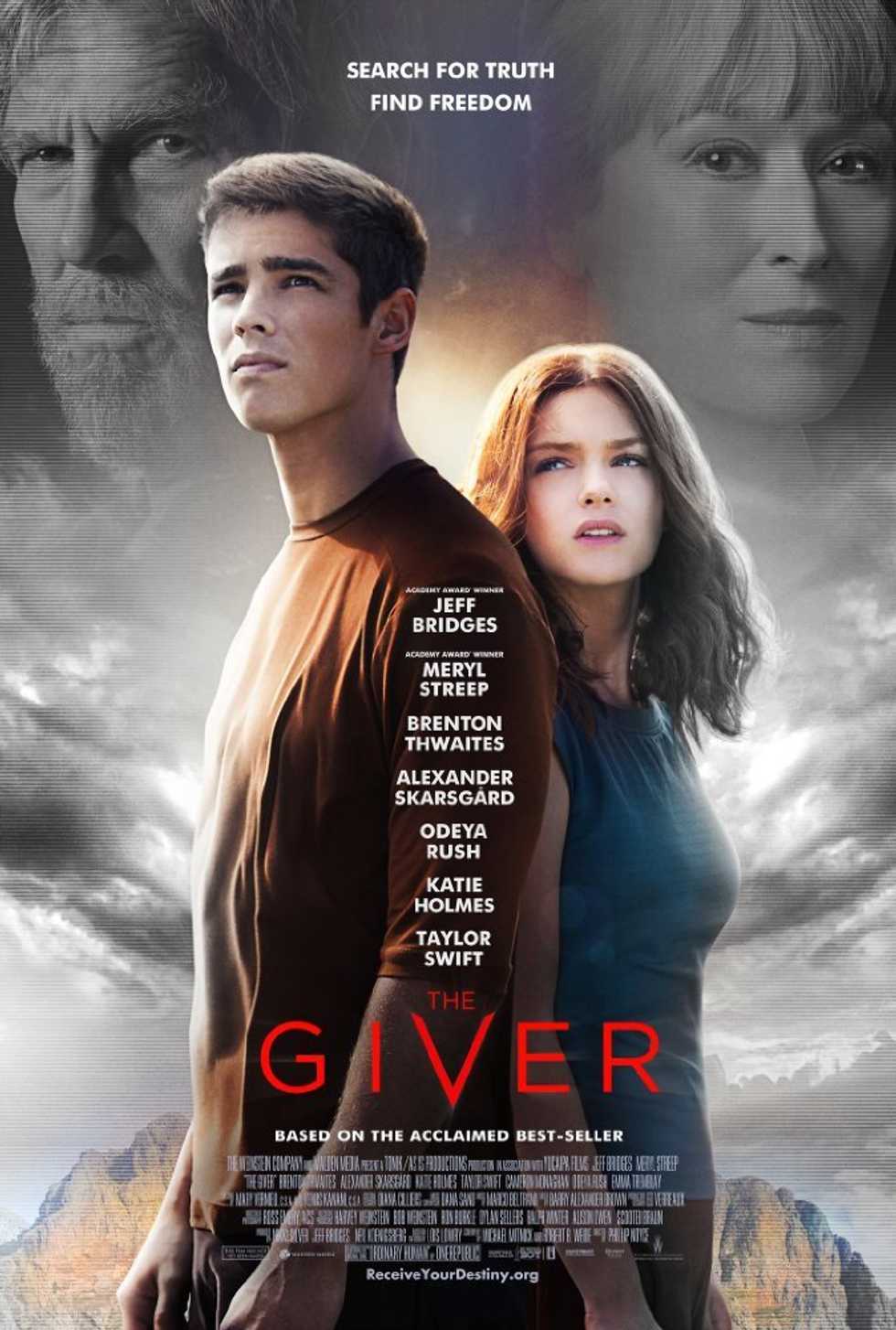
For those of you who don't know The Giver (2014) is a maybe- not-so-far-away dystopian future where a colorless (literal in the cinematic sense as well. See point #1) and equalitarian society is formed without the ability to have memories or any knowledge of past generations. Their Chief Elder, played by Meryl Streep, oversees and establishes order through an unusual set of rules mentioned early on in the film. These rules seem trivial to us in the 21st century; however, upon further examination I found them quite the opposite. They hold value and merit if our society ever ended up having to follow such a system. At the age of 18, all members of this society must undergo a graduation ceremony where they leave their childhoods behind and move towards a lifetime of an assigned and chosen career. One member, Jonas, is given the job of being the Receiver of Memories and works as a sort-of apprentice underneath The Giver, a man whose able to transport emotions and memories of the past generations onto the Receiver.
As someone who has a soft spot for old films and television shows, I could not get over how moving the monochromatic colors only helped the final product in its overall production. I love how the cinematographers and director chose to make 75-80% of the scenes in black and white. The monochromatic backdrop matched with the setting's tone and mood of the citizens. The characters were meant to show no emotion and how time seems to have been slowed down. I believe the movie would not have given the same feeling as if it were entirely in color.
The central themes of the tale revolved around discovery, love, loss, pain, fear, and curiosity. Each is experienced within moments of Jonas' new life and him trying to balance them all while still taking his role in his society seriously. These central themes exist in our world today which make it all the more harder to distance yourself as the viewer and Jonas, a fictional character. These themes caused the storyline to be more than just a typical adventure or romantic movie. The movie used these specific themes and emotions to be casted as a set of characters themselves.
As Jonas starts to tap into his newfound ability as the Receiver of Memory, we as the viewers are transported into his mind and what makes up that specific trait. It is as if these collection of photographs and videos (which are in full technicolor) are their physical representations.
If you let me rant for a second. I absolutely did not appreciate seeing a broken hearted pop start play as the character of the past Receiver just to be seen for not even five total minutes of screen time. End rant.
This movie allowed for the characters to experience things and moments for the first time like how life should be. We should always feel because Jonas said it best: "if you can't feel, what is the point?"
Speaking of quotes, I am never one to have lines from movies stick with me or even have the ability to remember them. So to have these set of them makes them all the more special.
1. "Feelings are just fleeting, on the surface, but emotions are very deep. Primal. They linger."
2. "Don't think about what you are feeling. Listen."
3. "Faith is a lot like wind. It is something felt not seen."
Until next week's episode of Delayed Movie Review. It is never too late to just watch and listen. :)