
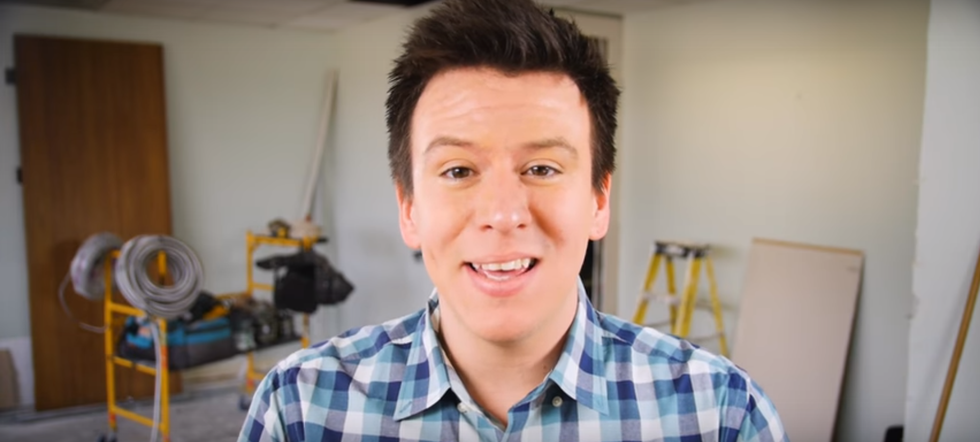
Afew days ago, Popular YouTube personality, and respected news commentator, Philip DeFranco made the announcement that he is going to launch a proper, independent, news network. Or as he puts it:
"I want to make the next great news network; a network that is run under my vision of; It is ok to have and share opinions, but let's get the facts right first."
This is no surprise to people who have been following the creator as his ambitions to change the landscape of news media is probably the worst kept secret in YouTube history. But it marks the latest of an interesting trend toward of YouTube personalities breaking into the news media world.
Using the internet to promote divergent, unconventional new is not an especially new concept: the Breitbart News Network, InfoWars and the always charming Humans Are Free are a few examples. The list goes on.
These so-called "alternative news sources" have popped up with the increased distrust in so called big media outlets. But instead of offering an alternative that could improve on the tangible problems that mainstream media does have. These blogs replaced journalism with commentary creating a space where facts were replaced by opinions.
This lead to a lot of really messed up issues in the alternative news scene. Breitbart gave rise to Milo Yiannopoulos, who depending on his mood and his audience is either a neo-fascist or a flamboyantly gay anti-republican. Then InfoWars making... well this happens regularly. And Humans Are Free tends to promote the history of a cosmic Illuminati.
Even the YoungTurks, who missed out on the crazy person train, seems to just reflect the problems of traditional media outlets.
By all measures, it seems like the experiment in alternative news outlets has failed and yet there seems to be a new wave of creators ready to try again.
First, we have Casey Niestat. He is not someone you would expect to start up a news network, although he is considered an expert in social media marketing and media entrepreneurship, he is better known as a kind of avant-garde filmmaker/crazy engineer. He launched a social media app called BEME, a kind of minimalist snap chat. The app itself doesn't matter because the app failed but the company was bought by CNN for about $25 million with the hope of building him building a new media arm.
Like I said Neistat is not the guy people expected to make that jump. More predictable was the recent announcement made by Philip DeFranco Jr. DeFranco is a news guy and has been since he started 10 years ago, as a matter of fact, DeFranco was one of the first creators on the site and has never stopped being obsessed with the news machine.
In a weird way, DeFranco mirrors Niestat. In 2012 his company "The DeFranco Collective" (or Group Nine Media or Sourcefed Studios) was bought out by the Discovery Network making DeFranco a senior VP in the media conglomerate. But as of a few days ago is now an independent content creator working to build his much-anticipated news network.
What does this mean? It means that a new phase of alternative news is about get started. Originally, Breitbart News Network, InfoWars and others got started out of an ideological dissatisfaction with major news outlets and the assumption of extreme liberal bias. The response was not just to create alternative news sources, but to create alternative ideologies along with it.
This was a major mistake. The issue was never ideology it was trust and factual accuracy. When people felt the traditional outlets were not truthful they looked to the alternative, only to find that they also cared little for truth.
Instead of truth people are finding ideological banter.
This is where DeFranco and Neistat are markedly different. Both are both politically opinionated (DeFranco a die hard Libertarian and Neistat a Progressive) neither of the men talk about ideology. Neistat talked his political opinion in you only one video and DeFranco only very, very occasionally mentions his personal perspective when it comes to being Libertarian.
These men have made a name for themselves in the world of online entertainment by being people first. Their audience trusts them as individuals and by extension will trust the projects they work to produce.
And that is the desperate need in the world of journalism. Trust.
















