Dress codes have been an ongoing topic of debate for many years, especially in grade school education. Now that I’m in college and my only problem when it comes to dressing for class is deciding which t-shirt and leggings combination to wear, I seem to have forgotten that dress codes continue to reflect gendered standards for those still in the most influential and educational period of life. Dress codes had always been the subject of contention when I was in middle and high school — often, we discussed whether we should have a dress code or not, or whether we should have a dress code or a uniform. Of course, the best argument my 8th grade self could make was that I just enjoyed wearing what I wanted and that clothes allow people to express themselves. While that likely still holds true, my 13-year-old self had no idea what type of gender issues stem from just the existence of a male-enforced dress code.
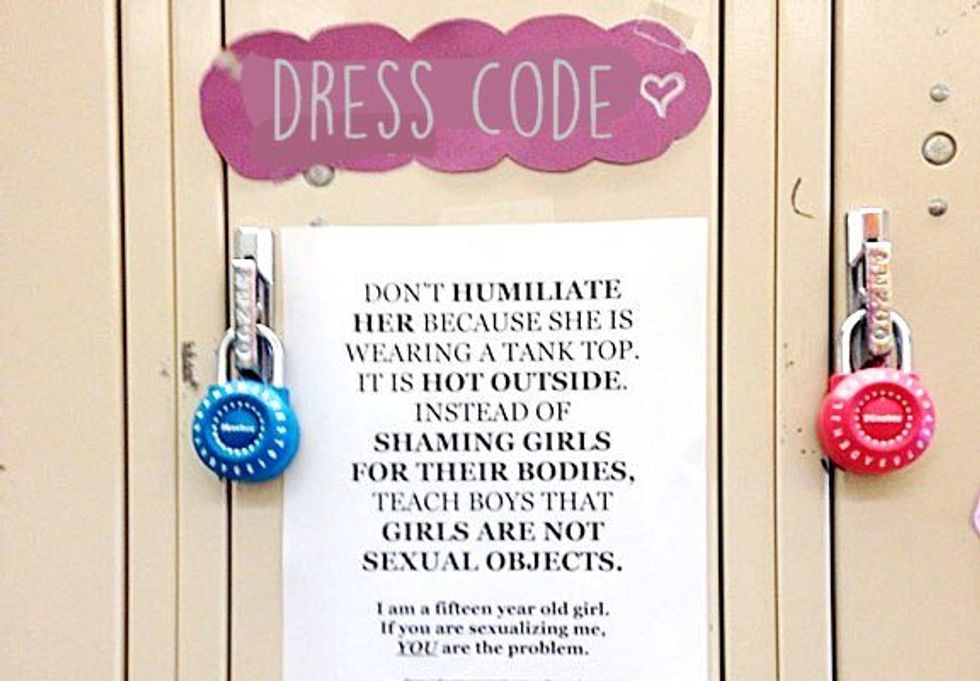
Long ago were the days when your skirt had to be fingertip-length and your tank top had to be at least four fingers in width. It was only until later on in high school when I realized that the defense school administration gave for these policies was to prevent “distraction” for the boys. Pretty ridiculous, right? Maybe we should teach the boys to focus on their studies and keep their eyes to themselves, instead of telling girls what to wear so that we don’t distract the boys.
I even remember one of my teachers attempting to justify this by explaining that this is the same reason that, say a bright purple mohawk with sharp spikes would be prohibited, as it is a distraction. I thought this was absurd. My friends and I often made fun of how just a shoulder might distract a boy in class. Countless times throughout the year, there are news articles about girls in other cities who are kicked out of their prom for wearing a dress that is “too short” or “too revealing," when it turns out to be any normal dress someone would wear to a high school prom. Countless times we've heard, “boys will be boys, it’s up to us as girls to be the more mature ones.” Countless times I've seen my taller girl friends getting sent to the security desk because they have longer arms and longer legs than I do, making it more difficult for them to find school appropriate shorts. Countless guy friends getting away with wearing tank tops that were against the dress code, but countless girls getting sent home to change for wearing a tank top one finger width too narrow.
Not only do these grade school dress codes emphasize over-sexualization of the female body starting at a young age, but these are clearly rules created and enforced by men in a male-dominated society. Since then, we seem to have come a long way. However, since coming to college and forgetting about the strictness of these dress codes, I was reminded just recently by workplace dress codes, and perhaps even introduced to a whole new set of issues with regards to dress codes.
As a disclaimer, the focus of this article is about non-gendered dress codes in workplaces in general and is not meant to target any one place in particular.
I thought the days of oppressive dress codes were over. Not only am I no longer in primary or secondary school, but I work in a place that prides itself on acceptance. I absolutely love my current workplace, as it has one of the most accepting, diverse, and open-minded environments you could find in a corporate world. There are people of all genders, sexualities, ethnicities, ages, people who speak different languages, and people with all sorts of tattoos and piercings. So in a place like this, where people are so willing to accept one another for their differences and also be able to express themselves, why is dress code a problem?
Now, I completely understand the issue of safety in a work environment; for example, we are required to wear a certain type of shoe in order to promote a safe work space. Furthermore, while it is an atmosphere of diversity, there is still a need for professional and appropriate attire, thus, we are required to wear tops with sleeves that are not too revealing in the chest or midriff, as well as bottoms that hit at least the knee, whether it be capris, jeans, or long skirts.
So what’s the issue? At first glance, this seems pretty reasonable — there is no required dress code, so people have the freedom to dress themselves as long as it is appropriate. However, this whole idea of what is “appropriate,” and what isn’t leads back to societal perception as well as gender inequality.
Let’s take a step back to see what I mean by this. At my job, I often have to go outside and exert physical labor, in 80-90° Charlottesville heat, often wearing jeans or long pants. With a rule that bottoms must reach at least the knees, my fellow male friends are able to wear shorts, as typical men’s shorts usually reaches the knees anyway. Meanwhile, anyone who has shopped in the women’s clothing section can agree that it is extremely difficult to find women’s shorts that are knee length. The options are either long pants or short shorts, and there is no in between.
In essence, the ease for men to find suitable and weather-friendly attire versus the difficulty for women to find such appropriate clothing creates a discrepancy between men and women in the workplace. Despite efforts to create an equal opportunity work environment for all members through uniform regulations of dress code, the policies in place create an unfair dilemma to those seeking appropriate work attire.
From one standpoint, these systematic rules that are meant to provide equality regardless of gender pushes us one step closer to gender equality. These rules allow us to treat everyone the same way without having to delve into issues of gender and sexuality. On the other hand, there is a question of if this system truly embodies equal treatment of workers, or if it's simply equality without equity. Equality means that everyone is treated the same way, such as applying the same regulation for everyone, regardless of differences, which is essentially what my workplace does. Equity is providing a level and fair playing field for all. This means that each person is able to start at the same point, such as having the same basic resources. For example, a disabled person may be given assistance in order to allow him or her to navigate at the same pace that a non-disabled person would. Is a standard non-gendered dress code an example of equality rather than equity?
When we discuss non-gendered solutions, perhaps these take away from dealing with an issue from an intersectional standpoint and understanding the diversity in backgrounds of each person. So, the question becomes if by ignoring such differences through a “fair” system, are we disregarding an acceptance of these differences? If different standards were held for men and women, would this just create even more gender inequality as well as a definitive gender binary?
Eliminating gender segregation only causes further problems of where to find a balance that would be truly fair and cater to people of all backgrounds. Evidently, this seems to create an awkward juxtaposition between striving for gender equality versus fairness for all people despite their differences.