
**The following may trigger emotional responses in certain individuals as the article refers to the negative aspects of social media criticism and their effects on others.**
On Wednesday June 22, 2016, tragedy struck the Southern California town of Huntington Beach as they lost their local social media celebrity. The Huntington Beach family, the Blake's, lost their eldest daughter, Samantha Blake, 18, to a major heart attack only a few hours after picking her up from a long beach day with her friends. Samantha was better known by the community as @SweetSam on Twitter, Instagram and Snapchat.

Only 18 years old, with no prior heart condition, Blake’s death was entirely unexpected and thus the family consented to an autopsy. Experts say Blake died of a Coronary Artery Spasm, a less common cause of heart attacks where the coronary artery tightens and causes loss of blood flow to the heart. After concluding cause of death, Huntington Beach Hospital’s head of Cardiology, Dr. Thomas Ticker, asked the family whether their daughter took drugs such as cocaine, had been recently exposed to extreme cold or smoked cigarettes as these are all the primary causes of these rare spasms. The Blake’s knew their daughter liked to maintain her image as she was in the Instagram spotlight daily. She would not risk her career getting caught smoking cigarettes or taking drugs. As for the extreme cold, Samantha had been at the beach all day in 90-degree weather. For the Blakes, it seemed as though they would never know what caused this fatal spasm in their daughter’s young and healthy heart.
Luckily, however, Dr. Ticker had seen cases like Samantha’s before. Within the past few years, Ticker had seen several young women, and a few young men, come into the Cardiology wing of Huntington Beach Hospital with clear signs of a heart attack. Apparently, young adults have been admitted into hospitals all over Southern California with similar heart attack symptoms. The cases puzzled Ticker because all these young adults were between 18 and 29 years old—too young for an unexpected heart attack—and many denied smoking cigarettes or doing certain drugs such as cocaine. At Samantha’s vigil Thursday evening, Ticker stated that he is “determined to find the cause of these Coronary Artery Spasms among young adults before another one falls ill”.
Samantha, better known as @SweetSam, had over thirty thousand followers on Instagram, Twitter and Snapchat combined. The death of this local celebrity has become the talk of this small Southern California town. At the vigil on Thursday evening, local news sources learned a little bit more about the day @SweetSam died from the friends who accompanied her to the beach on Wednesday. Ticker thinks that these stories could be the key to understanding the heart attack epidemic hitting the young adult community:
“I can’t even believe @SweetSam is gone,” said Mariah Jordan, “We spent the day laughing and taking pictures all over the beach and it breaks my heart that she won’t be in any of our photos any more. The pictures of the two of us always got the most likes on Instagram and Facebook.”
“The part that freaks me the most is that I saw her Instagram post moments before my mom called me into the kitchen to tell me @SweetSam died,” Sophia Link stated, “It was so shocking. It was a picture from our beach day too”.
“Who knew that the picture I took of @SweetSam under the pier would be the last picture of her,” another friend, Kayla Bryant, shared, “We would always send each other different edits of the same picture for advice on which one to post. When I didn’t get a text last night and then saw that she posted a picture, I have to admit I was a little offended. Now I just feel horrible.”
After hearing what Samantha’s friends had to say about the day of her death, Ticker realized that Instagram may be the real cause of her heart attack. With permission of the Blake family, Ticker took a look at @SweetSam’s most recent post and realized he was right…
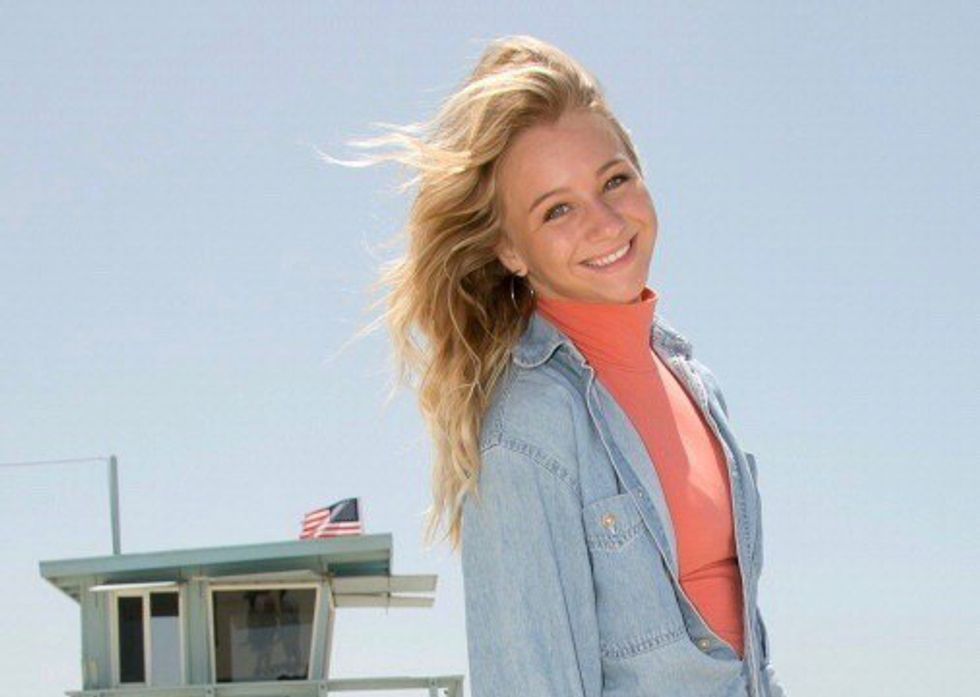
The most recent picture posted by @SweetSam was out of character for her Instagram page. Sticking to a pattern of posting three color photos over the course of a week followed by one black and white, it was clear to Ticker that @SweetSam followed strict methods for social media use. According to one of her fans, “The picture she posted that day was just not quite the “@SweetSam” we all know. I mean, does it look like she used a filter to you?”
Ticker released a follow up statement regarding cause of death for @SweetSam Friday morning:
“The answer to @SweetSam’s unexpected heart attack was right in front of us the whole time. @SweetSam’s Instagram fame is what drove the girls to the beach that day. The fame also drove her to stick to a very strict schedule regarding posting pictures. @SweetSam had over thirty editing apps on her iPhone as well as over 10 different versions of the picture above. Despite the 10 edited versions, @SweetSam posted the original, unedited version on accident. Another leading cause of these Coronary Artery Spasms is extreme emotional stress, which for an Instagram Celebrity can come from a mistake like this. Upon further inspection, all the other cases of premature heart attacks in Southern California were in 18-29 year olds who are avid social media users. The stress with choosing between filters, editing out flaws and the huge risk of posting the original picture is creating severe emotional stress amongst our young adults and creating a large risk for premature heart attacks.”
Dr. Ticker has pinpointed the issue at hand, but it is our job as a community to make sure tragedies like this never happen again.
Rather recently, there has been a substantial growth in social media use amongst 21-century young adults. Sites such as Instagram, Twitter, Snapchat and Facebook are used daily by 90% of young adults (18-29) today compared to the 12% in 2005. Overall, 35% of those 65 and older use the internet. This recent popularization of social media has its advantages and disadvantages within society.

The Uses and Gratifications Theory attempts to explain what social and psychological needs motivate audiences to select particular media channels and content choices. Advantageously, we use social media to help find a voice, express this voice, connect with others and access infinite amounts of information. According to the U&G Theory, the instant gratification of information seeking used to be the leading motivations for using social media sites. The modern U&G Theory, however, suggests that status attainment is another leading motivation for using social media. The form of instant gratification associated with this type of usage comes in the forms of likes, comments, retweets and/or shares.
According to the Dove Self Esteem Project, getting “likes” on photos can wield a powerful sense of accomplishment and, even more, community acceptance. Young adults are turning to their followers on social media for instant acknowledgements of beauty, success and power. These are clear indicators of the detrimental effects social media can have on self-esteem. However, the negative aspects of social media don’t stop here. This unhealthy behavior of securing likes as indicators of beauty unleashes an even unhealthier downward spiral.
In addition to this instant gratification, one of the main issues with social media is its comparative nature. The “feed” style of delivering information creates an environment where each post, whether it be a status or a photo, can be directly compared to those around it. Users can compare everything from number of likes to the aesthetic of the photo. Further, this comparative nature can lead the users to open up their viewing pool to as many “followers” as possible. While this may lead to more likes—more instant acknowledgements—it also creates an influx of posts to compare themselves to on their “feed”.
According to a study done by University of Salford in the UK, 50% of their 298 participants said that their use of social networks like Facebook and Twitter makes their lives worse and their self-esteem suffered when they compared their own accomplishments to those of their online friends.
By opening up the viewing pool of their accounts— in other words, by gaining more followers—they create a less controlled platform with an audience of varying ideas, interests and opinions. While they may agree with some of these ideas, interests and opinions, there will be those they disagree with as well. This creates more judgement and more comparison on these sites. The judgement and comparison cause low self-esteem that can be unhealthily lifted by attaining more likes. Thus, the cycle begins.
Teens like Samantha Blake do exists. While they rarely die of stress-induced heart attacks, the fear behind showing an original, unedited picture of oneself is very, very real. The reasoning behind this fear is the low self-esteem epidemic that is sweeping over America.
The way we use social media needs to change. It shouldn’t be a platform to gain self-esteem but rather, show it off! We are all beautiful the way we are; unedited. Keep teens like Samantha Blake in mind next time you post a picture. Posting an original shouldn’t create as much stress as it does. If you find your original is getting comparative or judgmental comments, it may be time to reduce your audience.
Those who love you are those worth sharing with and those who show you disrespect are unworthy of your beauty. Love yourself and post the picture you want whether that be an original or not. Let yourself control what you post and not your audience.
“Life is too short to waste any amount of time on wondering what other people think about you. In the first place, if they had better things going on in their lives, they wouldn't have the time to sit around and talk about you. What's important to me is not others' opinions of me, but what's important to me is my opinion of myself.”
― C. JoyBell C.
**For the purpose of this satirical article I used images of actress Mollee Gray to portray the fictional Samantha Blake. The story of Samantha Blake is not factual. Additionally, Gray has not passed away of a heart attack and the story I have created about Samantha Blake has nothing to do with Mollee Gray whatsoever**